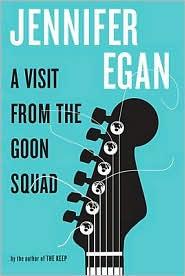
A Visit from the Goon Squad by Jennifer Egan is a 2010 literary fiction book about time and aging, music and commerce, identity across decades. The form of each chapter mirrors its content: a chapter about adolescent grandiosity is told as memoir; one about dissociation is a third-person sprint. Structure is meaning.
Summary
A Visit from the Goon Squad is a novel told in thirteen chapters, each from a different point of view and sometimes in a radically different form — including one chapter composed entirely as a PowerPoint presentation. The connective tissue is a loose network of characters orbiting Bennie Salazar, a record executive in New York, and Sasha, his assistant who steals small things compulsively. Some chapters are set in the 1970s punk scene; others jump to a near future where public relations is conducted by text messages designed to bypass critical thought. Time, Egan's novel insists, is the goon of the title — it comes for everyone.
What the book is actually about is harder to pin down. Each chapter reads almost as a standalone story, but together they form a portrait of what happens to people who were once young, passionate, and alive to music, and who have since become something else: corporate, compromised, estranged from their younger selves. Egan is interested in how people fail and how they reinvent themselves, how ambition curdles, how love transforms into something adjacent but different. The music industry serves as a lens — an industry that literally packages authenticity and sells it — and the novel never lets you forget the irony.
The formal daring is the book's most discussed feature, and the PowerPoint chapter earns its reputation: it's genuinely moving in a way that feels impossible until you experience it. Egan uses different structures not as tricks but as ways of inhabiting different relationships to time and memory. The novel won the Pulitzer Prize in 2011 and the National Book Critics Circle Award. It is one of the few formally experimental novels to achieve genuine mainstream readership, possibly because the underlying emotional preoccupations — getting older, wondering where you went, mourning what you once were — are not obscure.
This is not a linear novel and it is not for readers who need a clear protagonist to follow. The jumping across decades and voices requires you to track a large cast and occasionally reorient yourself. But for readers willing to meet it on its terms, it is one of the more ambitious and successful American novels of the past two decades — the kind of book that makes you think differently about what a novel can do with time.
Talk to A Visit from the Goon Squad like its author wrote you back.
Get the ideas that fit your life — not generic summaries.
- Chat with the book
- Audiobook-style main ideas
- Adapts to your life and goals
- Helps you take action
Key takeaways
- 1.
The form of each chapter mirrors its content: a chapter about adolescent grandiosity is told as memoir; one about dissociation is a third-person sprint. Structure is meaning.
- 2.
The music industry functions as a metaphor for all creative work's inevitable commerce: at some point you either sell it or you don't, and either choice costs something.
- 3.
Sasha's kleptomania is never moralized — Egan presents it as a language she uses to feel alive, which is more disturbing and more honest than treating it as a character flaw.
- 4.
The PowerPoint chapter demonstrates that emotional resonance is not the property of any particular prose style — what matters is the pattern of connection, not the surface form.
- 5.
Time destroys the people we are, but the novel also suggests that the people we become are not always worse — just different, and grievable.
- 6.
Egan is interested in how we construct the story of our own lives retrospectively, and how unreliable that construction is.
- 7.
The near-future sections of the novel have held up unusually well — the 'parrots' (PR operatives who orchestrate word-of-mouth campaigns) feel less like satire than prediction.
- 8.
Almost every character in the novel was marked by a moment in their youth that could have gone differently, and the novel asks: what do we owe to that earlier version of ourselves?
Discussion questions
Use these on your own, with a book club, or as chat starters in Superbook. Book club version, ready to copy or print →
- 1.
The novel is structured as interconnected stories rather than a traditional narrative. Did the form enhance your reading experience, or did it make you feel emotionally disconnected from the characters?
- 2.
The PowerPoint chapter is the book's most famous formal experiment. Did it work for you emotionally? What does it gain — and lose — by being presented that way?
- 3.
Bennie Salazar is described as someone who was once genuinely passionate about music and is now in the business of selling it. Where in the novel does his grief for his younger self feel most acute?
- 4.
Sasha steals things she doesn't need. The novel doesn't explain why in any clinical way. What do you think her theft is actually about, based on how she's portrayed?
- 5.
Time is described as the 'goon' — an enforcer that comes for everyone. By the end of the novel, do you think Egan sees time as purely destructive, or is there something it gives as well as takes?
- 6.
The near-future chapters feature a PR world built on manufactured authenticity. How does that feel as commentary on the music industry, and does it feel like social satire or something darker?
- 7.
Which character's story affected you most? What was it about their chapter's form that matched or amplified their emotional situation?
- 8.
The novel never gives Sasha and Bennie a dramatic confrontation or resolution. Does the absence of that scene feel like restraint or evasion?
- 9.
Scotty Hausmann, who was once a talented musician, appears in two very different states across the novel's timeline. What does Egan seem to be saying about talent that doesn't find an outlet?
- 10.
Egan has said she was inspired by Proust. Where do you see that influence — is it the meditation on time, the way memory works, something else?
- 11.
The book won the Pulitzer Prize, which surprised some critics who found it too experimentally structured. Do you think it deserved the prize? What does that debate reveal about what we think novels should do?
- 12.
By the novel's end, Jules Jones has committed an act of violence and served time. The novel treats him with surprising sympathy. Is that sympathy earned, or does it let him off too easily?
Themes
Frequently asked questions
-
Is A Visit from the Goon Squad worth reading?
Yes, with the caveat that it requires you to actively reconstruct connections between chapters rather than following a single narrative thread. If you enjoy formally ambitious literary fiction and are willing to work for the emotional payoff, it is one of the best American novels of the past twenty years.
-
What is the PowerPoint chapter about?
It is narrated by Sasha's daughter Alison at some future point, telling the story of a family weekend at her grandfather's ranch in the desert. It follows a roughly twelve-year-old child's internal life with a precision that is both funny and devastating. It works because the spare slideshow form captures the way a child parcels out and guards information.
-
Is A Visit from the Goon Squad hard to follow?
It takes some attention to track the chronology and the connections between characters. The chapters jump across decades and narrators without warning. Many readers find it useful to keep a loose mental map of who's connected to whom. The difficulty is navigational, not stylistic — Egan's prose is clear.
-
Do I need to read it in order?
The chapters are ordered intentionally and the payoffs accumulate through that ordering, so yes. Some readers have read it out of order on re-reads and found it rewarding in a different way, but the first read is best done in sequence.
-
Who shouldn't read this book?
Readers who need a protagonist to anchor to and a clear dramatic arc to follow. Each chapter essentially starts over with new characters and a new formal register. If you find that exhausting rather than exhilarating, it is probably not for you.