Business · Book club
A World Without Email book club questions
Here are 12 book club questions for A World Without Email by Cal Newport, ordered to open easily and end somewhere worth arguing about. Copy them, print them, or bring them up one at a time.
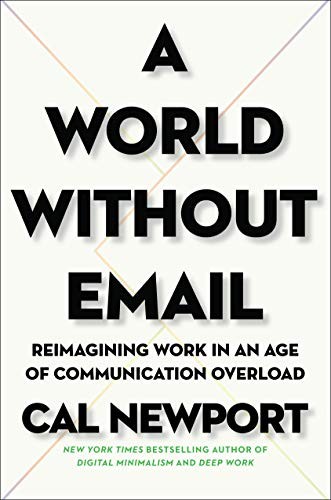
A World Without Email is Cal Newport's most targeted critique of modern knowledge work culture.
Cal Newport · 2021 · 4h 45m
Full summary and key takeaways →The 12 questions
- 1.
Newport claims the hyperactive hive mind emerged by default rather than design. Does that match your experience of how communication norms at your organization developed?
- 2.
How many hours per day do you estimate you spend on email, Slack, or equivalent messaging? How does that compare to time spent on the actual outputs your work requires?
- 3.
What would change about your work if your response time to non-urgent messages was measured in hours rather than minutes?
- 4.
Newport argues that constant availability is culturally expected but not operationally necessary for most knowledge work. Do you agree? What would the exceptions be?
- 5.
Pick one recurring conversation in your inbox. Could it be replaced with a protocol, a shared document, or a weekly check-in? What would that require?
- 6.
Where in your work does the pressure to appear available conflict with your ability to do your best work?
- 7.
Newport profiles organizations that have reduced unstructured messaging. What would the biggest obstacle be at your organization to a similar change?
- 8.
What assumptions about responsiveness do you think your colleagues have about you? Are they accurate?
- 9.
Think of a project that involved a lot of back-and-forth communication. Could a clearer upfront structure have reduced that overhead without sacrificing quality?
- 10.
If you managed a team, what protocol changes would you implement first to reduce unnecessary messaging?
- 11.
Newport suggests that the hyperactive hive mind makes workers feel busy while eroding the conditions for deep work. Have you noticed this dynamic personally?
- 12.
What would you do with two additional hours of uninterrupted time each day if messaging overhead dropped?
How to run the discussion
- Pick six to eight, not all of them. An hour of real discussion covers fewer questions than anyone expects, and racing the list is what makes a book club feel like homework.
- Open with what people noticed, not what they concluded. Asking for a verdict first hardens opinions before anyone has heard each other.
- Let the disagreement run. The questions below that split a room are the ones worth the time; the ones everyone answers the same way can be skipped.
- Ask the quiet person a specific question. A direct, narrow question is far easier to answer than an open invitation to contribute.
Themes worth steering toward
If the conversation stalls, these are the threads that usually restart it.
Common questions
What are good book club questions for A World Without Email?
Here are 12 book club questions for A World Without Email by Cal Newport, ordered to open easily and end somewhere worth arguing about. The strongest openers ask what each reader noticed rather than what they concluded, and the discussion usually turns on email, productivity, knowledge work.
How long should a book club discussion of A World Without Email last?
Most groups run 60 to 90 minutes of actual discussion. That is roughly six to eight questions, not all of them, so pick the ones that suit your group rather than working down the list in order.
What are the main themes in A World Without Email?
Email, Productivity, Knowledge work, Communication, Focus. Those are the threads most likely to divide a room, which makes them the useful places to steer a discussion that has gone quiet.
Picking the next one? See books like A World Without Email or questions for other book club picks.
