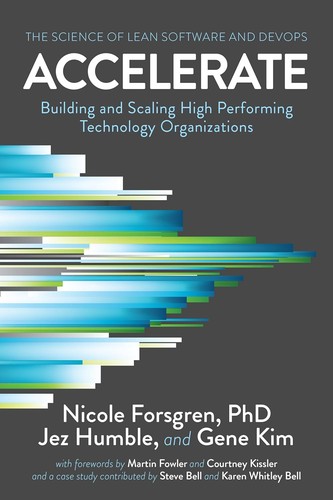
Accelerate by Nicole Forsgren, Jez Humble, and Gene Kim is a 2018 business book about software delivery, organizational performance, devops. High-performing software teams deploy more frequently and recover from failures faster than low performers, disproving the trade-off between speed and stability.
Summary
Accelerate is the research-backed account of what actually makes software delivery teams fast without sacrificing stability. Nicole Forsgren, Jez Humble, and Gene Kim spent four years running the State of DevOps Report surveys, and this book is their attempt to turn that data into something practitioners can act on. The central finding is that high-performing technology organizations are not trading speed for stability — they achieve both simultaneously, and the gap between them and low performers is widening every year.
The authors define four key metrics for measuring software delivery performance: deployment frequency, lead time for changes, mean time to restore service after an incident, and change failure rate. What separates elite teams is not head count or budget but practices: continuous delivery, trunk-based development, test automation, loosely coupled architecture, and a generative culture where information flows freely and failure is treated as learning rather than blame.
A substantial portion of the book addresses culture directly, drawing on Westrum's model of organizational typology. Pathological cultures hoard information; bureaucratic cultures follow rules; generative cultures focus on mission. The authors find that culture predicts software delivery performance more strongly than tools or process. Leaders who build psychological safety and minimize approval gates tend to ship faster and break things less often, not because they're reckless but because their teams surface problems earlier.
The final section addresses transformational leadership — the behaviors that predict whether change programs take hold. Forsgren and her co-authors are careful about causality throughout: the book is explicit about what the data shows and what it doesn't. That intellectual honesty is part of what makes Accelerate useful beyond the DevOps community. Any organization where software is a core capability will recognize its teams in the performance profiles described here.
Talk to Accelerate like its author wrote you back.
Get the ideas that fit your life — not generic summaries.
- Chat with the book
- Audiobook-style main ideas
- Adapts to your life and goals
- Helps you take action
Key takeaways
- 1.
High-performing software teams deploy more frequently and recover from failures faster than low performers, disproving the trade-off between speed and stability.
- 2.
Four key metrics capture delivery performance: deployment frequency, lead time for changes, mean time to restore, and change failure rate.
- 3.
Continuous delivery practices — trunk-based development, test automation, deployment pipelines — are the strongest technical predictors of performance.
- 4.
Loosely coupled architectures let teams deploy independently. Organizations where teams can't deploy without coordinating with others are architecturally constrained regardless of their process.
- 5.
Westrum's generative culture — where information flows freely and problems are surfaced early — predicts both delivery performance and organizational safety.
- 6.
Psychological safety is not a soft outcome; it's a measurable enabler of the risk-taking required to improve continuously.
- 7.
Change approval processes that rely on external review boards correlate with slower delivery and no improvement in stability.
- 8.
Transformational leadership behaviors — inspiring a shared vision, intellectual stimulation, personal recognition — predict both team climate and delivery performance.
Discussion questions
Use these on your own, with a book club, or as chat starters in Superbook. Book club version, ready to copy or print →
- 1.
Which of the four key metrics does your organization measure, and which ones are invisible to leadership?
- 2.
Forsgren argues that speed and stability are not in tension for high performers. Where in your organization does the assumed trade-off show up, and is it real?
- 3.
What approval gates slow down your team's deployments? Which ones are genuinely risk-reducing and which are theater?
- 4.
The book links architecture to autonomy. What about your system's architecture prevents teams from deploying independently?
- 5.
How would you describe your organization's culture using Westrum's three types — pathological, bureaucratic, or generative? What evidence supports that reading?
- 6.
The authors found that psychological safety predicts performance. What specific behaviors in your team make it safe or unsafe to raise problems?
- 7.
Change failure rate is one of the four metrics. What is your current rate, and what is your team's honest theory about why incidents happen?
- 8.
If your team could eliminate one manual step in your deployment process, what would it be and what is stopping you?
- 9.
The book was written in 2018. Which of its findings feel more true today than they did then, and which feel less relevant?
- 10.
Forsgren is explicit about the limits of the research. Where do you think the data's conclusions break down for your context?
- 11.
What does your organization reward — speed, caution, or learning from failure? How does that reward structure shape behavior?
- 12.
Who in your organization has the authority to remove the biggest constraint on delivery performance right now?
Themes
Frequently asked questions
-
Is Accelerate worth reading for non-engineers?
Yes, particularly for technology executives, product managers, and anyone responsible for a team that ships software. The book's most useful ideas — about culture, architecture, and approval processes — apply regardless of whether you write code yourself.
-
How long does it take to read Accelerate?
Around four to five hours. The first two-thirds cover the findings; the last third is a summary of the statistical methods used, which is optional for most readers unless you want to evaluate the research design directly.
-
What is the main argument of Accelerate?
That software delivery performance is measurable, that specific practices predict it, and that the best teams achieve high speed and high stability at the same time. The book gives you a framework for diagnosing where your organization stands and what to change first.
-
What are the four key metrics from Accelerate?
Deployment frequency, lead time for changes, mean time to restore service after a failure, and change failure rate. Elite teams score well on all four simultaneously. The DORA team later added reliability as a fifth metric.
-
Who should read Accelerate?
Engineering managers, CTOs, product leaders, and DevOps practitioners who want research-backed arguments for changes they already suspect are necessary. Also useful for skeptics who demand data before changing how their teams work.