High Output Management by Andrew S. Grove is a 1983 business book about management, productivity, decision-making. A manager's output is the output of their organization, not their own individual work. Measuring personal busyness misses the point entirely.
Summary
High Output Management is Andrew Grove's manual for how managers at any level should think about their work. Grove was Intel's president when he wrote it, and the book reads like a distillation of what he actually learned running one of the most demanding engineering organizations in the world. The central claim is simple but radical: a manager's output is the output of their team, not their own individual work. That shift in framing changes almost everything that follows.
Grove builds his framework around the idea of leverage. Every task a manager performs has some multiplying effect on the people and processes around them. A well-run one-on-one meeting or a clearly reasoned hiring decision might affect dozens of people for months. A poorly organized meeting or a delayed decision has the same multiplying effect in the other direction. The job is to identify high-leverage activities and do more of them, while finding ways to delegate or eliminate everything else.
The book introduces several tools that have become standard vocabulary in tech companies. OKRs — objectives and key results — appear here in their earliest clear articulation, though Grove called them by slightly different names. The concept of the managerial "production process," borrowed explicitly from manufacturing, frames everything from running meetings to making hiring decisions as steps in a repeatable system that can be observed, measured, and improved. Grove is also unusually direct about the manager's role in performance: if a subordinate is underperforming, the diagnosis is almost always either a skill gap or a motivation gap, and each requires a different response.
What holds the book together is Grove's intellectual honesty. He does not pretend management is easy or that good intentions are enough. He acknowledges that meetings, the most maligned tool in organizational life, are genuinely necessary when used correctly. He writes about being a "high-output manager" not as a personality type but as a set of practices anyone can learn. The book is not long, but it is dense — chapters reward re-reading once you have a team to manage and can match the ideas to real situations. Readers who have never managed anyone will find some sections abstract; readers who manage managers will find Grove's thinking on dual reporting structures and decision-making authority particularly sharp.
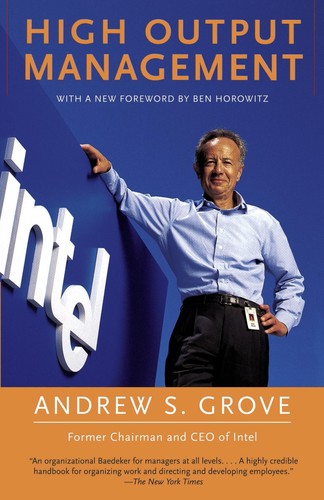
Talk to High Output Management like its author wrote you back.
Get the ideas that fit your life — not generic summaries.
- Chat with the book
- Audiobook-style main ideas
- Adapts to your life and goals
- Helps you take action
Key takeaways
- 1.
A manager's output is the output of their organization, not their own individual work. Measuring personal busyness misses the point entirely.
- 2.
Leverage is the key concept: every managerial action multiplies across the team. High-leverage activities like one-on-ones and hiring decisions have outsized downstream effects.
- 3.
The production metaphor applies to management. Identify the limiting step in any process, optimize around it, and treat meetings as part of the production system, not interruptions to it.
- 4.
OKRs — objectives and key results — give teams a shared definition of what winning looks like. Grove's version emphasizes that the key results must be measurable and time-bound.
- 5.
Underperformance has two causes: a skill gap or a motivation gap. The manager's job is to diagnose correctly, because the fix is completely different in each case.
- 6.
Meetings are not inherently wasteful. Process-oriented meetings handle recurring information needs; mission-oriented meetings solve a specific problem. Conflating the two wastes everyone's time.
- 7.
Task-relevant maturity determines how much direction a person needs. A new employee doing familiar work needs less oversight than a veteran doing something new.
- 8.
Decisions should be made at the lowest level where the relevant knowledge lives. Moving decisions up the hierarchy when the knowledge is lower down is a common and costly mistake.
Discussion questions
Use these on your own, with a book club, or as chat starters in Superbook. Book club version, ready to copy or print →
- 1.
Grove argues a manager's output is their team's output. How does that change how you evaluate your own performance week to week?
- 2.
What are the highest-leverage activities in your current role? Are you spending time on them, or are lower-leverage tasks crowding them out?
- 3.
Think of a one-on-one meeting you run regularly. Whose agenda is it really? What would change if the direct report owned it?
- 4.
Grove says underperformance is either a skill problem or a motivation problem. Think of someone you manage or have managed — which was it, and did you respond to the right cause?
- 5.
Where in your organization do decisions get made higher up the hierarchy than the knowledge that should inform them? What would it take to move those decisions down?
- 6.
Grove applies manufacturing logic to knowledge work: identify the limiting step, build around it. What is the limiting step in the most important process your team runs?
- 7.
How do you decide when a decision needs more people involved versus when adding people slows things down without improving the outcome?
- 8.
The book distinguishes task-relevant maturity from general seniority. Can you think of a senior person on your team who is effectively a beginner at something important right now? How are you managing that?
- 9.
Grove is direct about the manager's role in setting culture: what you tolerate defines your standards. What behaviors are you currently tolerating that you would rather not be?
- 10.
If you audited your last two weeks of work, what percentage of your time went to activities that genuinely multiplied your team's output? What would have to change to increase that?
- 11.
Grove wrote this in 1983 at Intel. Which ideas have aged best? Which feel most dated given remote work, distributed teams, or AI-assisted work?
- 12.
If you had to identify one person in your organization who is operating as Grove describes a high-output manager — what specifically are they doing differently from everyone else?
Themes
Frequently asked questions
-
Is High Output Management still relevant today?
Yes. The core framework — manager output equals team output, leverage, task-relevant maturity — holds up well across industries and decades. Some operational details feel dated (Grove writes for an office-centric, pre-internet world), but the underlying logic applies equally to remote teams and software companies. Many current tech executives cite it as the most useful management book they've read.
-
What is the main idea of High Output Management?
That management is a skill with learnable practices, not a personality trait. Grove's central argument is that a manager's job is to maximize the output of their organization through high-leverage activities: structured one-on-ones, clear goal-setting, good hiring, and decisions made at the right level.
-
How long does it take to read High Output Management?
Roughly four to five hours for the 230-page book at average reading pace. The chapters are short and the writing is dense with concrete examples. Many readers take notes and re-read specific chapters when they encounter the situations Grove describes — the hiring chapter, the performance review chapter, the dual reporting structure section.
-
Who should read High Output Management?
Anyone who manages people, especially first-time managers who haven't yet developed a mental model for what the job actually requires. It's also valuable for individual contributors who want to understand how good managers think. Founders building their first teams get a lot out of the organizational systems chapters.
-
What's the most actionable idea in High Output Management?
The one-on-one meeting structure. Grove argues one-on-ones should be owned by the direct report, not the manager, and should run long enough to get past surface updates to real problems. Most managers who adopt this format report it changes the quality of their team relationships within weeks.
Similar books
The Hard Thing About Hard Things
Ben Horowitz
Measure What Matters
John Doerr
The 7 Habits of Highly Effective People
Stephen R. Covey
Drive: The Surprising Truth About What Motivates Us
Daniel H. Pink
