Psychology · Book club
Against Empathy: The Case for Rational Compassion book club questions
Here are 12 book club questions for Against Empathy: The Case for Rational Compassion by Paul Bloom, ordered to open easily and end somewhere worth arguing about. Copy them, print them, or bring them up one at a time.
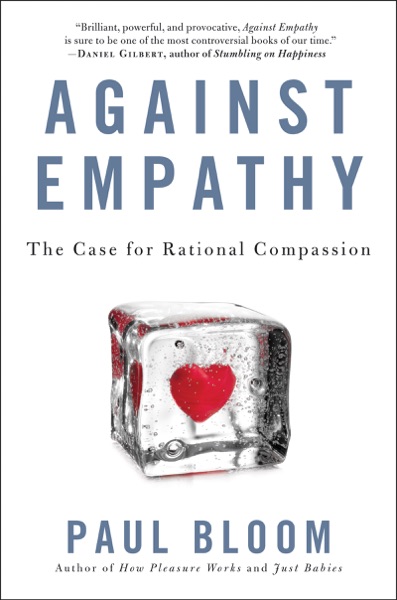
Paul Bloom's argument is not that we should care less about others.
Paul Bloom · 2016 · 4h 15m
Full summary and key takeaways →The 12 questions
- 1.
Bloom distinguishes between affective empathy (feeling others' emotions) and cognitive empathy (understanding their perspective) and both from compassion. Which of these actually drives your helping behavior when you reflect on it honestly?
- 2.
Think of a time when empathic response led you or an organization to a decision that helped one person visibly but may have done less good than a less emotionally resonant alternative. What made the empathy-driven choice feel more right at the time?
- 3.
Bloom argues effective altruism is closer to rational compassion than typical charity giving. Have you encountered resistance to effective altruism ideas in yourself or others? What does that resistance reveal about how we actually make moral decisions?
- 4.
The claim that high-empathy caregivers don't produce better outcomes is counterintuitive. Does it match your experience of the best doctors, teachers, or therapists you've known?
- 5.
If empathy is biased toward vivid, named, similar individuals, what structures — institutional or personal — have you found that partially counteract that bias?
- 6.
Bloom is making an argument about what we should value morally, not just describing psychology. Is the argument that empathy is a poor guide to moral action a normative claim that can be derived from the empirical evidence, or does it require additional ethical premises?
- 7.
The book implies that a culture that elevates empathy as the highest moral virtue will make systematically worse collective decisions. Do you see evidence of this in current political discourse?
- 8.
Bloom acknowledges that rejecting empathy as a moral guide feels cold. When you try to explain the argument to someone who hasn't read the book, what is the most common pushback you anticipate, and how would you respond to it?
- 9.
Compassion fatigue is described as partly a consequence of excessive empathy rather than too much caring. Does that distinction match the experience of anyone you know in a caregiving role?
- 10.
Bloom's view implies that moral progress requires overriding empathic intuitions with principled reasoning. Is that psychologically realistic at scale, or is it an argument that only works for a small subset of deliberate, rational people?
- 11.
How does the critique of empathy interact with arguments about diversity and inclusion, which sometimes rely heavily on empathy — asking people to imagine others' experiences — as a mechanism of moral progress?
- 12.
At the end of the book, what does Bloom say rational compassion requires in practice, and does his account feel sufficient to motivate moral behavior without empathic feeling?
How to run the discussion
- Pick six to eight, not all of them. An hour of real discussion covers fewer questions than anyone expects, and racing the list is what makes a book club feel like homework.
- Open with what people noticed, not what they concluded. Asking for a verdict first hardens opinions before anyone has heard each other.
- Let the disagreement run. The questions below that split a room are the ones worth the time; the ones everyone answers the same way can be skipped.
- Ask the quiet person a specific question. A direct, narrow question is far easier to answer than an open invitation to contribute.
Themes worth steering toward
If the conversation stalls, these are the threads that usually restart it.
Common questions
What are good book club questions for Against Empathy: The Case for Rational Compassion?
Here are 12 book club questions for Against Empathy: The Case for Rational Compassion by Paul Bloom, ordered to open easily and end somewhere worth arguing about. The strongest openers ask what each reader noticed rather than what they concluded, and the discussion usually turns on empathy, moral reasoning, compassion.
How long should a book club discussion of Against Empathy: The Case for Rational Compassion last?
Most groups run 60 to 90 minutes of actual discussion. That is roughly six to eight questions, not all of them, so pick the ones that suit your group rather than working down the list in order.
What are the main themes in Against Empathy: The Case for Rational Compassion?
Empathy, Moral reasoning, Compassion, Decision-making, Bias. Those are the threads most likely to divide a room, which makes them the useful places to steer a discussion that has gone quiet.
Picking the next one? See books like Against Empathy: The Case for Rational Compassion or questions for other book club picks.
