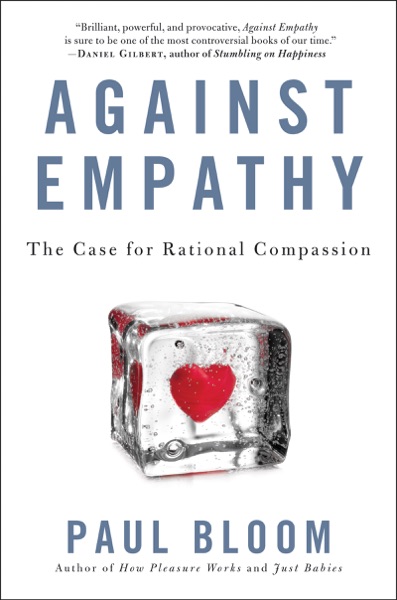
Against Empathy: The Case for Rational Compassion by Paul Bloom is a 2016 psychology book about empathy, moral reasoning, compassion. Empathy and compassion are not the same. Empathy means feeling another's emotion; compassion means caring about their welfare. They are dissociable and empathy often leads to worse outcomes.
Summary
Paul Bloom's argument is not that we should care less about others. It is that empathy — feeling what another person feels — is a poor guide to caring well. Empathy is biased, innumerate, and parochial. It responds to the one over the many, the vivid over the statistical, the proximate over the distant, and the similar over the unfamiliar. These biases lead us to make worse moral decisions than we would if we replaced empathic feeling with rational compassion — a broader, cooler concern for others' welfare that can be directed by evidence rather than emotional salience.
Bloom draws a sharp distinction between empathy and compassion. Empathy is feeling someone else's pain; compassion is caring about their welfare and wanting to help. The two can come apart. Doctors who score high on affective empathy — who feel patients' distress as their own — show higher burnout rates and no better patient outcomes than those who score lower. Therapists who maintain emotional distance while caring genuinely about clients tend to produce better results. Firefighters, emergency responders, and surgeons benefit from calm concern, not from sharing the panic or agony of the people they're helping.
The political and policy implications are substantial. Empathy-based responses to crisis tend to favor named individuals over larger populations, recent and visible suffering over chronic structural problems, and in-group members over outgroups. Wars have been started because a charismatic figure directed public empathy toward a victim story. Effective altruism — the movement to direct charitable giving toward causes that do the most good per dollar — operates explicitly against empathic intuitions by insisting that statistical children count the same as the ones with faces and names.
Bloom is aware that the book's title is inflammatory and addresses the objection that opposing empathy makes someone sound cold. His position is that we need more precision about what kind of caring leads to better outcomes. Rational compassion is not indifference; it is caring efficiently and fairly. The book is more persuasive in its diagnosis of empathy's failures than in its account of what rational compassion looks like in practice, but as an argument against elevating empathy to a moral ideal, it is one of the more challenging recent books in popular psychology.
Talk to Against Empathy: The Case for Rational Compassion like its author wrote you back.
Get the ideas that fit your life — not generic summaries.
- Chat with the book
- Audiobook-style main ideas
- Adapts to your life and goals
- Helps you take action
Key takeaways
- 1.
Empathy and compassion are not the same. Empathy means feeling another's emotion; compassion means caring about their welfare. They are dissociable and empathy often leads to worse outcomes.
- 2.
Empathy is numerically blind. It responds far more powerfully to one identified individual than to a hundred statistical victims, which makes it a systematically misleading guide to where we should direct our moral effort.
- 3.
Empathy is biased toward the similar, the proximate, and the vivid. This reinforces in-group favoritism and makes it harder, not easier, to extend moral concern to distant or unfamiliar people.
- 4.
High affective empathy correlates with burnout and compassion fatigue in caregiving professions, not with better care. Professionals who maintain emotional distance while staying genuinely motivated to help tend to perform better.
- 5.
Empathy can be weaponized. Directing public empathy toward a compelling victim story has historically been used to justify wars, punitive policies, and outgroup hostility, because empathic outrage ignores statistical trade-offs.
- 6.
Rational compassion means caring about others' welfare and trying to act effectively on that care, guided by evidence rather than emotional resonance. It is more demanding than empathy, not less.
- 7.
Effective altruism is the practical embodiment of the alternative to empathy-based charity. It asks which cause does the most good per dollar and redirects resources away from emotionally compelling but less effective interventions.
- 8.
Children's natural moral development involves both empathic responses and rule-based reasoning. The evidence suggests that as moral sophistication increases, rational principles rather than empathic feeling become the more reliable guide.
Discussion questions
Use these on your own, with a book club, or as chat starters in Superbook. Book club version, ready to copy or print →
- 1.
Bloom distinguishes between affective empathy (feeling others' emotions) and cognitive empathy (understanding their perspective) and both from compassion. Which of these actually drives your helping behavior when you reflect on it honestly?
- 2.
Think of a time when empathic response led you or an organization to a decision that helped one person visibly but may have done less good than a less emotionally resonant alternative. What made the empathy-driven choice feel more right at the time?
- 3.
Bloom argues effective altruism is closer to rational compassion than typical charity giving. Have you encountered resistance to effective altruism ideas in yourself or others? What does that resistance reveal about how we actually make moral decisions?
- 4.
The claim that high-empathy caregivers don't produce better outcomes is counterintuitive. Does it match your experience of the best doctors, teachers, or therapists you've known?
- 5.
If empathy is biased toward vivid, named, similar individuals, what structures — institutional or personal — have you found that partially counteract that bias?
- 6.
Bloom is making an argument about what we should value morally, not just describing psychology. Is the argument that empathy is a poor guide to moral action a normative claim that can be derived from the empirical evidence, or does it require additional ethical premises?
- 7.
The book implies that a culture that elevates empathy as the highest moral virtue will make systematically worse collective decisions. Do you see evidence of this in current political discourse?
- 8.
Bloom acknowledges that rejecting empathy as a moral guide feels cold. When you try to explain the argument to someone who hasn't read the book, what is the most common pushback you anticipate, and how would you respond to it?
- 9.
Compassion fatigue is described as partly a consequence of excessive empathy rather than too much caring. Does that distinction match the experience of anyone you know in a caregiving role?
- 10.
Bloom's view implies that moral progress requires overriding empathic intuitions with principled reasoning. Is that psychologically realistic at scale, or is it an argument that only works for a small subset of deliberate, rational people?
- 11.
How does the critique of empathy interact with arguments about diversity and inclusion, which sometimes rely heavily on empathy — asking people to imagine others' experiences — as a mechanism of moral progress?
- 12.
At the end of the book, what does Bloom say rational compassion requires in practice, and does his account feel sufficient to motivate moral behavior without empathic feeling?
Themes
Frequently asked questions
-
Is Against Empathy worth reading?
Yes, especially if you've absorbed a lot of the current rhetoric elevating empathy as a civic virtue. Bloom's case is carefully argued and grounded in research. Even readers who ultimately disagree will find it useful for clarifying what they actually think the role of emotion in moral life should be.
-
Is Bloom arguing we should be less caring about others?
No. He is arguing that caring effectively requires rational compassion rather than empathic feeling. The goal is not less concern for others but more reliable ways of directing that concern toward what actually helps. Bloom is explicit that his target is empathy-as-moral-ideal, not caring per se.
-
What is the difference between empathy and compassion in this book?
Empathy is feeling the emotions of another person. Compassion is caring about their welfare and wanting to help. Bloom argues these come apart — you can be compassionate without empathizing, and empathizing often doesn't produce the best help. Skilled caregivers typically rely more on compassion than affective empathy.
-
How does Against Empathy relate to Just Babies?
Just Babies describes the innate moral psychology that includes early empathic responses. Against Empathy takes the further step of arguing that mature moral reasoning should override rather than follow empathic intuitions. Just Babies provides the empirical setup; Against Empathy makes the normative argument.
-
Who might not find Against Empathy convincing?
Readers who believe that emotional resonance with others is intrinsically valuable, not just instrumentally useful, will push back on the framing. The book's argument is largely consequentialist — good outcomes are what matter — and readers with deontological or virtue-ethics commitments will find the framework incomplete.
Similar books
Just Babies: The Origins of Good and Evil
Paul Bloom
The Righteous Mind: Why Good People Are Divided by Politics and Religion
Jonathan Haidt
Thinking, Fast and Slow
Daniel Kahneman
Stumbling on Happiness
Daniel Gilbert
