History · Book club
Against the Gods: The Remarkable Story of Risk book club questions
Here are 11 book club questions for Against the Gods: The Remarkable Story of Risk by Peter L. Bernstein, ordered to open easily and end somewhere worth arguing about. Copy them, print them, or bring them up one at a time.
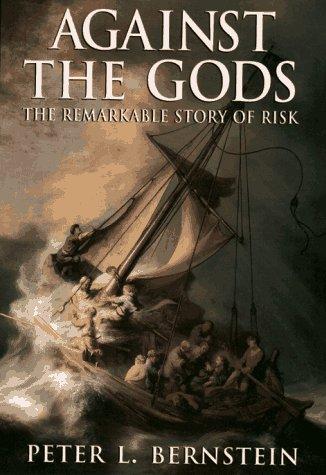
Against the Gods is Peter Bernstein's intellectual history of how humanity learned to measure, quantify, and manage risk — a story he traces from ancient gambling in the Mediterranean through the development of modern probability theory, statistics, and financial derivatives.
Peter L. Bernstein · 1996 · 7h 30m
Full summary and key takeaways →The 11 questions
- 1.
Bernstein argues that risk management is the defining achievement of modernity. Do you agree that learning to quantify and manage risk changed human civilization fundamentally?
- 2.
Before probability theory, the future was understood as fate or divine will. How much of that pre-scientific thinking persists in the way you personally think about uncertain outcomes?
- 3.
Pascal's wager — a probabilistic argument about belief in God — appears in the book. Do you find it compelling as an application of expected value reasoning?
- 4.
Regression to the mean is one of the most counterintuitive statistical ideas. Can you think of examples in your own life where you've been fooled by not accounting for it?
- 5.
Bernstein distinguishes between risk (measurable) and uncertainty (unmeasurable). How do you make decisions in the face of genuine uncertainty that can't be quantified?
- 6.
Markowitz's portfolio theory earns a Nobel Prize for formalizing what intuition suggested. How much of good investing is applied mathematics versus judgment that can't be reduced to numbers?
- 7.
The behavioral economics chapters show that humans are systematically bad at probability. In what domains do you think your own probability intuitions are most unreliable?
- 8.
Bernstein is writing in 1996 but already worried about the limits of financial models. His concerns proved prescient. What risks today might we be systematically underestimating?
- 9.
The history in this book covers gamblers, merchants, astronomers, and economists. Is risk thinking fundamentally the same across those domains, or does context change it fundamentally?
- 10.
Insurance is described as one of the first large-scale applications of probability. How do you personally think about insurance — as risk management or as waste when nothing goes wrong?
- 11.
The book ends with unresolved tension between the power of models and the irreducibility of genuine novelty. Has that tension been resolved since 1996, or is it the same problem we face today?
How to run the discussion
- Pick six to eight, not all of them. An hour of real discussion covers fewer questions than anyone expects, and racing the list is what makes a book club feel like homework.
- Open with what people noticed, not what they concluded. Asking for a verdict first hardens opinions before anyone has heard each other.
- Let the disagreement run. The questions below that split a room are the ones worth the time; the ones everyone answers the same way can be skipped.
- Ask the quiet person a specific question. A direct, narrow question is far easier to answer than an open invitation to contribute.
Themes worth steering toward
If the conversation stalls, these are the threads that usually restart it.
Common questions
What are good book club questions for Against the Gods: The Remarkable Story of Risk?
Here are 11 book club questions for Against the Gods: The Remarkable Story of Risk by Peter L. Bernstein, ordered to open easily and end somewhere worth arguing about. The strongest openers ask what each reader noticed rather than what they concluded, and the discussion usually turns on risk, probability, financial history.
How long should a book club discussion of Against the Gods: The Remarkable Story of Risk last?
Most groups run 60 to 90 minutes of actual discussion. That is roughly six to eight questions, not all of them, so pick the ones that suit your group rather than working down the list in order.
What are the main themes in Against the Gods: The Remarkable Story of Risk?
Risk, Probability, Financial history, Decision-making, Mathematics. Those are the threads most likely to divide a room, which makes them the useful places to steer a discussion that has gone quiet.
Picking the next one? See books like Against the Gods: The Remarkable Story of Risk or questions for other book club picks.
