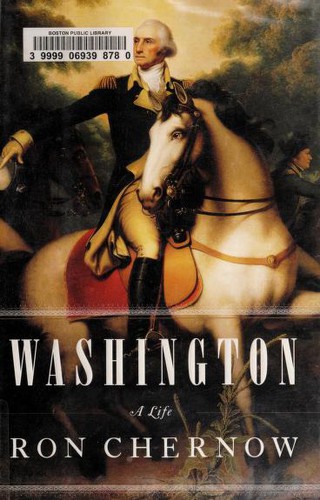
Washington: A Life by Ron Chernow is a 2010 biography book about leadership, revolution, slavery. Washington's most remarkable quality was not his courage in battle but his willingness to relinquish power. In an era when military commanders routinely became political rulers, he chose not to.
Summary
Ron Chernow's Pulitzer Prize-winning biography of George Washington is the most comprehensive single-volume life of the first president, tracing his formation as a Virginia planter, his military career in the French and Indian War and the Revolution, his presiding over the Constitutional Convention, and his eight years as the first executive of an untested republic. Published in 2010, it received the Pulitzer Prize for Biography and is widely considered the definitive Washington for general readers.
The biographical challenge with Washington is his famous opacity. Unlike Jefferson and Hamilton, who were prolific and revealing writers, Washington was guarded and formal in his correspondence, and the interior life behind the public statue is difficult to access. Chernow navigates this through the sheer accumulation of evidence — thousands of letters, diaries, and accounts by people who knew him — and through careful reading of what Washington reveals by what he does rather than what he says. His handling of military defeat, his management of subordinates, and above all his decision to relinquish power are the most revealing episodes in the record.
The slavery sections are among the biography's most important and, for many readers, most discomforting. Washington enslaved over 300 people at Mount Vernon and was a sophisticated and attentive manager of his enslaved labor force. He expressed private ambivalence about slavery and eventually provided for the emancipation of his enslaved people in his will — the only founder to do so — while taking no meaningful public action against the institution during his lifetime. Chernow gives this contradiction substantial attention and resists both the hagiographic tendency to minimize it and the anachronistic tendency to judge Washington entirely by contemporary standards.
The presidency chapters trace the establishment of precedents that Washington himself understood he was setting. Every decision about executive power, cabinet consultation, and the relationship between the president and Congress was, in effect, a founding act. Washington's acceptance of a second term and his refusal to seek a third shaped the American executive in ways that persisted until the twentieth century. His Farewell Address, warning against party spirit and foreign entanglement, is read with particular attention for what it reveals about the republic Washington feared he was handing to his successors.
Talk to Washington: A Life like its author wrote you back.
Get the ideas that fit your life — not generic summaries.
- Chat with the book
- Audiobook-style main ideas
- Adapts to your life and goals
- Helps you take action
Key takeaways
- 1.
Washington's most remarkable quality was not his courage in battle but his willingness to relinquish power. In an era when military commanders routinely became political rulers, he chose not to.
- 2.
Self-command as a lifelong project: Washington was by his own account prone to anger and vanity, and he spent his life cultivating the stoic public manner that history remembers. The effort is visible in the record.
- 3.
Slavery at Mount Vernon was a sophisticated economic operation that Washington managed with attention. His private ambivalence and public silence are equally documented facts.
- 4.
Presidential precedent-setting was both conscious and consequential. Washington understood that his decisions about executive behavior would become templates, and he was careful accordingly.
- 5.
The Farewell Address contains warnings that feel specifically prophetic: about the dangers of political parties, the corruption that comes with foreign alliances, and the vulnerability of republican government to demagoguery.
- 6.
Washington's generalship was not characterized by tactical brilliance but by his ability to hold an army together through defeat, disease, and desertion. His most important military quality was persistence.
- 7.
The Constitutional Convention's success depended substantially on Washington's presence. His willingness to attend and preside gave the Convention credibility it could not have had without him.
- 8.
A man can be both admirable and complicit in a great evil simultaneously. Washington's life makes this uncomfortable but inescapable.
Discussion questions
Use these on your own, with a book club, or as chat starters in Superbook. Book club version, ready to copy or print →
- 1.
Washington is described as deliberately opaque. How does Chernow access his inner life given the limitations of the record?
- 2.
Washington provided for the emancipation of his enslaved people in his will — the only founding father to do so — while taking no public action against slavery during his life. How do you evaluate that record?
- 3.
His decision not to seek a third term set a precedent that held for 150 years. Was it a principled decision or a practical one given the political climate?
- 4.
The Farewell Address warns against party spirit. How does that warning look from the vantage point of American politics today?
- 5.
Washington's anger and vanity are documented but not well-known in popular memory. How does that dimension of his character change the statue?
- 6.
Chernow argues that Washington's self-control — his management of his own passions — was his most important quality. Is that convincing?
- 7.
The Revolution required Washington to manage not just the military but the civilian leadership, the French alliance, and the morale of a starving army. Which of those tasks was most difficult?
- 8.
Washington's relationship with Alexander Hamilton was one of the most consequential personal relationships in American history. How does Chernow render it?
- 9.
The biography runs to nearly 900 pages. What does the length give a reader that a shorter account cannot?
- 10.
Washington was the unanimous choice for president and universally understood to be exceptional. How does that unanimity shape what kind of president he was able to be?
- 11.
What does Washington's life suggest about the relationship between character and institutional design?
Themes
Frequently asked questions
-
Is Washington: A Life the best Washington biography?
It is widely considered the most comprehensive single-volume biography for general readers. Earlier biographies by Douglas Southall Freeman (seven volumes) and James Thomas Flexner are richer in some respects, but Chernow synthesizes the scholarship and primary sources more accessibly than either.
-
How does Washington: A Life compare to Alexander Hamilton by the same author?
Both are comprehensive, meticulously researched, and written for general readers. Hamilton is somewhat more dramatic — Hamilton's life has more obvious narrative tension. Washington is more psychologically challenging because the subject is more guarded. Most readers find Hamilton more immediately engaging.
-
Does the book address Washington's wooden teeth?
It addresses Washington's dental problems, which were severe and lifelong, and notes that his dentures were made from ivory, hippopotamus bone, and human teeth — including teeth purchased from enslaved people — rather than wood. The wooden teeth story is a myth.
-
How does Chernow handle Washington's enslaved people?
With substantial attention. He names individual enslaved people where the record allows, documents the conditions at Mount Vernon, examines Washington's will, and engages seriously with the contradiction between Washington's expressed ambivalence and his public silence.
-
Is Washington interesting as a biographical subject given his opacity?
Chernow makes a convincing case that he is, partly by approaching Washington through his actions rather than his words. The presidency chapters in particular are illuminating precisely because Washington's decisions had to carry so much weight.