Psychology · Book club
Algorithms to Live By: The Computer Science of Human Decisions book club questions
Here are 11 book club questions for Algorithms to Live By: The Computer Science of Human Decisions by Brian Christian and Tom Griffiths, ordered to open easily and end somewhere worth arguing about. Copy them, print them, or bring them up one at a time.
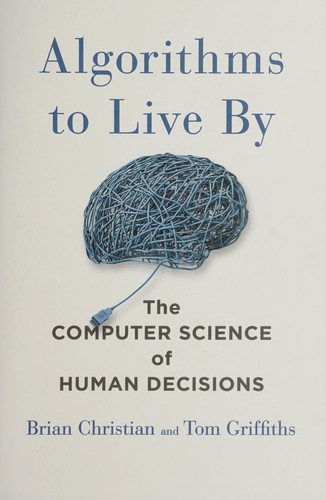
Brian Christian is a writer and Tom Griffiths is a cognitive scientist, and together they argue that computer science has worked out rigorous solutions to many of the problems humans face every day — when to stop searching for a better option, how to manage your schedule, how to sort your memory — and that these solutions are both interesting and useful.
Brian Christian and Tom Griffiths · 2016 · 5h 20m
Full summary and key takeaways →The 11 questions
- 1.
The 37 percent rule is elegant but depends on assumptions about how much of your option space you can inspect. How well do those assumptions fit the kinds of decisions you face in work or relationships?
- 2.
The explore-exploit tradeoff depends on time horizon. How does your current career or life stage affect how much you should be exploring versus exploiting what you have already found?
- 3.
The book applies sorting algorithms to filing and organizing. Do you currently sort your information environment? What would computational sorting principles suggest you do differently?
- 4.
Bayesian reasoning requires updating on base rates, not just individual evidence. Can you identify a current belief you hold that probably underweights base rates?
- 5.
The authors argue that many human cognitive patterns that look like errors are actually reasonable approximations of computationally expensive algorithms. Does that make those patterns feel more or less concerning?
- 6.
Computational kindness — making other people's optimization problems easier — is an unusual ethical frame. What would it look like to apply it to how you make requests of colleagues or family members?
- 7.
The secretary problem has been used as a model of romantic search. How do you react to that framing — is mathematical modeling of relationship decisions useful, alienating, or both?
- 8.
The book argues that when you have too little information, you should explore more; when you have lots, you should exploit. At what point in most important decisions in your life do you actually have enough information?
- 9.
Overfitting is the error of building a model too closely matched to past data that performs poorly on new data. Where do you see overfitting operating in how you or your organization draws lessons from experience?
- 10.
The book proposes that computational thinking illuminates human cognition. What does it fail to illuminate — what aspects of human decision-making resist algorithmic framing?
- 11.
Which algorithm covered in the book do you find most directly applicable to a current practical challenge in your life?
How to run the discussion
- Pick six to eight, not all of them. An hour of real discussion covers fewer questions than anyone expects, and racing the list is what makes a book club feel like homework.
- Open with what people noticed, not what they concluded. Asking for a verdict first hardens opinions before anyone has heard each other.
- Let the disagreement run. The questions below that split a room are the ones worth the time; the ones everyone answers the same way can be skipped.
- Ask the quiet person a specific question. A direct, narrow question is far easier to answer than an open invitation to contribute.
Themes worth steering toward
If the conversation stalls, these are the threads that usually restart it.
Common questions
What are good book club questions for Algorithms to Live By: The Computer Science of Human Decisions?
Here are 11 book club questions for Algorithms to Live By: The Computer Science of Human Decisions by Brian Christian and Tom Griffiths, ordered to open easily and end somewhere worth arguing about. The strongest openers ask what each reader noticed rather than what they concluded, and the discussion usually turns on decision-making, algorithms, cognitive science.
How long should a book club discussion of Algorithms to Live By: The Computer Science of Human Decisions last?
Most groups run 60 to 90 minutes of actual discussion. That is roughly six to eight questions, not all of them, so pick the ones that suit your group rather than working down the list in order.
What are the main themes in Algorithms to Live By: The Computer Science of Human Decisions?
Decision-making, Algorithms, Cognitive science, Optimal stopping, Exploration vs. exploitation. Those are the threads most likely to divide a room, which makes them the useful places to steer a discussion that has gone quiet.
Picking the next one? See books like Algorithms to Live By: The Computer Science of Human Decisions or questions for other book club picks.
