History · Book club
American Moonshot book club questions
Here are 12 book club questions for American Moonshot by Douglas Brinkley, ordered to open easily and end somewhere worth arguing about. Copy them, print them, or bring them up one at a time.
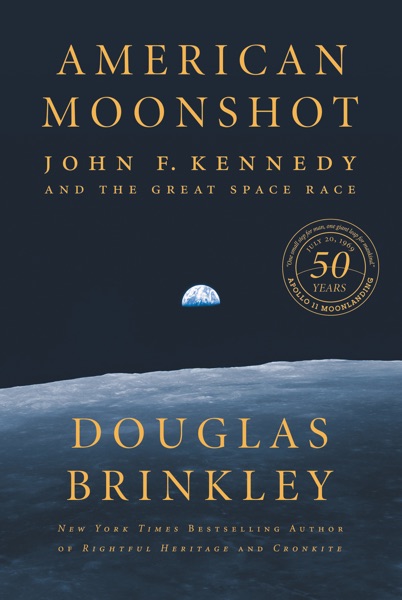
Douglas Brinkley's American Moonshot focuses less on the engineering triumph of Apollo 11 than on the political decision that made it possible: John F.
Douglas Brinkley · 2019 · 9h 15m
Full summary and key takeaways →The 12 questions
- 1.
Kennedy committed to the Moon before there was a clear plan for how to get there. When, in leadership, is it appropriate to commit to an outcome before you know the path, and when is that reckless?
- 2.
Brinkley argues the Cold War made the Moon mission possible. Would a comparable national investment in science and engineering be politically achievable without a comparable external threat?
- 3.
Wernher von Braun built rockets for the Nazis before building them for NASA. How do you evaluate the decision to use his expertise, and does historical distance make that evaluation easier or harder?
- 4.
Kennedy's 'We choose to go to the Moon' speech is one of the most celebrated examples of political communication. What made it work, and what communication challenge in your own context could learn from it?
- 5.
NASA grew from a small agency to a massive organization within a decade. What was gained and what was probably lost in that growth?
- 6.
Kennedy didn't live to see the Moon landing. How does it change your relationship to a project or commitment when you know the initiator won't see it completed?
- 7.
Brinkley is sympathetic to Kennedy throughout. What might a less sympathetic reading of the same decision — its costs, its diversion of resources, its Cold War motives — look like?
- 8.
Apollo set a standard for what focused national investment can achieve. What contemporary problem deserves equivalent scale of attention and resources?
- 9.
The Moon program employed hundreds of thousands of people across the country. How does that kind of distributed national effort differ from equivalent private-sector investment?
- 10.
The space race was explicitly competitive with the Soviet Union. Are there domains today where international competition is similarly driving technological progress?
- 11.
Fifty years after Apollo 11, human spaceflight has become dominated by private companies rather than government agencies. Does that shift represent progress, regression, or simply change?
- 12.
Which decision — committing to the Moon in 1961, or achieving it in 1969 — required more courage?
How to run the discussion
- Pick six to eight, not all of them. An hour of real discussion covers fewer questions than anyone expects, and racing the list is what makes a book club feel like homework.
- Open with what people noticed, not what they concluded. Asking for a verdict first hardens opinions before anyone has heard each other.
- Let the disagreement run. The questions below that split a room are the ones worth the time; the ones everyone answers the same way can be skipped.
- Ask the quiet person a specific question. A direct, narrow question is far easier to answer than an open invitation to contribute.
Themes worth steering toward
If the conversation stalls, these are the threads that usually restart it.
Common questions
What are good book club questions for American Moonshot?
Here are 12 book club questions for American Moonshot by Douglas Brinkley, ordered to open easily and end somewhere worth arguing about. The strongest openers ask what each reader noticed rather than what they concluded, and the discussion usually turns on space exploration, leadership, cold war.
How long should a book club discussion of American Moonshot last?
Most groups run 60 to 90 minutes of actual discussion. That is roughly six to eight questions, not all of them, so pick the ones that suit your group rather than working down the list in order.
What are the main themes in American Moonshot?
Space exploration, Leadership, Cold War, Science, American ambition. Those are the threads most likely to divide a room, which makes them the useful places to steer a discussion that has gone quiet.
Picking the next one? See books like American Moonshot or questions for other book club picks.
