History · Book club
America's Bank: The Epic Struggle to Create the Federal Reserve book club questions
Here are 12 book club questions for America's Bank: The Epic Struggle to Create the Federal Reserve by Roger Lowenstein, ordered to open easily and end somewhere worth arguing about. Copy them, print them, or bring them up one at a time.
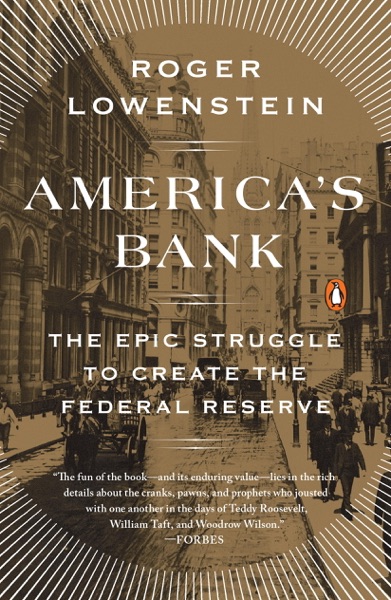
The Federal Reserve was created in 1913, but the story of how it came into existence spans three decades and involves a level of political resistance, financial panic, and legislative maneuvering that makes the eventual outcome seem unlikely in retrospect.
Roger Lowenstein · 2015 · 6h 45m
Full summary and key takeaways →The 12 questions
- 1.
The absence of a lender of last resort meant that every major panic before 1913 required either private intervention or cascading collapse. What does that tell you about how financial stability actually works?
- 2.
The Jekyll Island meeting was held in secrecy precisely because Wall Street involvement would doom the legislation. What does that tell you about the relationship between expertise and democratic legitimacy in financial regulation?
- 3.
Populist fears about central banking were not entirely wrong — previous central banks had favored Eastern financial interests. How do you evaluate those fears against the costs of having no central bank?
- 4.
Lowenstein portrays Paul Warburg as the intellectual hero of the story: a patient expert who spent years educating a hostile public. Is that kind of patient persuasion still available in contemporary political life?
- 5.
The regional Fed structure was a political compromise, not the most technically efficient design. How much does the form of American financial regulation today still reflect the political fears of 1913?
- 6.
The Panic of 1907 was resolved by J.P. Morgan's personal intervention. What are the risks of depending on private actors to solve systemic financial crises?
- 7.
Aldrich and his allies drafted the Federal Reserve plan in secret partly because they believed the democratic process would produce a worse outcome. How do you evaluate that argument?
- 8.
Wilson's requirements changed the Aldrich Plan substantially, adding public oversight and limiting private bank control. Did those changes make the institution better or worse at its core function?
- 9.
The Fed's mandate has expanded over a century far beyond what any of its founders intended. Is that expansion the result of its success or a drift from its original purpose?
- 10.
The book is primarily about a political struggle to create an institution most people thought they didn't want. What contemporary institutions were created similarly, over significant opposition, that turned out to matter?
- 11.
Lowenstein tells the story largely through biography. What does that choice illuminate that a more structural institutional history would miss?
- 12.
The Federal Reserve's 2008 response to the financial crisis was the largest intervention in its history. Does knowing its founding story change how you evaluate that response?
How to run the discussion
- Pick six to eight, not all of them. An hour of real discussion covers fewer questions than anyone expects, and racing the list is what makes a book club feel like homework.
- Open with what people noticed, not what they concluded. Asking for a verdict first hardens opinions before anyone has heard each other.
- Let the disagreement run. The questions below that split a room are the ones worth the time; the ones everyone answers the same way can be skipped.
- Ask the quiet person a specific question. A direct, narrow question is far easier to answer than an open invitation to contribute.
Themes worth steering toward
If the conversation stalls, these are the threads that usually restart it.
Common questions
What are good book club questions for America's Bank: The Epic Struggle to Create the Federal Reserve?
Here are 12 book club questions for America's Bank: The Epic Struggle to Create the Federal Reserve by Roger Lowenstein, ordered to open easily and end somewhere worth arguing about. The strongest openers ask what each reader noticed rather than what they concluded, and the discussion usually turns on banking, politics, economic history.
How long should a book club discussion of America's Bank: The Epic Struggle to Create the Federal Reserve last?
Most groups run 60 to 90 minutes of actual discussion. That is roughly six to eight questions, not all of them, so pick the ones that suit your group rather than working down the list in order.
What are the main themes in America's Bank: The Epic Struggle to Create the Federal Reserve?
Banking, Politics, Economic history, Monetary policy, Reform. Those are the threads most likely to divide a room, which makes them the useful places to steer a discussion that has gone quiet.
Picking the next one? See books like America's Bank: The Epic Struggle to Create the Federal Reserve or questions for other book club picks.
