America's Bank: The Epic Struggle to Create the Federal Reserve by Roger Lowenstein is a 2015 history book about banking, politics, economic history. The United States had no lender of last resort before 1913, which meant every major bank panic — 1873, 1893, 1907 — threatened to cascade into economic collapse without private intervention.
Summary
The Federal Reserve was created in 1913, but the story of how it came into existence spans three decades and involves a level of political resistance, financial panic, and legislative maneuvering that makes the eventual outcome seem unlikely in retrospect. Roger Lowenstein's America's Bank reconstructs that story from primary sources, tracing the reform movement from the panics of the late nineteenth century through the Panic of 1907, which demonstrated the catastrophic consequences of having no lender of last resort, to the eventual passage of the Federal Reserve Act under Woodrow Wilson.
The book is organized around a handful of central figures. Nelson Aldrich, the Senate Republican majority leader and father-in-law of John D. Rockefeller Jr., was the most powerful advocate of banking reform and led the secret 1910 meeting at Jekyll Island, Georgia, where the blueprint for the Fed was drafted by a small group of senior bankers and economists. Paul Warburg, a German-born banker who had worked with central banking systems in Europe, was the intellectual architect of the Jekyll Island plan and spent years patiently explaining what a central bank actually did to audiences that associated it with Wall Street conspiracy. Carter Glass, the Virginia congressman and future Senator, was the Democratic face of the final legislation and spent years negotiating between Wilson's progressive requirements and the banking community's interests.
What Lowenstein captures is how deeply controversial the Federal Reserve was before its creation. Populists feared that a central bank would give Wall Street permanent control over the money supply; farmers who depended on seasonal credit feared that a banker-run institution would tighten credit at precisely the moments they needed it most; Southern and Western politicians distrusted any reform that concentrated financial power in New York. The compromise that eventually passed created a decentralized system with regional banks — a structure that reflected these political fears and shaped the institution's character for a century.
The book's strongest quality is its readability. Lowenstein tells a story that could easily be a dry institutional history as a genuine political drama. The mechanics of banking reform are explained clearly enough that readers without economics backgrounds can follow the stakes. For anyone trying to understand what the Federal Reserve is and why it exists in its particular form, this is the most accessible single account available.
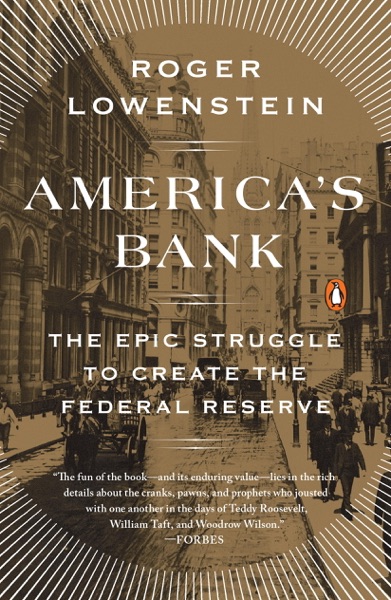
Talk to America's Bank: The Epic Struggle to Create the Federal Reserve like its author wrote you back.
Get the ideas that fit your life — not generic summaries.
- Chat with the book
- Audiobook-style main ideas
- Adapts to your life and goals
- Helps you take action
Key takeaways
- 1.
The United States had no lender of last resort before 1913, which meant every major bank panic — 1873, 1893, 1907 — threatened to cascade into economic collapse without private intervention.
- 2.
The Panic of 1907, resolved only because J.P. Morgan personally organized a bank rescue, demonstrated that the problem was too large for private actors to manage reliably.
- 3.
The Jekyll Island meeting of 1910 produced the Aldrich Plan, the blueprint for the Federal Reserve drafted in secrecy by senior bankers precisely because the involvement of Wall Street was politically toxic.
- 4.
Populist opposition to central banking was intense and not irrational: previous central banks had been dominated by Eastern financial interests at the expense of agricultural regions.
- 5.
The compromise that created the Fed — a network of regional banks rather than a single central institution — was a political solution to political fears, not the most technically efficient design.
- 6.
Paul Warburg's patient educational work over years, explaining what a central bank did and didn't do, was essential to overcoming public ignorance and hostility to the concept.
- 7.
Woodrow Wilson's progressive requirements — democratic governance, public oversight, limits on private bank control — shaped the Fed's structure in ways that persist to the present day.
Discussion questions
Use these on your own, with a book club, or as chat starters in Superbook. Book club version, ready to copy or print →
- 1.
The absence of a lender of last resort meant that every major panic before 1913 required either private intervention or cascading collapse. What does that tell you about how financial stability actually works?
- 2.
The Jekyll Island meeting was held in secrecy precisely because Wall Street involvement would doom the legislation. What does that tell you about the relationship between expertise and democratic legitimacy in financial regulation?
- 3.
Populist fears about central banking were not entirely wrong — previous central banks had favored Eastern financial interests. How do you evaluate those fears against the costs of having no central bank?
- 4.
Lowenstein portrays Paul Warburg as the intellectual hero of the story: a patient expert who spent years educating a hostile public. Is that kind of patient persuasion still available in contemporary political life?
- 5.
The regional Fed structure was a political compromise, not the most technically efficient design. How much does the form of American financial regulation today still reflect the political fears of 1913?
- 6.
The Panic of 1907 was resolved by J.P. Morgan's personal intervention. What are the risks of depending on private actors to solve systemic financial crises?
- 7.
Aldrich and his allies drafted the Federal Reserve plan in secret partly because they believed the democratic process would produce a worse outcome. How do you evaluate that argument?
- 8.
Wilson's requirements changed the Aldrich Plan substantially, adding public oversight and limiting private bank control. Did those changes make the institution better or worse at its core function?
- 9.
The Fed's mandate has expanded over a century far beyond what any of its founders intended. Is that expansion the result of its success or a drift from its original purpose?
- 10.
The book is primarily about a political struggle to create an institution most people thought they didn't want. What contemporary institutions were created similarly, over significant opposition, that turned out to matter?
- 11.
Lowenstein tells the story largely through biography. What does that choice illuminate that a more structural institutional history would miss?
- 12.
The Federal Reserve's 2008 response to the financial crisis was the largest intervention in its history. Does knowing its founding story change how you evaluate that response?
Themes
Frequently asked questions
-
Do you need an economics background to read America's Bank?
No. Lowenstein explains the mechanics of banking and monetary policy as the story requires it. The book is written as political history, and the financial concepts are context for the human drama rather than the subject itself.
-
How is this book different from other Federal Reserve histories?
Most Fed histories focus on its operations and monetary policy decisions. America's Bank focuses entirely on the founding: the political struggle from 1907 to 1913. It ends at the moment the institution comes into existence, so it pairs well with accounts of what the Fed did after it was created.
-
What is the book's main argument?
That the Federal Reserve's founding was a political achievement more than a technocratic one, and that the institution's peculiar structure — decentralized, with both public and private elements — reflects the political compromises required to get it passed rather than any optimal design.
-
Is Lowenstein sympathetic to the Federal Reserve?
Generally yes. He treats the absence of a central bank as a genuine problem and the Panic of 1907 as evidence for the reformers' case. He is not uncritical — the book is clear about the ways the final legislation was shaped by private banking interests — but the overall narrative treats the creation of the Fed as a positive achievement.
-
How long does it take to read?
Around six to seven hours. The narrative moves well — Lowenstein is a skilled storyteller — and the chapters are organized around events and characters rather than concepts, which keeps the pace up even when the material is complex.
Similar books
The Big Short: Inside the Doomsday Machine
Michael Lewis
When Genius Failed
Roger Lowenstein
Liar's Poker
Michael Lewis
The Ascent of Money: A Financial History of the World
Niall Ferguson
