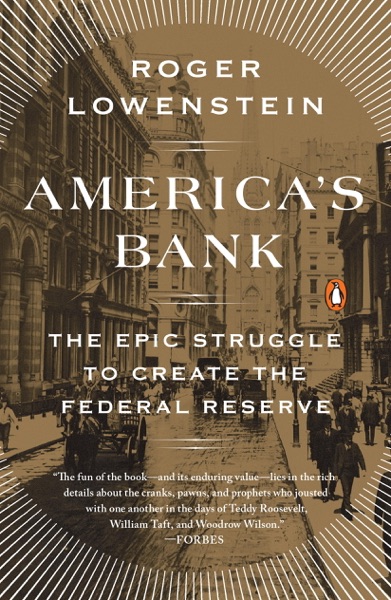
Talk to America's Bank: The Epic Struggle to Create the Federal Reserve like its author wrote you back.
Get the ideas that fit your life — not generic summaries.
- Chat with the book
- Audiobook-style main ideas
- Adapts to your life and goals
- Helps you take action
What it argues
The Federal Reserve was created in 1913, but the story of how it came into existence spans three decades and involves a level of political resistance, financial panic, and legislative maneuvering that makes the eventual outcome seem unlikely in retrospect. Roger Lowenstein's America's Bank reconstructs that story from primary sources, tracing the reform movement from the panics of the late nineteenth century through the Panic of 1907, which demonstrated the catastrophic consequences of having no lender of last resort, to the eventual passage of the Federal Reserve Act under Woodrow Wilson.
The book is organized around a handful of central figures. Nelson Aldrich, the Senate Republican majority leader and father-in-law of John D. Rockefeller Jr., was the most powerful advocate of banking reform and led the secret 1910 meeting at Jekyll Island, Georgia, where the blueprint for the Fed was drafted by a small group of senior bankers and economists. Paul Warburg, a German-born banker who had worked with central banking systems in Europe, was the intellectual architect of the Jekyll Island plan and spent years patiently explaining what a central bank actually did to audiences that associated it with Wall Street conspiracy. Carter Glass, the Virginia congressman and future Senator, was the Democratic face of the final legislation and spent years negotiating between Wilson's progressive requirements and the banking community's interests.
What it gets right
- 1.
The United States had no lender of last resort before 1913, which meant every major bank panic — 1873, 1893, 1907 — threatened to cascade into economic collapse without private intervention.
- 2.
The Panic of 1907, resolved only because J.P. Morgan personally organized a bank rescue, demonstrated that the problem was too large for private actors to manage reliably.
- 3.
The Jekyll Island meeting of 1910 produced the Aldrich Plan, the blueprint for the Federal Reserve drafted in secrecy by senior bankers precisely because the involvement of Wall Street was politically toxic.
What it covers
Who wrote it
Roger Lowenstein is an American financial journalist and author who spent years as a reporter and columnist for The Wall Street Journal. His books include Buffett: The Making of an American Capitalist (1995), which remains one of the most-read accounts of Warren Buffett's career; When Genius Failed (2000), on the collapse of Long-Term Capital Management; and The End of Wall Street (2010), on the 2008 financial crisis. America's Bank, published in 2015, is his most historically ambitious book. He writes from the perspective of someone who covers financial markets as a practitioner would, which gives his accounts of policy and crisis a specificity that more academic treatments lack.
