Health · Book club
Anatomy of an Epidemic book club questions
Here are 12 book club questions for Anatomy of an Epidemic by Robert Whitaker, ordered to open easily and end somewhere worth arguing about. Copy them, print them, or bring them up one at a time.
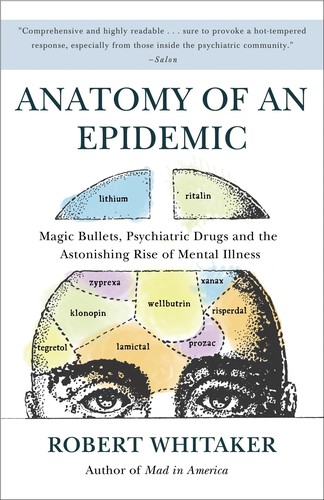
Anatomy of an Epidemic is Robert Whitaker's investigation into a paradox: as the use of psychiatric medication in the United States has increased dramatically over the past half-century, the number of people on disability due to mental illness has risen in parallel.
Robert Whitaker · 2010 · 6h 45m
Full summary and key takeaways →The 12 questions
- 1.
Whitaker's argument — that psychiatric drugs may cause long-term harm — is made by a journalist, not a clinician. Does the messenger affect how you receive the message? Why?
- 2.
The chemical imbalance theory of depression was widely communicated to patients for decades. If it was oversimplified or wrong, what should doctors say instead to patients asking why they're depressed?
- 3.
The book describes people whose mental health got worse over years of medication. How do you think about the difference between correlation and causation in those cases?
- 4.
Whitaker argues that long-term outcome data was available but ignored. What would have to be true about the psychiatric establishment for that to have happened, and is it plausible?
- 5.
If you or someone you know takes psychiatric medication, how did this book affect your thinking? What questions would you want to ask a prescribing physician?
- 6.
The book cites better outcomes in countries where antipsychotic prescribing is less aggressive. What other explanations besides medication levels might account for those differences?
- 7.
Whitaker distinguishes between short-term efficacy and long-term outcomes. Why might a treatment that helps in the short term produce worse results over years, and is that trade-off ever worth it?
- 8.
The disability paradox — more treatment, more disability — is the book's central puzzle. What other explanations could account for it besides the drugs themselves?
- 9.
Psychiatry's defenders argue Whitaker cherry-picks evidence. What would a fair evaluation of his claims require, and who would you trust to do it?
- 10.
The book raises questions about informed consent — whether patients are told enough about risks and alternative approaches. What does genuine informed consent for psychiatric medication look like?
- 11.
If Whitaker's thesis is substantially correct, what responsibility do pharmaceutical companies, prescribing physicians, and regulators bear for the outcomes he describes?
- 12.
What would it take for you to taper off or decline psychiatric medication you or a family member was prescribed? What information would you need?
How to run the discussion
- Pick six to eight, not all of them. An hour of real discussion covers fewer questions than anyone expects, and racing the list is what makes a book club feel like homework.
- Open with what people noticed, not what they concluded. Asking for a verdict first hardens opinions before anyone has heard each other.
- Let the disagreement run. The questions below that split a room are the ones worth the time; the ones everyone answers the same way can be skipped.
- Ask the quiet person a specific question. A direct, narrow question is far easier to answer than an open invitation to contribute.
Themes worth steering toward
If the conversation stalls, these are the threads that usually restart it.
Common questions
What are good book club questions for Anatomy of an Epidemic?
Here are 12 book club questions for Anatomy of an Epidemic by Robert Whitaker, ordered to open easily and end somewhere worth arguing about. The strongest openers ask what each reader noticed rather than what they concluded, and the discussion usually turns on psychiatry, psychiatric medication, mental illness.
How long should a book club discussion of Anatomy of an Epidemic last?
Most groups run 60 to 90 minutes of actual discussion. That is roughly six to eight questions, not all of them, so pick the ones that suit your group rather than working down the list in order.
What are the main themes in Anatomy of an Epidemic?
Psychiatry, Psychiatric medication, Mental illness, Science and medicine, Public health. Those are the threads most likely to divide a room, which makes them the useful places to steer a discussion that has gone quiet.
Picking the next one? See books like Anatomy of an Epidemic or questions for other book club picks.
