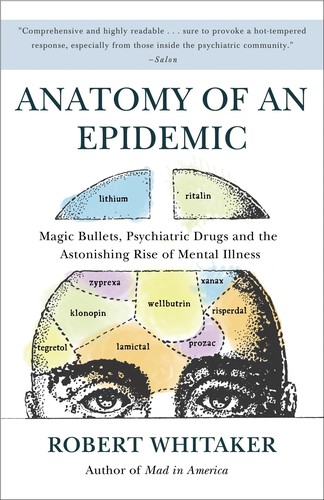
Anatomy of an Epidemic by Robert Whitaker is a 2010 health book about psychiatry, psychiatric medication, mental illness. Disability rates due to mental illness have risen sharply in the United States during the same decades that psychiatric drug prescriptions have increased dramatically — a correlation that Whitaker argues is not coincidental.
Summary
Anatomy of an Epidemic is Robert Whitaker's investigation into a paradox: as the use of psychiatric medication in the United States has increased dramatically over the past half-century, the number of people on disability due to mental illness has risen in parallel. If antidepressants, antipsychotics, and other psychiatric drugs are as effective as claimed, why are long-term outcomes for mental illness getting worse, not better? Whitaker, a medical journalist, argues that the answer is in the drugs themselves.
The book is built on a careful reading of clinical research, including long-term outcome studies that Whitaker argues the pharmaceutical industry and the psychiatric establishment have minimized or ignored. For schizophrenia, he cites research showing that patients in developing countries — where medication rates are lower — have better long-term outcomes than patients in the United States. For depression, he examines evidence that antidepressants may cause chemical changes that make the brain more vulnerable to future depressive episodes rather than less. For benzodiazepines and stimulants, he documents dependency and withdrawal effects that are frequently underdisclosed.
Whitaker's thesis is not that psychiatric medications never help. He acknowledges that some people with severe conditions benefit from short-term use. His argument is narrower and more troubling: that long-term maintenance medication, as commonly prescribed, may produce worse outcomes than more cautious approaches, and that this evidence has been systematically suppressed or ignored because it conflicts with both financial interests and clinical identity.
The book was controversial on publication and remains so. Psychiatry's defenders argue that Whitaker selects evidence, that the disability data reflects increased recognition rather than worsening outcomes, and that untreated mental illness carries its own devastating costs. These are legitimate objections and readers should hold them in mind. But as a documented inquiry into what the long-term outcome research actually shows — rather than what drug companies advertise — Anatomy of an Epidemic raises questions that the field has not fully answered.
Talk to Anatomy of an Epidemic like its author wrote you back.
Get the ideas that fit your life — not generic summaries.
- Chat with the book
- Audiobook-style main ideas
- Adapts to your life and goals
- Helps you take action
Key takeaways
- 1.
Disability rates due to mental illness have risen sharply in the United States during the same decades that psychiatric drug prescriptions have increased dramatically — a correlation that Whitaker argues is not coincidental.
- 2.
Long-term outcome studies for schizophrenia, conducted in multiple countries, show better functional recovery among patients who did not take or who tapered off antipsychotic medication, compared to those on long-term maintenance doses.
- 3.
Antidepressants appear to cause compensatory changes in the brain's serotonin system that may make people more prone to depression over time, not less — a phenomenon Whitaker calls 'tardive dysphoria.'
- 4.
The chemical imbalance theory of depression — that depression is caused by low serotonin — was a marketing narrative that outran the evidence. The science never established this as a straightforward causal mechanism.
- 5.
Benzodiazepines and stimulants, widely prescribed for anxiety and ADHD, carry dependency and withdrawal risks that are frequently undercommunicated to patients at the time of prescription.
- 6.
The pharmaceutical industry's funding of psychiatric research creates incentives that systematically favor positive findings and suppress or minimize negative ones — including long-term outcome data.
- 7.
Some patients with psychosis who are gradually tapered off antipsychotics, with careful support, achieve better long-term functioning than those maintained on medication indefinitely. This evidence has not become standard clinical practice.
- 8.
Whitaker's core claim is not that psychiatric medication never helps but that the evidence base for long-term maintenance prescribing is weaker than the profession represents, and that patients deserve honest disclosure of that uncertainty.
Discussion questions
Use these on your own, with a book club, or as chat starters in Superbook. Book club version, ready to copy or print →
- 1.
Whitaker's argument — that psychiatric drugs may cause long-term harm — is made by a journalist, not a clinician. Does the messenger affect how you receive the message? Why?
- 2.
The chemical imbalance theory of depression was widely communicated to patients for decades. If it was oversimplified or wrong, what should doctors say instead to patients asking why they're depressed?
- 3.
The book describes people whose mental health got worse over years of medication. How do you think about the difference between correlation and causation in those cases?
- 4.
Whitaker argues that long-term outcome data was available but ignored. What would have to be true about the psychiatric establishment for that to have happened, and is it plausible?
- 5.
If you or someone you know takes psychiatric medication, how did this book affect your thinking? What questions would you want to ask a prescribing physician?
- 6.
The book cites better outcomes in countries where antipsychotic prescribing is less aggressive. What other explanations besides medication levels might account for those differences?
- 7.
Whitaker distinguishes between short-term efficacy and long-term outcomes. Why might a treatment that helps in the short term produce worse results over years, and is that trade-off ever worth it?
- 8.
The disability paradox — more treatment, more disability — is the book's central puzzle. What other explanations could account for it besides the drugs themselves?
- 9.
Psychiatry's defenders argue Whitaker cherry-picks evidence. What would a fair evaluation of his claims require, and who would you trust to do it?
- 10.
The book raises questions about informed consent — whether patients are told enough about risks and alternative approaches. What does genuine informed consent for psychiatric medication look like?
- 11.
If Whitaker's thesis is substantially correct, what responsibility do pharmaceutical companies, prescribing physicians, and regulators bear for the outcomes he describes?
- 12.
What would it take for you to taper off or decline psychiatric medication you or a family member was prescribed? What information would you need?
Themes
Frequently asked questions
-
What is Anatomy of an Epidemic about?
It investigates why rates of mental illness disability have risen alongside increased psychiatric drug prescribing, and argues that long-term maintenance medication may worsen outcomes for many patients — a claim based on a reading of outcome research the author says the profession has ignored.
-
Is Anatomy of an Epidemic scientifically credible?
Whitaker documents real research, and several of the studies he cites are genuine and peer-reviewed. The book's conclusions are contested — mainstream psychiatry disputes his interpretation of the evidence, and the disability data is subject to multiple competing explanations. It should be read critically, not as settled science.
-
Should I stop taking my psychiatric medication after reading this?
No — and Whitaker does not advise that. Abruptly stopping psychiatric medication can be dangerous. The book's argument is about long-term maintenance prescribing patterns and informed consent, not a directive to individual patients. Any changes to medication should involve a prescribing physician.
-
Who should read Anatomy of an Epidemic?
People who take or have family members on long-term psychiatric medication and want to understand what the outcome research shows. Also useful for anyone interested in the intersection of pharmaceutical industry incentives and clinical practice. Go in ready to think critically about both the argument and its critics.
-
How does this book compare to other critiques of psychiatry?
Anatomy of an Epidemic is empirical rather than philosophical — it engages with clinical outcome studies rather than questioning psychiatry's conceptual foundations. It's more in the tradition of investigative journalism than philosophy of medicine, which makes it concrete but also limited to what the evidence directly supports.
Similar books

Bad Blood: Secrets and Lies in a Silicon Valley Startup
John Carreyrou

The Emperor of All Maladies: A Biography of Cancer
Siddhartha Mukherjee
The Immortal Life of Henrietta Lacks
Rebecca Skloot
The Body Keeps the Score
Bessel van der Kolk
