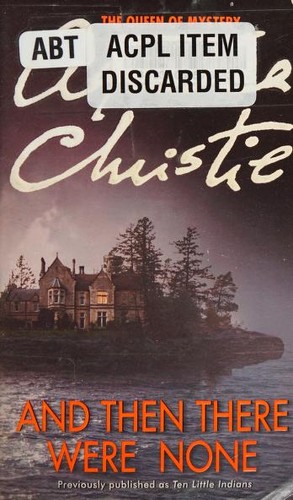
Talk to And Then There Were None like its author wrote you back.
Get the ideas that fit your life — not generic summaries.
- Chat with the book
- Audiobook-style main ideas
- Adapts to your life and goals
- Helps you take action
What it argues
Ten strangers are invited to an island off the Devon coast under various pretexts. They have nothing obvious in common — a retired general, a young woman, a judge, a doctor, a manservant, several others. Within hours of their arrival, a recorded voice accuses each of them of a murder they escaped legal punishment for. Then people start dying, one by one, in patterns matching a nursery rhyme. And Then There Were None is the best-selling mystery novel of all time, and its reputation is deserved.
The book is a locked-room problem scaled up to an entire island. Christie strips away everything that usually makes mystery fiction comfortable: there is no detective figure, no orderly procedural, no external authority who will arrive and sort things out. The ten characters are both suspects and victims, and the reader is positioned in the same epistemic situation as everyone on the island — knowing that someone among this group is responsible, unable to determine who. The paranoia this creates is the book's real subject.
What it gets right
- 1.
Christie eliminates the detective figure entirely, forcing the reader into the same epistemological position as the characters — no privileged observer, no procedural comfort.
- 2.
The nursery rhyme structure is not decoration. Using a children's rhyme to sequence adult murders creates a specific kind of dread — the sense of an inevitable, arbitrary logic.
- 3.
Each victim is genuinely guilty of something, and Christie does not let the reader forget this. The book is not about innocents being killed; it's about what justice means when formal processes fail.
What it covers
Who wrote it
Agatha Christie (1890-1976) is the best-selling fiction writer of all time after Shakespeare and the Bible, with estimated sales exceeding two billion copies. She is the creator of Hercule Poirot and Miss Marple and the author of 66 detective novels, 14 short story collections, and the longest-running play in history (The Mousetrap, still running in London). And Then There Were None remains her most successful single novel. Christie also wrote six romance novels under the pseudonym Mary Westmacott. She was made a Dame Commander of the Order of the British Empire in 1971.
