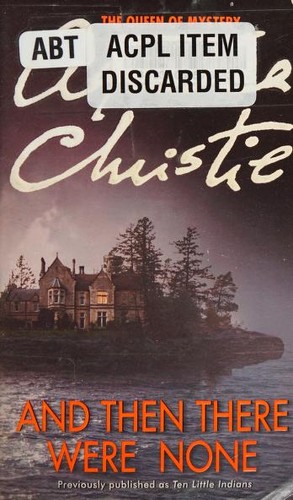
Talk to And Then There Were None like its author wrote you back.
Get the ideas that fit your life — not generic summaries.
- Chat with the book
- Audiobook-style main ideas
- Adapts to your life and goals
- Helps you take action
And Then There Were None, in detail
Ten strangers are invited to an island off the Devon coast under various pretexts. They have nothing obvious in common — a retired general, a young woman, a judge, a doctor, a manservant, several others. Within hours of their arrival, a recorded voice accuses each of them of a murder they escaped legal punishment for. Then people start dying, one by one, in patterns matching a nursery rhyme. And Then There Were None is the best-selling mystery novel of all time, and its reputation is deserved.
The book is a locked-room problem scaled up to an entire island. Christie strips away everything that usually makes mystery fiction comfortable: there is no detective figure, no orderly procedural, no external authority who will arrive and sort things out. The ten characters are both suspects and victims, and the reader is positioned in the same epistemic situation as everyone on the island — knowing that someone among this group is responsible, unable to determine who. The paranoia this creates is the book's real subject.
Christie also takes the moral question seriously. Each of the ten has killed someone and been protected by circumstance, class, or luck. The island's unknown judge is inflicting a punishment the law failed to. The novel forces the reader to hold two uncomfortable thoughts: that legal innocence and moral innocence are different things, and that extrajudicial execution is still murder even when the victim is guilty. Christie doesn't resolve this — she leaves both sides of it standing.
The solution, revealed in a postscript, is formally brilliant and famously fair-play: the clues are present in the text, visible in retrospect, and the solution requires no information the reader didn't have access to. For the puzzle-lover, this is one of the great achievements in the genre. For the reader who cares about character, the novel is thinner — the ten strangers are sketched rather than developed. But as an exercise in suspense, structure, and moral unease, it remains unmatched eighty years on.
The big ideas
- 1.
Christie eliminates the detective figure entirely, forcing the reader into the same epistemological position as the characters — no privileged observer, no procedural comfort.
- 2.
The nursery rhyme structure is not decoration. Using a children's rhyme to sequence adult murders creates a specific kind of dread — the sense of an inevitable, arbitrary logic.
- 3.
Each victim is genuinely guilty of something, and Christie does not let the reader forget this. The book is not about innocents being killed; it's about what justice means when formal processes fail.
