Philosophy · Book club
Antifragile: Things That Gain from Disorder book club questions
Here are 12 book club questions for Antifragile: Things That Gain from Disorder by Nassim Nicholas Taleb, ordered to open easily and end somewhere worth arguing about. Copy them, print them, or bring them up one at a time.
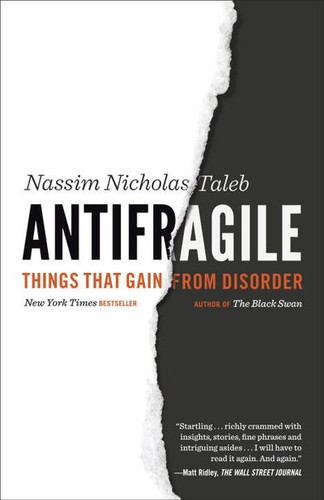
Antifragile is Nassim Nicholas Taleb's argument that the opposite of fragile is not robust or resilient — it is antifragile.
Nassim Nicholas Taleb · 2012 · 10h 45m
Full summary and key takeaways →The 12 questions
- 1.
Taleb distinguishes fragile, robust, and antifragile. Where in your own life have you built fragility in the name of comfort or predictability?
- 2.
The barbell strategy recommends extreme caution at one end and aggressive optionality at the other. What would a barbell look like in your career or finances right now?
- 3.
Taleb argues that stressors and small failures are necessary information for a healthy system. What in your organization or life is being over-protected from stress in a way that might be creating hidden fragility?
- 4.
Via negativa says subtraction is often more powerful than addition. What is one thing you could remove from your life or work that would improve it more than adding something new?
- 5.
The Lindy Effect suggests old ideas and institutions have proven durability that new ones haven't. Which new thing in your field are you betting on that might not survive the Lindy test?
- 6.
Taleb is contemptuous of experts who bear no consequences for their advice. Who in your life or field makes high-stakes recommendations without skin in the game? How does that change how you should weigh their advice?
- 7.
Think of a large institution — a company, a government agency, a healthcare system — that you depend on. What would make it antifragile rather than merely robust?
- 8.
Taleb claims that nature learns by doing, not by theorizing. Where are you relying on a theory or plan when experimentation would teach you more?
- 9.
The book argues that over-optimization removes the slack and redundancy that systems need to survive shocks. Where in your work or life have you over-optimized in a way that left you exposed?
- 10.
Has a setback, failure, or period of disorder in your life ever made you better in a way that success wouldn't have? What did it require of you to extract that benefit?
- 11.
Taleb says the problem is not uncertainty but the illusion of certainty. Where are you most susceptible to false certainty right now?
- 12.
If you applied Taleb's framework to a decision you're currently facing, what would the fragile option be, the robust option, and the antifragile option?
How to run the discussion
- Pick six to eight, not all of them. An hour of real discussion covers fewer questions than anyone expects, and racing the list is what makes a book club feel like homework.
- Open with what people noticed, not what they concluded. Asking for a verdict first hardens opinions before anyone has heard each other.
- Let the disagreement run. The questions below that split a room are the ones worth the time; the ones everyone answers the same way can be skipped.
- Ask the quiet person a specific question. A direct, narrow question is far easier to answer than an open invitation to contribute.
Themes worth steering toward
If the conversation stalls, these are the threads that usually restart it.
Common questions
What are good book club questions for Antifragile: Things That Gain from Disorder?
Here are 12 book club questions for Antifragile: Things That Gain from Disorder by Nassim Nicholas Taleb, ordered to open easily and end somewhere worth arguing about. The strongest openers ask what each reader noticed rather than what they concluded, and the discussion usually turns on antifragility, risk and uncertainty, optionality.
How long should a book club discussion of Antifragile: Things That Gain from Disorder last?
Most groups run 60 to 90 minutes of actual discussion. That is roughly six to eight questions, not all of them, so pick the ones that suit your group rather than working down the list in order.
What are the main themes in Antifragile: Things That Gain from Disorder?
Antifragility, Risk and uncertainty, Optionality, Complexity, Decision-making. Those are the threads most likely to divide a room, which makes them the useful places to steer a discussion that has gone quiet.
Picking the next one? See books like Antifragile: Things That Gain from Disorder or questions for other book club picks.
