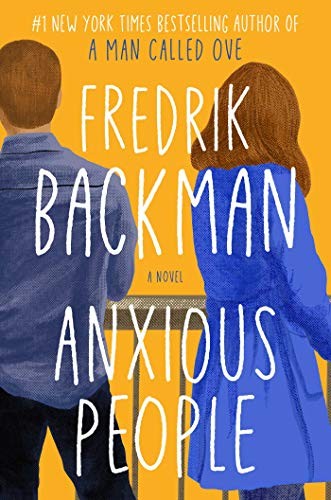
Anxious People by Fredrik Backman is a 2020 contemporary fiction book about anxiety and connection, failure and forgiveness, coincidence and consequence. Backman structures the novel as a mystery in which the actual mystery (who was the robber) matters far less than the question of who each of these people is and what they needed from the day.
Summary
Anxious People begins with a failed bank robbery. The would-be robber, who doesn't actually have a gun, flees into the nearest open door — a real estate viewing for an apartment in a small Swedish town — and accidentally takes a roomful of strangers hostage. The strangers include a pregnant woman, a young couple buying their first home, an elderly man, a retired couple trying to sell their apartment, and a woman who is clearly not what she appears to be. When the police arrive, no one quite agrees on what happened, and eventually the robber vanishes.
The novel is structured as an investigation: a father-and-son police duo is trying to reconstruct the hostage incident from interviews with each of the apartment viewers. What they slowly discover is that every person in that room was having the worst day of their life for reasons that had nothing to do with the robbery, and that the robbery itself interrupted a series of private crises at the moment each person most needed interrupting. Backman braids these backstories with the investigation, revealing what connected these strangers before and after the apartment, until what seemed like a chaotic farce reveals itself as something more carefully architected.
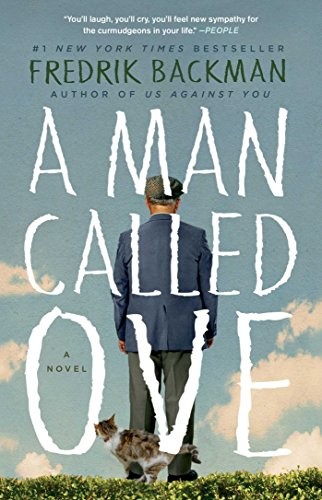
The novel's central argument is that everyone is carrying more than they show, and that small, accidental kindnesses — the kind that happen when strangers are thrown together — are sometimes the only intervention that works. This is Backman's fullest statement of a theme he has been developing since A Man Called Ove, and it is handled with more structural sophistication here. The mystery format (who is the robber, where did they go) gives the novel a forward pull that A Man Called Ove's episodic structure doesn't have.
Anxious People is funnier than its premise and sadder than its comedy suggests. The title is literal and not ironic: the book is genuinely interested in anxiety as a condition — the kind that makes people make bad decisions, the kind that comes from looking at the world and not knowing how to hold it. Whether that's your anxiety or everyone's is part of what the novel asks you to sit with.
Talk to Anxious People like its author wrote you back.
Get the ideas that fit your life — not generic summaries.
- Chat with the book
- Audiobook-style main ideas
- Adapts to your life and goals
- Helps you take action
Key takeaways
- 1.
Backman structures the novel as a mystery in which the actual mystery (who was the robber) matters far less than the question of who each of these people is and what they needed from the day.
- 2.
Every hostage is in crisis before the robbery begins — the robbery is structurally an excuse to gather people whose lives were already colliding without their knowledge.
- 3.
The father-son police duo carries the novel's meta-argument about communication: two people who love each other can fail to say the one thing that would help for years.
- 4.
Backman's comedy here is more deliberately crafted than in earlier books — the jokes are structural, arising from the gap between how characters describe events and what actually happened.
- 5.
The novel is interested in the specific loneliness of people who are technically surrounded by others but feel unseen — apartment viewings, open houses, these spaces of intimate transaction between strangers.
- 6.
The hostage-taker is given full interiority late in the novel, and that shift — from antagonist to subject — is one of the book's most deliberate formal moves.
- 7.
Coincidence in Backman is not a cheat but a thesis: his novels argue that accidents of proximity create the conditions for care that intention rarely achieves.
- 8.
The ending is warm without being false — the crises are not resolved so much as metabolized, and the characters leave the apartment changed in ways that are small and specific rather than redemptive and general.
Discussion questions
Use these on your own, with a book club, or as chat starters in Superbook. Book club version, ready to copy or print →
- 1.
The novel is structured as an investigation, but the mystery isn't really whodunit — it's whodunit for what reason and what it cost them. When did you figure out the robber's identity, and how did that affect your reading?
- 2.
Each hostage is described as anxious about something real. Which character's anxiety felt most familiar to you?
- 3.
Jack and his father Jim communicate badly despite loving each other. What specific thing would each of them have needed to say earlier? Does the novel let them say it by the end?
- 4.
The apartment itself — an apartment no one could actually afford, in a market no one could actually navigate — functions as a symbol. Of what?
- 5.
Backman uses humor to deliver emotional content the reader might otherwise resist. Give a specific moment where the comedy lowered your guard and something hit you unexpectedly.
- 6.
The novel argues that accidental kindness is more effective than intentional kindness. Do you agree? Can you think of examples from your own life?
- 7.
Compared to A Man Called Ove, Anxious People has a more complex structure but a similar emotional thesis. Which version of that thesis did you find more persuasive?
- 8.
The robber makes a series of bad decisions that lead to the hostage situation. Are those decisions sympathetic? At what point, if any, did you stop sympathizing?
- 9.
Several of the characters have been concealing something important from the people closest to them. Is the novel's resolution of those concealments satisfying?
- 10.
The novel was written and published in 2020, during the COVID-19 pandemic. Does the book's interest in isolation, proximity, and strangers read differently given that context?
- 11.
Is the novel's ending earned? Or does Backman's warmth tip into sentimentality by the final pages?
- 12.
If you were in that apartment, which of the other hostages would you most want to talk to, and what would you want to ask them?
Themes
Frequently asked questions
-
Is Anxious People worth reading?
Yes, especially if you liked A Man Called Ove and want something with more structural ambition. The mystery format gives it a forward pull that Backman's earlier novels lack. It is warm, funny, and genuinely moving without being saccharine.
-
Do I need to have read Fredrik Backman's other books first?
No. Anxious People is completely self-contained. Some readers find it the best entry point precisely because its structure is tighter than A Man Called Ove.
-
Is Anxious People hard to follow?
The non-linear structure requires you to hold multiple timelines and a large cast of characters. For most readers it snaps into clarity by the midpoint. The mystery format helps — you are always working toward something.
-
Is there an adaptation?
Yes. A Swedish-language Netflix miniseries titled Anxious People (Lyckliga gatan) was released in 2021. It is well regarded and quite faithful to the novel.
-
Who shouldn't read this book?
Readers who find Backman's emotional directness manipulative, or who want more morally complex or stylistically challenging fiction. The novel is sincere about its warmth and does not apologize for it.