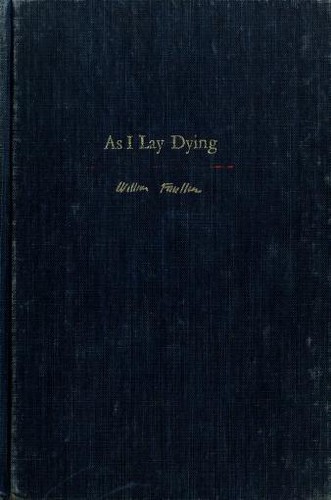
Talk to As I Lay Dying like its author wrote you back.
Get the ideas that fit your life — not generic summaries.
- Chat with the book
- Audiobook-style main ideas
- Adapts to your life and goals
- Helps you take action
What it argues
As I Lay Dying is the story of the Bundren family's journey across Mississippi to bury Addie Bundren, wife and mother, in her hometown of Jefferson. She dies at the beginning of the novel, and the rest of it is the Bundrens hauling her coffin through summer heat, floods, and fire for nine days — a journey marked by mishap, private motivation, and dark comedy. Faulkner tells it through 59 interior monologues distributed among 15 narrators, including the dead Addie herself, whose single chapter is one of the strangest and most remarkable things in American fiction.
Each Bundren pursues their own agenda within the funeral journey. Cash, the eldest son, is an obsessive carpenter who built the coffin while his mother lay dying, angling each board in her sight. Darl is the most visionary and most isolated of the children; his narration is the most literary and the most unstable. Jewel, Addie's favorite, is a man of violent action and limited speech. Vardaman, the youngest, cannot process his mother's death and conflates her with a fish he caught the same day. Dewey Dell is pregnant and the trip to Jefferson is partly her opportunity to get an abortion. Anse, the father, wants his teeth. This list is not an exaggeration.
What it gets right
- 1.
The 59-narrator structure is not decoration — it is the argument: grief and death are experienced differently by every person in the room, and no single account adds up to the truth.
- 2.
Addie Bundren's chapter, delivered posthumously, is the novel's moral inversion: she speaks after death to explain how hollow the language of love and family has always felt to her. It reframes everything.
- 3.
Anse Bundren is one of American fiction's great comic grotesques: a man whose parasitism is so thorough he has constructed an entire moral framework around it. He never tills the soil because it gives him sweating sickness.
What it covers
Who wrote it
William Faulkner (1897–1962) was an American novelist and short story writer from Mississippi, generally considered one of the most technically innovative writers in American literary history. He spent most of his life in Oxford, Mississippi, near which his fictional Yoknapatawpha County is set. His major works include The Sound and the Fury, As I Lay Dying, Light in August, Absalom, Absalom!, and The Bear. He was awarded the Nobel Prize in Literature in 1949. As I Lay Dying was written in six weeks while Faulkner worked night shifts at a power plant.
