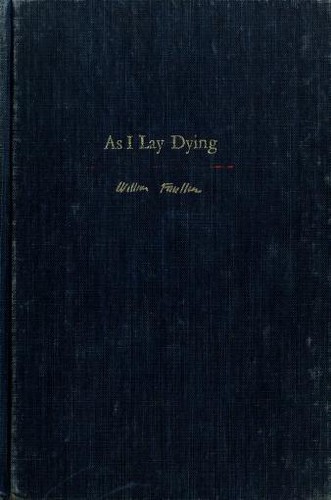
As I Lay Dying by William Faulkner is a 1930 literary fiction book about death and grief, family obligation, selfishness and sacrifice. The 59-narrator structure is not decoration — it is the argument: grief and death are experienced differently by every person in the room, and no single account adds up to the truth.
Summary
As I Lay Dying is the story of the Bundren family's journey across Mississippi to bury Addie Bundren, wife and mother, in her hometown of Jefferson. She dies at the beginning of the novel, and the rest of it is the Bundrens hauling her coffin through summer heat, floods, and fire for nine days — a journey marked by mishap, private motivation, and dark comedy. Faulkner tells it through 59 interior monologues distributed among 15 narrators, including the dead Addie herself, whose single chapter is one of the strangest and most remarkable things in American fiction.
Each Bundren pursues their own agenda within the funeral journey. Cash, the eldest son, is an obsessive carpenter who built the coffin while his mother lay dying, angling each board in her sight. Darl is the most visionary and most isolated of the children; his narration is the most literary and the most unstable. Jewel, Addie's favorite, is a man of violent action and limited speech. Vardaman, the youngest, cannot process his mother's death and conflates her with a fish he caught the same day. Dewey Dell is pregnant and the trip to Jefferson is partly her opportunity to get an abortion. Anse, the father, wants his teeth. This list is not an exaggeration.
The novel is simultaneously tragic and blackly funny, and Faulkner holds both registers without letting either undermine the other. The structural experiment — multiple short sections, shifting perspectives, no reliable omniscient voice — enacts the novel's theme: there is no single truth about grief, death, obligation, or family. Every narrator sees differently; every narrator is partly wrong; the sum of their perspectives is approximately (but never quite) the whole picture.
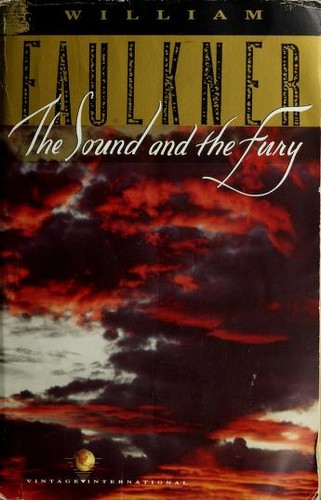
Shorter and faster than The Sound and the Fury, As I Lay Dying is often recommended as a better entry point into Faulkner's experimental work. It is still difficult — the shifting voices require patience, and Darl's increasingly surrealist late narration can be disorienting — but the momentum of the journey gives it a propulsion the earlier novel lacks. Readers who finish it tend to feel they've read something genuinely strange and genuinely true.
Talk to As I Lay Dying like its author wrote you back.
Get the ideas that fit your life — not generic summaries.
- Chat with the book
- Audiobook-style main ideas
- Adapts to your life and goals
- Helps you take action
Key takeaways
- 1.
The 59-narrator structure is not decoration — it is the argument: grief and death are experienced differently by every person in the room, and no single account adds up to the truth.
- 2.
Addie Bundren's chapter, delivered posthumously, is the novel's moral inversion: she speaks after death to explain how hollow the language of love and family has always felt to her. It reframes everything.
- 3.
Anse Bundren is one of American fiction's great comic grotesques: a man whose parasitism is so thorough he has constructed an entire moral framework around it. He never tills the soil because it gives him sweating sickness.
- 4.
The journey is presented with comic escalation — flood, fire, broken leg, vultures — that reads as dark comedy rather than tragedy. Faulkner understands that extremity and absurdity are close neighbors.
- 5.
Cash's obsessive craftsmanship (he counts the angles of each board aloud while dying) is the novel's only instance of a character whose work actually matches their inner state. He is strange, but he is not dishonest.
- 6.
Darl's breakdown and removal to the asylum in the novel's final third is the cost of seeing too clearly in a world that needs to keep moving. The Bundrens commit him partly to protect themselves.
- 7.
Dewey Dell's subplot — a pregnant woman in a world with no legal or practical access to abortion, navigating exploitation — is quietly devastating and rarely gets the attention it deserves.
- 8.
The novel ends with Anse remarrying, dentures in, within days of his wife's burial. Faulkner's last image is a deflation so complete it is almost a formal joke — and it holds.
Discussion questions
Use these on your own, with a book club, or as chat starters in Superbook. Book club version, ready to copy or print →
- 1.
Addie's posthumous chapter says that words like 'love' and 'motherhood' are violations of the reality they name. Does the novel agree with her, or is it showing us the limits of her perspective?
- 2.
The journey to Jefferson is undertaken for Addie's sake, but every family member has a private motive. At what point does legitimate private grief shade into self-interest?
- 3.
Anse is deeply unpleasant and never seems to suffer for it. Does the novel condemn him, tolerate him, or use him for something beyond characterization?
- 4.
Darl is the most literary narrator and the one who gets committed to an asylum. Is the novel suggesting that heightened perception is dangerous, or that his family simply needs a scapegoat?
- 5.
The dark comedy and the genuine grief coexist throughout. Did the comedy undermine the novel's emotional impact for you, or deepen it?
- 6.
Cash builds the coffin while Addie is dying, in her sight. Is this portrayed as love, obsession, obtuseness, or something that doesn't reduce to any of those?
- 7.
Dewey Dell never gets an abortion and is exploited by the pharmacist who pretends to help her. Does Faulkner treat this with the weight it deserves, or is it just another strand in the novel's tapestry of suffering?
- 8.
Vardaman says 'My mother is a fish.' This is the most famous line in the novel. What is Faulkner doing with it — a child's genuine confusion, a formal joke, or an argument about how we process the unprocessable?
- 9.
Compare this to The Sound and the Fury as Faulkner's experiments in multiple perspectives. Which do you find more successful, and which is harder to read?
- 10.
The ending — Anse with new teeth and a new wife — has been called one of literature's great deflations. Does it feel like the right ending, or does it trivialize what came before?
- 11.
The novel is set in the same Yoknapatawpha County as most of Faulkner's work. Does knowing this changes anything about how the Bundrens feel — are they part of a world or a world unto themselves?
- 12.
Addie says she punished her students physically to establish that she existed. What does the novel make of this — is she a sympathetic figure, a damaged one, or both?
Themes
Frequently asked questions
-
Is As I Lay Dying a good entry point to Faulkner?
Better than The Sound and the Fury for most readers. It is shorter (around 250 pages), has more narrative momentum, and the multiple-voice structure — though strange — is easier to orient yourself in because the physical journey gives it a shape. That said, it is still Faulkner: demanding, rewarding, not apologetic about being difficult.
-
Is it funny? People say it's funny.
Yes, genuinely. Anse is a great comic creation. Vardaman's fish logic is darkly absurd. The escalating catastrophes of the journey have a comedy-of-errors quality. But the comedy and the grief are entangled — one keeps interrupting the other, which is the point.
-
What is the most famous line and what does it mean?
'My mother is a fish.' Vardaman, the youngest son, catches a fish the same day his mother dies and cannot separate the two events cognitively. Faulkner presents this without irony as an instance of how the mind processes the unprocessable — by yoking it to something concrete.
-
Who shouldn't read it?
Readers who find unreliable, competing narrators frustrating rather than interesting. The novel never provides a stable outside perspective that reconciles the family members' different versions of events. If you need a narrator you can trust, this is the wrong book.
-
Was As I Lay Dying really written in six weeks?
Faulkner claimed to have written it in six weeks while working night shifts at a university power plant, writing on a wheelbarrow by coal shovel light. Whether entirely true or not, the story captures something real about how the novel feels — driven, compressed, written as if the author needed to get it out quickly.