Business · Book club
Bad Blood: Secrets and Lies in a Silicon Valley Startup book club questions
Here are 12 book club questions for Bad Blood: Secrets and Lies in a Silicon Valley Startup by John Carreyrou, ordered to open easily and end somewhere worth arguing about. Copy them, print them, or bring them up one at a time.
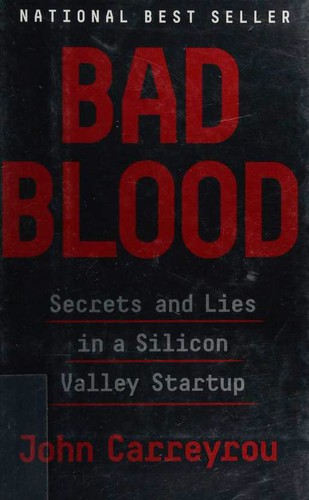
Bad Blood is Wall Street Journal reporter John Carreyrou's account of Theranos, the blood-testing startup founded by Elizabeth Holmes that claimed its proprietary technology could run hundreds of diagnostic tests from a single finger-prick of blood.
John Carreyrou · 2018 · 6h 0m
Full summary and key takeaways →The 12 questions
- 1.
Holmes told investors and the press what they wanted to hear for years. What features of Silicon Valley culture made that easier — and what made it harder to stop?
- 2.
The board included secretaries of state and a former defense secretary but no practicing physicians or clinical lab scientists. How should boards be composed when a company's core claim is technical?
- 3.
Several employees raised internal concerns and were fired or threatened. At what point does loyalty to a company stop being a virtue, and what would you have done in their position?
- 4.
Theranos's investors repeatedly skipped scientific due diligence because Holmes was compelling and the pitch was good. What does this suggest about how charisma functions in high-stakes decisions?
- 5.
Carreyrou describes a culture where employees learned not to share information across teams. Have you worked in an organization where internal secrecy made it hard to see problems clearly?
- 6.
Holmes argued, even after conviction, that she genuinely believed the technology would work. How much does intent matter when the harm to patients was real and documented?
- 7.
The phrase 'fake it till you make it' is widely accepted in startup culture. Where is the line between optimistic projection and fraud, and who gets to draw it?
- 8.
Tyler Shultz blew the whistle despite direct pressure from his grandfather, who was on the Theranos board. What does it take for someone to report wrongdoing when the personal costs are that high?
- 9.
Theranos targeted underserved patients who couldn't easily access traditional labs. The pitch was democratizing healthcare. How did a nominally progressive mission get used to deflect scrutiny?
- 10.
Journalists published glowing profiles of Holmes for years before Carreyrou's investigation. What should a reporter ask when a founder refuses to let experts examine the product?
- 11.
Balwani ran day-to-day operations through fear and public humiliation. What organizational conditions allow that kind of management style to persist unchallenged?
- 12.
Bad Blood ends with Holmes's fraud exposed but the structural conditions that enabled it largely unchanged. What would actually have to change in how we fund, regulate, and cover startups for this to be less likely?
How to run the discussion
- Pick six to eight, not all of them. An hour of real discussion covers fewer questions than anyone expects, and racing the list is what makes a book club feel like homework.
- Open with what people noticed, not what they concluded. Asking for a verdict first hardens opinions before anyone has heard each other.
- Let the disagreement run. The questions below that split a room are the ones worth the time; the ones everyone answers the same way can be skipped.
- Ask the quiet person a specific question. A direct, narrow question is far easier to answer than an open invitation to contribute.
Themes worth steering toward
If the conversation stalls, these are the threads that usually restart it.
Common questions
What are good book club questions for Bad Blood: Secrets and Lies in a Silicon Valley Startup?
Here are 12 book club questions for Bad Blood: Secrets and Lies in a Silicon Valley Startup by John Carreyrou, ordered to open easily and end somewhere worth arguing about. The strongest openers ask what each reader noticed rather than what they concluded, and the discussion usually turns on corporate fraud, silicon valley culture, investigative journalism.
How long should a book club discussion of Bad Blood: Secrets and Lies in a Silicon Valley Startup last?
Most groups run 60 to 90 minutes of actual discussion. That is roughly six to eight questions, not all of them, so pick the ones that suit your group rather than working down the list in order.
What are the main themes in Bad Blood: Secrets and Lies in a Silicon Valley Startup?
Corporate fraud, Silicon Valley culture, Investigative journalism, Deception, Startup mythology. Those are the threads most likely to divide a room, which makes them the useful places to steer a discussion that has gone quiet.
Picking the next one? See books like Bad Blood: Secrets and Lies in a Silicon Valley Startup or questions for other book club picks.
