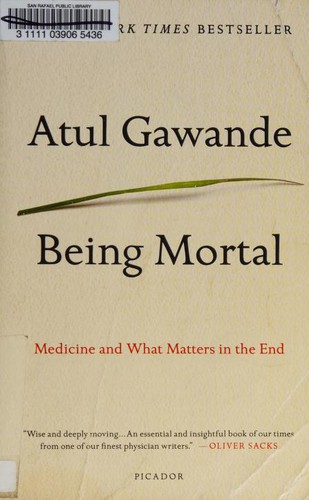
Talk to Being Mortal: Medicine and What Matters in the End like its author wrote you back.
Get the ideas that fit your life — not generic summaries.
- Chat with the book
- Audiobook-style main ideas
- Adapts to your life and goals
- Helps you take action
What it argues
Being Mortal is Atul Gawande's investigation into why modern medicine is so bad at helping people die well. Gawande is a surgeon, and the book starts from a personal frustration: despite years of training, he was never taught how to talk to dying patients about what they actually wanted. The medical system, he argues, was built to fight death, not accommodate it, and that orientation causes enormous suffering in the final months of life.
The book moves through three overlapping problems. The first is how we house the old and the frail. Gawande traces the history of nursing homes in America, showing how they evolved from poorhouses into medical institutions that prioritize safety and clinical efficiency over the things that actually make life worth living — autonomy, purpose, relationships with animals and children. He profiles Felix Mann, an assisted-living pioneer, and Bill Thomas, who transformed a nursing home in upstate New York by bringing in dogs, cats, and more than a hundred parakeets, and found that the residents' health and engagement improved. The second problem is how medicine handles terminal illness. Gawande follows several patients and their families through cancer diagnoses and treatment decisions, documenting how doctors default to offering more intervention even when it cannot cure and often shortens or degrades whatever time remains. The third is the conversation: what does a good death actually require, and how do you start that discussion without abandoning hope?
What it gets right
- 1.
Modern medicine treats death as a problem to be solved rather than a process to be navigated, and that default causes unnecessary suffering at the end of life.
- 2.
The nursing home model prioritizes safety and clinical metrics over the things that give life meaning — autonomy, purpose, and human connection.
- 3.
Research on terminal cancer patients shows that hospice and comfort-focused care often produces longer survival and better quality of life than aggressive treatment.
What it covers
Who wrote it
Atul Gawande is a surgeon, public health researcher, and staff writer at The New Yorker. He is the author of four books, including Complications, Better, and The Checklist Manifesto, the last of which helped transform how hospitals approach surgical safety worldwide. He has been a MacArthur Fellow and a practicing general and endocrine surgeon at Brigham and Women's Hospital in Boston. His writing consistently bridges clinical medicine and broader questions of how systems and individuals make decisions under uncertainty.
