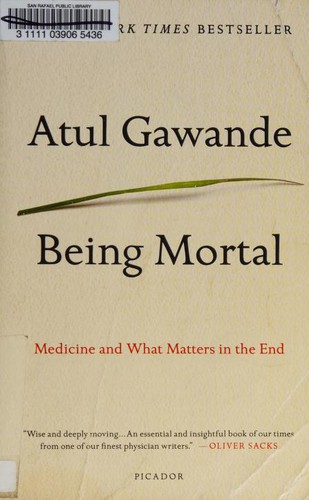
Being Mortal: Medicine and What Matters in the End by Atul Gawande is a 2014 health book about aging, end-of-life care, medicine. Modern medicine treats death as a problem to be solved rather than a process to be navigated, and that default causes unnecessary suffering at the end of life.
Summary
Being Mortal is Atul Gawande's investigation into why modern medicine is so bad at helping people die well. Gawande is a surgeon, and the book starts from a personal frustration: despite years of training, he was never taught how to talk to dying patients about what they actually wanted. The medical system, he argues, was built to fight death, not accommodate it, and that orientation causes enormous suffering in the final months of life.
The book moves through three overlapping problems. The first is how we house the old and the frail. Gawande traces the history of nursing homes in America, showing how they evolved from poorhouses into medical institutions that prioritize safety and clinical efficiency over the things that actually make life worth living — autonomy, purpose, relationships with animals and children. He profiles Felix Mann, an assisted-living pioneer, and Bill Thomas, who transformed a nursing home in upstate New York by bringing in dogs, cats, and more than a hundred parakeets, and found that the residents' health and engagement improved. The second problem is how medicine handles terminal illness. Gawande follows several patients and their families through cancer diagnoses and treatment decisions, documenting how doctors default to offering more intervention even when it cannot cure and often shortens or degrades whatever time remains. The third is the conversation: what does a good death actually require, and how do you start that discussion without abandoning hope?
Gawande's answer draws on hospice care and on the work of palliative medicine pioneers who discovered that when patients with terminal cancer chose comfort-focused care over aggressive chemotherapy, they not only had better quality of life but often lived longer. The evidence is counterintuitive but consistent: fighting to the end tends to produce more suffering, shorter survival, and worse deaths than honest conversations about priorities and limits.
The book's strength is its restraint. Gawande doesn't lecture about how to die correctly. He interviews patients, families, and physicians, and he turns the lens on his own failures — including a conversation with his father, also a physician, who was diagnosed with a spinal tumor. The result is a book that reads like a long piece of journalism: specific, uncomfortable, and harder to dismiss than an argument.
Talk to Being Mortal: Medicine and What Matters in the End like its author wrote you back.
Get the ideas that fit your life — not generic summaries.
- Chat with the book
- Audiobook-style main ideas
- Adapts to your life and goals
- Helps you take action
Key takeaways
- 1.
Modern medicine treats death as a problem to be solved rather than a process to be navigated, and that default causes unnecessary suffering at the end of life.
- 2.
The nursing home model prioritizes safety and clinical metrics over the things that give life meaning — autonomy, purpose, and human connection.
- 3.
Research on terminal cancer patients shows that hospice and comfort-focused care often produces longer survival and better quality of life than aggressive treatment.
- 4.
A good death requires honest conversation. Gawande identifies five questions every seriously ill person should be asked: What do you understand about your illness? What are your fears? What are your goals if your health worsens? What tradeoffs are you willing to make?
- 5.
Assisted living works better when it prioritizes residents' own priorities over institutional safety — even when that means accepting risks the family or staff find uncomfortable.
- 6.
Doctors are trained to present options but rarely to help patients articulate what matters most to them. That gap leads to families and physicians defaulting to more treatment even when patients would choose otherwise.
- 7.
The concept of a 'best case, worst case, most likely' framing helps patients understand prognosis without stripping away all hope.
- 8.
Felix Mann's assisted-living model and Bill Thomas's Eden Alternative both show that small interventions — real control over daily life, plants, animals, children — dramatically improve resident well-being in ways medication cannot.
Discussion questions
Use these on your own, with a book club, or as chat starters in Superbook. Book club version, ready to copy or print →
- 1.
Gawande argues that medicine's core mission — fighting disease — makes it structurally bad at helping people die well. Do you think that conflict is fixable, or is it built into how doctors are trained and hospitals are run?
- 2.
Have you ever watched someone close to you navigate a serious illness or end-of-life care? What worked, and what would you change in hindsight?
- 3.
Gawande's five questions for the seriously ill are remarkably specific. If you were told you had a terminal diagnosis, what would your honest answers be?
- 4.
The book argues that patients often choose aggressive treatment not because they want to live longer at any cost, but because they don't realize there's another option. Is that a failure of patients, families, doctors, or the system?
- 5.
What would it take for you to tell a doctor 'no more treatment, let's focus on comfort'? What fears would you need to overcome?
- 6.
Gawande describes nursing homes that are designed around institutional needs — staff schedules, liability, clinical safety — rather than residents' lives. What would you want your own environment to look like if you could no longer live independently?
- 7.
Bill Thomas brought animals and children into a nursing home and found measurable improvements in health outcomes. What does that experiment suggest about what humans need to stay alive and engaged?
- 8.
The hospice research Gawande cites shows that patients who chose comfort over aggressive chemotherapy lived longer on average. Why do you think that finding hasn't changed how oncologists typically present treatment options?
- 9.
Gawande admits his own failures in this area, including how he handled conversations with his dying father. What makes those conversations so hard to have even for people who know exactly what they should say?
- 10.
The book distinguishes between a 'safe death' and a 'good death.' What's the difference in your mind, and which would you want for yourself?
- 11.
Gawande writes about people who chose to forgo treatment to attend a grandchild's wedding or spend one last summer at home. What would your equivalent be — the thing that would make the time worth protecting?
- 12.
If you had a parent or close friend in declining health, how would you start a conversation about what they actually want? What would stop you from having it?
Themes
Frequently asked questions
-
Is Being Mortal worth reading if I'm not facing a terminal illness?
Yes. The book is as much about how we treat the elderly and how medicine makes decisions as it is about dying. Most readers find it reshapes how they think about aging parents, nursing homes, and the conversations they've been putting off. You don't need to be facing death to get a lot out of it.
-
How long does it take to read Being Mortal?
Around six hours at average reading pace for the roughly 280-page book. The chapters are structured around individual patients and families, so it reads more like narrative journalism than a self-help book and moves quickly despite the difficult subject matter.
-
What is the main argument of Being Mortal?
That modern medicine systematically fails people at the end of life because it's built to treat illness rather than support living with it. Gawande argues that honest conversations about priorities, combined with palliative and hospice care, produce better outcomes — including sometimes longer survival — than aggressive treatment pursued past the point of benefit.
-
Who should read Being Mortal?
Anyone with aging parents or grandparents, anyone working in medicine or eldercare, and anyone who has found themselves unable to have an honest conversation with a seriously ill family member. It's also a sharp read for policy thinkers interested in how healthcare systems shape the experience of dying.
-
What's the most actionable idea in the book?
Gawande's five questions for serious illness: What do you understand about where you are? What are your fears? What are your goals? What are you willing to trade off? What does a good day look like? Asking these before a crisis — or printing them out and giving them to a doctor — can change the entire arc of a person's final chapter.