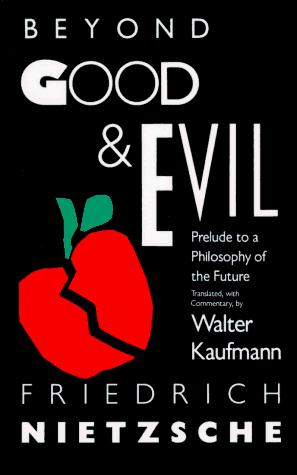
Beyond Good and Evil by Friedrich Nietzsche is a 1886 philosophy book about morality, power, truth. Philosophers' seemingly objective truths are often rationalizations of personal drives, cultural biases, and unexamined prejudices dressed in logical form.
Summary
Beyond Good and Evil is Nietzsche's assault on the philosophical tradition he had been trained in and had grown to distrust. Published in 1886, it reads as a critique of virtually every major thinker from Plato to Kant, and more broadly as an attack on the moral assumptions of 19th-century European culture. The title is programmatic: Nietzsche does not claim that good and evil don't exist, but that the opposition has been set up badly and needs to be broken apart before something more honest can emerge.
The book opens with Nietzsche questioning the will to truth itself. Why do we assume that truth is more valuable than illusion? Philosophers have smuggled in prejudices — about the value of consciousness, the reliability of introspection, the priority of altruism — and then called the results objective. Nietzsche calls this "dogmatism" and credits Plato as its founding figure. Much of the book is a catalog of how philosophers mistake their own drives and perspectives for universal truths.
The concept of the will to power runs through the work as a replacement for simpler notions of self-interest or pleasure-seeking. Life, on Nietzsche's view, is not primarily about self-preservation but about self-overcoming — the drive to discharge, expand, and impose form on material both internal and external. Morality, particularly the Christian-descended morality of pity and equality, is diagnosed as a will to power in disguise: the weak imposing their values on the strong by calling weakness "virtue."
The book's most famous sections concern the contrast between master morality and slave morality. Masters create values from a position of strength; slaves react to their masters by inverting the hierarchy and calling their own powerlessness "goodness." Nietzsche doesn't think modern Europeans are masters — he thinks the slave revolt in morality won, definitively, and that the task now is to think past that victory. Whether he offers a convincing alternative or merely a diagnosis remains one of the most contested questions in the entire philosophical tradition.
Talk to Beyond Good and Evil like its author wrote you back.
Get the ideas that fit your life — not generic summaries.
- Chat with the book
- Audiobook-style main ideas
- Adapts to your life and goals
- Helps you take action
Key takeaways
- 1.
Philosophers' seemingly objective truths are often rationalizations of personal drives, cultural biases, and unexamined prejudices dressed in logical form.
- 2.
The will to power is not the desire to dominate others but a fundamental drive toward growth, discharge of energy, and self-overcoming.
- 3.
Master morality values strength, nobility, and the capacity to create values; slave morality values meekness, pity, and equality as reactive inversions of powerlessness.
- 4.
The will to truth is itself a value choice, not a neutral given — we should ask what the belief in truth costs us and what it serves.
- 5.
European morality descends primarily from Christianity and has made 'herd' values — conformity, equality, pity — into the dominant framework, at the cost of excellence.
- 6.
The 'free spirit' is someone who has become suspicious of all received values and is willing to experiment with new ones at personal risk.
- 7.
Noble values do not emerge from reaction or resentment but from an affirmative sense of what is excellent and worth pursuing.
- 8.
The task after the death of God is to create new values rather than inherit and defer to the old ones.
Discussion questions
Use these on your own, with a book club, or as chat starters in Superbook. Book club version, ready to copy or print →
- 1.
Nietzsche claims philosophers have smuggled their own prejudices into their 'objective' arguments. Can you identify a moral belief you hold that might be a prejudice rather than a reasoned conclusion?
- 2.
The distinction between master and slave morality is one of the most influential and most disputed ideas in ethics. Does it describe anything you recognize in contemporary moral culture?
- 3.
Nietzsche says the will to truth is itself a value that needs justification. Do you think the pursuit of truth — in your own work or life — is always valuable? Are there things you'd rather not know?
- 4.
What would 'self-overcoming' mean in your own life, as distinct from self-improvement in the conventional sense?
- 5.
Nietzsche associates pity with weakness and calls it a problem. Is there a meaningful distinction between genuine compassion and the pity he criticizes?
- 6.
The book implies that modern democracy is an expression of slave morality. Is that a fair diagnosis of any aspect of democratic politics you see around you?
- 7.
Nietzsche thinks the 'free spirit' must become suspicious of all inherited values. Is that kind of radical skepticism liberating or destabilizing — or both?
- 8.
Beyond Good and Evil doesn't clearly specify what values should replace the ones it demolishes. Is that a flaw in the argument, or is the diagnosis the point?
- 9.
How would you describe the difference between Nietzsche's critique of morality and simple moral relativism — the view that all values are equally valid?
- 10.
Nietzsche is one of the most misappropriated thinkers in history, used to justify things he clearly didn't endorse. What in the text makes it so susceptible to misreading?
- 11.
The book argues that equality as a value is a form of leveling that suppresses excellence. Where in your own field do you see tension between equality and the cultivation of exceptional performance?
- 12.
What would it mean to create your own values rather than inherit them? Is that even possible, or does value-creation always depend on a tradition you're reacting against?
Themes
Frequently asked questions
-
What does Nietzsche mean by 'beyond good and evil'?
He is not saying good and evil don't exist, but that the traditional moral opposition needs to be dismantled and examined. Conventional morality rests on unexamined assumptions — about weakness, pity, equality — that Nietzsche wants to expose before anything more honest can be built.
-
Is Beyond Good and Evil worth reading?
Yes, if you can tolerate a thinker who rarely argues in the traditional sense and often proceeds by assertion and aphorism. The ideas about truth, morality, and power remain genuinely provocative. Read it with a guide or commentary if you're new to Nietzsche.
-
What is master morality vs slave morality?
Master morality originates in strength — the noble person defines what is good and then calls its opposite bad. Slave morality originates in resentment — the weak define the strong as evil and then call themselves good by contrast. Nietzsche thinks modern European ethics is primarily slave morality.
-
How should I read Nietzsche — literally or figuratively?
Both and neither. Nietzsche deliberately uses hyperbole and provocation as rhetorical tools. His claims should be taken as philosophical probes rather than literal propositions. The question is always: what does this force you to examine in your own assumptions?
-
What's the difference between Nietzsche and nihilism?
Nietzsche diagnoses nihilism — the collapse of all inherited values — as a real cultural problem. But he is not a nihilist. His project is to respond to nihilism by creating new values rather than collapsing into despair or clinging to old ones.