Psychology · Book club
Black Box Thinking book club questions
Here are 12 book club questions for Black Box Thinking by Matthew Syed, ordered to open easily and end somewhere worth arguing about. Copy them, print them, or bring them up one at a time.
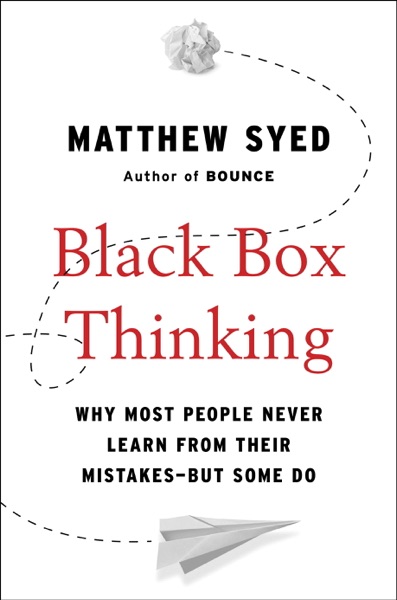
Black Box Thinking is Matthew Syed's argument that the difference between industries and organizations that improve over time and those that stagnate comes down to how they handle failure.
Matthew Syed · 2015 · 5h 45m
Full summary and key takeaways →The 12 questions
- 1.
Aviation and medicine are Syed's main contrasting cases. Do you think the comparison is fair? What institutional features make honest error reporting easier in aviation than medicine?
- 2.
Think of an organization you've worked in. How did it handle failure? Did the culture encourage honest reporting or punish it?
- 3.
Syed argues that cognitive dissonance is a major barrier to learning from failure. Can you recall a recent example where you or someone you know defended a decision that wasn't working rather than adjusting?
- 4.
The book advocates treating mistakes as data rather than verdicts. How do you actually do that in practice, especially when a mistake has real consequences for other people?
- 5.
Which industries besides aviation have built genuine learning-from-failure cultures? What structural features make that possible?
- 6.
The marginal gains philosophy involves identifying every small deficiency honestly. What would that look like applied to your own work or a project you're involved in?
- 7.
Syed is critical of medicine's error culture. Do you think that criticism is fair given the differences between aviation incidents and medical errors — scale, complexity, patient variation?
- 8.
What's the difference between a blame culture and genuine accountability? How do you hold people responsible without creating the fear that suppresses honest reporting?
- 9.
The growth mindset framing treats failure as informative. Is there a category of failure that is just failure — where the lesson is 'don't do this again' rather than 'here's what to iterate'?
- 10.
Syed uses sports examples extensively — cycling, soccer. Do those examples feel analogous to organizational failure, or are they in a different category?
- 11.
Black Box Thinking covers similar ground to The Checklist Manifesto and Being Mortal. If you've read either, where does Syed's argument add something new, and where does it overlap?
- 12.
What would a black box equivalent look like in your own professional domain — a mechanism that reliably captured every failure and made the information available for learning?
How to run the discussion
- Pick six to eight, not all of them. An hour of real discussion covers fewer questions than anyone expects, and racing the list is what makes a book club feel like homework.
- Open with what people noticed, not what they concluded. Asking for a verdict first hardens opinions before anyone has heard each other.
- Let the disagreement run. The questions below that split a room are the ones worth the time; the ones everyone answers the same way can be skipped.
- Ask the quiet person a specific question. A direct, narrow question is far easier to answer than an open invitation to contribute.
Themes worth steering toward
If the conversation stalls, these are the threads that usually restart it.
Common questions
What are good book club questions for Black Box Thinking?
Here are 12 book club questions for Black Box Thinking by Matthew Syed, ordered to open easily and end somewhere worth arguing about. The strongest openers ask what each reader noticed rather than what they concluded, and the discussion usually turns on failure and learning, growth mindset, systems thinking.
How long should a book club discussion of Black Box Thinking last?
Most groups run 60 to 90 minutes of actual discussion. That is roughly six to eight questions, not all of them, so pick the ones that suit your group rather than working down the list in order.
What are the main themes in Black Box Thinking?
Failure and learning, Growth mindset, Systems thinking, Aviation safety, Feedback loops. Those are the threads most likely to divide a room, which makes them the useful places to steer a discussion that has gone quiet.
Picking the next one? See books like Black Box Thinking or questions for other book club picks.
