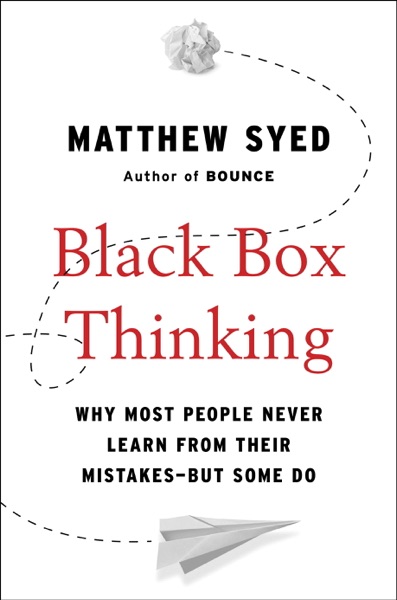
Black Box Thinking by Matthew Syed is a 2015 psychology book about failure and learning, growth mindset, systems thinking. Aviation's extraordinary safety record comes from a cultural and institutional commitment to learning from every failure, however small, without punishing honest reporting.
Summary
Black Box Thinking is Matthew Syed's argument that the difference between industries and organizations that improve over time and those that stagnate comes down to how they handle failure. The title comes from the flight recorder — the black box — that aviation authorities recover after every crash and use to systematically understand what went wrong. Aviation's remarkable safety record, Syed argues, is not primarily the result of better technology but of a cultural and institutional commitment to learning from every incident, near-miss, and accident without assigning blame that deters honest reporting.
Syed contrasts aviation with medicine, an industry with comparable stakes where errors are frequently covered up, where defensive medicine and professional hierarchy make honest reporting culturally difficult, and where the same mistakes recur because the feedback loops that would prevent them are never activated. The comparison is pointed and well-documented. Thousands of preventable deaths occur in hospitals annually, many of them traceable to errors that have killed patients before in the same setting.
The book's second argument is about the psychology of failure response. Syed draws on cognitive dissonance research to explain why individuals and organizations resist acknowledging their errors: admitting failure threatens identity, especially for people and institutions that have built their reputation on expertise. The solution is not more willpower against this tendency but reframing what failure means — treating every mistake as a data point in an evolving hypothesis about the world rather than a verdict on your character or competence.
Syed extends this argument into entrepreneurship, sports, and politics, with case studies ranging from David Beckham's practice regimen to the marginal gains philosophy that transformed British cycling. The book shares intellectual territory with Carol Dweck's growth mindset work and James Reason's research on human error, though Syed's approach is more journalistic and the aviation examples give it a vividness that more abstract treatments lack. The limitation is that the argument is simpler than the book's length suggests — many chapters make the same core point with new examples rather than genuinely advancing the analysis.
Talk to Black Box Thinking like its author wrote you back.
Get the ideas that fit your life — not generic summaries.
- Chat with the book
- Audiobook-style main ideas
- Adapts to your life and goals
- Helps you take action
Key takeaways
- 1.
Aviation's extraordinary safety record comes from a cultural and institutional commitment to learning from every failure, however small, without punishing honest reporting.
- 2.
Medicine, by contrast, has systematic barriers to learning from error: hierarchy, professional reputation, and blame cultures that make honest incident reporting costly.
- 3.
The 'black box' metaphor is about having reliable feedback loops. Organizations that thrive over time build mechanisms to capture and learn from failures; those that stagnate suppress the data.
- 4.
Cognitive dissonance explains why individuals and institutions resist acknowledging mistakes: admitting failure threatens identity, especially for experts who've built their credibility on being right.
- 5.
The growth mindset approach to failure treats every mistake as information — a data point in an evolving hypothesis — rather than as a verdict on ability or character.
- 6.
Marginal gains thinking, as applied in British cycling, aggregates small improvements systematically. The gains are only possible if the team is honest about every current deficiency.
- 7.
Blame cultures are epistemically costly. When people fear punishment for errors, they hide mistakes rather than reporting them, and the organization loses the information it needs to improve.
- 8.
The difference between high-performing and mediocre organizations often isn't starting capability — it's the speed and honesty of their feedback loops about what isn't working.
Discussion questions
Use these on your own, with a book club, or as chat starters in Superbook. Book club version, ready to copy or print →
- 1.
Aviation and medicine are Syed's main contrasting cases. Do you think the comparison is fair? What institutional features make honest error reporting easier in aviation than medicine?
- 2.
Think of an organization you've worked in. How did it handle failure? Did the culture encourage honest reporting or punish it?
- 3.
Syed argues that cognitive dissonance is a major barrier to learning from failure. Can you recall a recent example where you or someone you know defended a decision that wasn't working rather than adjusting?
- 4.
The book advocates treating mistakes as data rather than verdicts. How do you actually do that in practice, especially when a mistake has real consequences for other people?
- 5.
Which industries besides aviation have built genuine learning-from-failure cultures? What structural features make that possible?
- 6.
The marginal gains philosophy involves identifying every small deficiency honestly. What would that look like applied to your own work or a project you're involved in?
- 7.
Syed is critical of medicine's error culture. Do you think that criticism is fair given the differences between aviation incidents and medical errors — scale, complexity, patient variation?
- 8.
What's the difference between a blame culture and genuine accountability? How do you hold people responsible without creating the fear that suppresses honest reporting?
- 9.
The growth mindset framing treats failure as informative. Is there a category of failure that is just failure — where the lesson is 'don't do this again' rather than 'here's what to iterate'?
- 10.
Syed uses sports examples extensively — cycling, soccer. Do those examples feel analogous to organizational failure, or are they in a different category?
- 11.
Black Box Thinking covers similar ground to The Checklist Manifesto and Being Mortal. If you've read either, where does Syed's argument add something new, and where does it overlap?
- 12.
What would a black box equivalent look like in your own professional domain — a mechanism that reliably captured every failure and made the information available for learning?
Themes
Frequently asked questions
-
What is Black Box Thinking about?
It's about how organizations and individuals learn — or fail to learn — from their mistakes. Syed uses aviation's black box flight recorder as a metaphor for systematic failure analysis and contrasts it with industries like medicine where error is routinely concealed and the same mistakes recur.
-
Is Black Box Thinking worth reading if I've already read Mindset?
Partially. Both books make a version of the 'failure is information' argument. Syed adds the aviation/medicine contrast and the organizational culture dimension, which Dweck doesn't cover. If you've read Mindset, you can probably skim the chapters on individual psychology and focus on the institutional sections.
-
Who should read Black Box Thinking?
Leaders of teams and organizations, healthcare professionals, and anyone designing systems where mistakes have significant consequences. Also useful for individuals trying to build a more honest relationship with their own failures.
-
Is Matthew Syed's argument original?
The core argument draws substantially on existing research — Carol Dweck on growth mindset, James Reason on human error, Atul Gawande on medicine's error culture. Syed synthesizes and popularizes these ideas accessibly, but readers who've already engaged with the source material will find less that's new.
-
What's the most actionable idea in Black Box Thinking?
Building explicit feedback mechanisms into projects and processes — pre-mortems, after-action reviews, anonymous incident reporting — so that failures surface and can be analyzed rather than being quietly buried by people protecting their reputations.
Similar books

The Checklist Manifesto
Atul Gawande

Mindset: The New Psychology of Success
Carol S. Dweck

Range: Why Generalists Triumph in a Specialized World
David Epstein
Thinking, Fast and Slow
Daniel Kahneman
