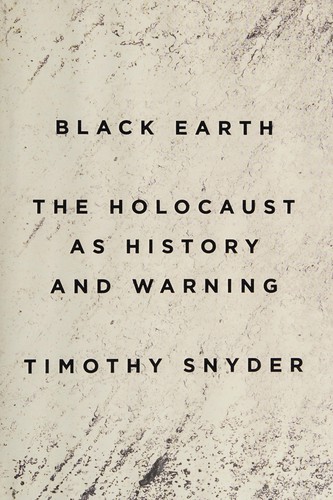
Black Earth: The Holocaust as History and Warning by Timothy Snyder is a 2015 history book about the holocaust, state destruction, ecology. Hitler's antisemitism was rooted not in race theory alone but in a theory of ecological competition: Jews were the enemy because they blocked Germany's access to the agricultural land it needed to survive.
Summary
Black Earth is Timothy Snyder's reinterpretation of the Holocaust that places it in an ecological and political framework rather than a strictly ideological one. Most histories of the Holocaust begin with Hitler's antisemitism and ask how it was operationalized. Snyder begins instead with Hitler's ideas about land, food, and geopolitical competition. For Hitler, Snyder argues, Jews were not primarily a racial category in the conventional sense but a political force that stood between the German nation and the land it needed to survive. The Holocaust was therefore not simply a product of racism but of a particular theory of politics in which the elimination of the legal and state structures that protected Jews was a precondition for seizing territory.
Snyder's central empirical finding is that the greatest proportion of Holocaust victims — about five of the six million — were killed in a zone of destroyed or double-occupied states: territories that had lost their sovereign institutions first to the Soviets and then to the Nazis. In these places, where no state structure remained to even formally protect Jews, mass murder was fastest and most complete. Countries that retained some form of state apparatus — Romania, Hungary, Bulgaria — killed Jews at lower rates, not out of greater virtue but because the institutional infrastructure had not been entirely destroyed.
The second argument is ecological and prospective. Hitler's vision, Snyder shows, was rooted in a Social Darwinist interpretation of imperial competition for arable land. The specific land Hitler coveted was Ukraine — the black earth of the title — which he described as Germany's version of what the American West was for the United States. This framing allowed him to use American conquest of native peoples as a model for what Germany should do in the east.
The book closes with a warning: the conditions that enabled the Holocaust — stateless zones, resource competition, ecological pressure, the collapse of institutions that protect minorities — are not unique to the 1930s and 1940s. Climate change, Snyder argues, will create new stateless zones and new resource pressures that could produce comparable violence in the future. This final section has been criticized as speculative, but it reflects Snyder's consistent concern with the Holocaust not merely as history but as a category of human possibility.
Talk to Black Earth: The Holocaust as History and Warning like its author wrote you back.
Get the ideas that fit your life — not generic summaries.
- Chat with the book
- Audiobook-style main ideas
- Adapts to your life and goals
- Helps you take action
Key takeaways
- 1.
Hitler's antisemitism was rooted not in race theory alone but in a theory of ecological competition: Jews were the enemy because they blocked Germany's access to the agricultural land it needed to survive.
- 2.
The Holocaust was fastest and most complete in zones of double occupation or destroyed statehood. Where no state survived to provide even formal protection, Jews were killed at the highest rates.
- 3.
State structures, even compromised or collaborationist ones, slowed killing. Their presence created institutional friction that perpetrators had to work around.
- 4.
The model for Nazi colonization in the east was, in Hitler's own thinking, the American conquest of indigenous peoples. The United States served as evidence that racial removal at scale was possible and produced a stable result.
- 5.
The specific territory Hitler coveted was Ukraine's black earth — the most fertile agricultural land in Europe. Control of this land was, in Hitler's view, the solution to Germany's geopolitical vulnerability.
- 6.
Local collaboration was essential. The destruction of state institutions left local populations without protection and created a population of local actors willing, for various reasons, to participate in killing.
- 7.
Holocaust memory has been distorted by the survival bias of Western European Jewish witnesses. The majority of victims were Eastern European Jews who left far fewer testimonies, and their deaths are less well remembered.
- 8.
The conditions that enabled the Holocaust — collapsed states, resource competition, the stripping away of legal protections for minorities — are not historically unique and can recur.
Discussion questions
Use these on your own, with a book club, or as chat starters in Superbook. Book club version, ready to copy or print →
- 1.
Snyder argues that Hitler's antisemitism was as much ecological and political as racial. Does this reframing change how you understand the Holocaust, or does it matter how we categorize the ideology behind it?
- 2.
Snyder's finding that destroyed statehood correlated with higher killing rates suggests that institutions protect minorities as a byproduct of their normal functions. What implications does this have for thinking about state failure and minority rights today?
- 3.
The book argues that American western expansion served as a model for Nazi colonialism. How should that comparison change how we think about American history and its relationship to European fascism?
- 4.
Snyder makes a prospective argument that climate change could create conditions for mass killing by destroying state structures and creating resource competition. Do you find this argument persuasive? What evidence would you want to see?
- 5.
How do we balance the historical specificity of the Holocaust with the need to draw lessons from it? Is there a point at which comparisons to the Holocaust become reductive or appropriative?
- 6.
Snyder places heavy emphasis on the role of destroyed institutions in enabling mass killing. Is this primarily a historical argument or also a normative one about what we should do to protect vulnerable populations today?
- 7.
The book's treatment of local collaboration in Ukraine and Poland is historically important but politically sensitive. How should historians handle evidence of local participation in genocide when it remains contested in national memory?
- 8.
Snyder's analysis focuses on political and ecological conditions rather than the psychology of perpetrators. Does this depersonalize mass murder in a way that is analytically useful, morally problematic, or both?
- 9.
Most of the Holocaust's victims were killed by shooting, not in camps. Why do you think the camp-centric image of the Holocaust became dominant in postwar memory?
- 10.
Black Earth was criticized for the speculative quality of its final argument about climate and future violence. When is historical analogy a legitimate analytical tool, and when does it overreach?
- 11.
Snyder argues that the Holocaust resulted from the elimination of legal and political barriers that protected Jews. Does the same logic apply to other genocides of the twentieth century?
- 12.
How does Black Earth change or complicate what you previously knew about the Holocaust?
Themes
Frequently asked questions
-
What is the main argument of Black Earth?
That the Holocaust should be understood not as the product of race theory alone but as the result of a combination of ecological competition ideology, the deliberate destruction of state institutions, and the creation of stateless zones where Jews had no legal or institutional protection.
-
How does Black Earth differ from Bloodlands?
Bloodlands covers the full range of Nazi and Soviet mass killing in Eastern Europe between 1933 and 1945. Black Earth focuses specifically on the Holocaust and provides a more detailed theoretical argument about why it happened — the ecological and political framework — and what it might warn us about.
-
Is Black Earth controversial among historians?
The central empirical argument about state destruction and killing rates has been widely accepted. The ecological and climate-change section in the final chapters has been more contested, with some critics finding the prospective argument speculative and a departure from the historical evidence.
-
Who should read Black Earth?
Readers with some prior knowledge of the Holocaust who want a deeper engagement with why it happened and where it actually occurred. It is particularly useful for understanding the Eastern European dimension of the Holocaust that is less covered in standard accounts.
-
How long does it take to read Black Earth?
Roughly seven to eight hours at an average reading pace. It is a full scholarly work, dense with historical detail, though Snyder writes clearly and avoids unnecessary jargon.