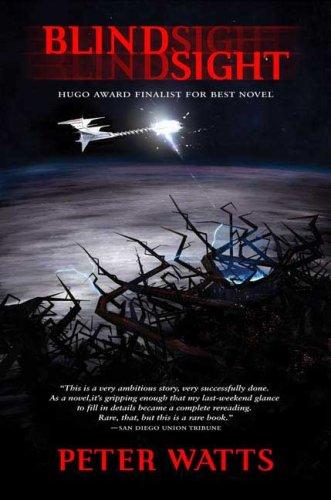
Talk to Blindsight like its author wrote you back.
Get the ideas that fit your life — not generic summaries.
- Chat with the book
- Audiobook-style main ideas
- Adapts to your life and goals
- Helps you take action
What it argues
Blindsight follows a crew of post-human specialists sent to intercept an alien object at the edge of the solar system in 2082. The narrator, Siri Keeton, is a man who had half his brain removed as a child — a surgical solution to epilepsy that left him functionally intelligent but emotionally disconnected, a kind of human camera observing others without truly participating in experience. The ship is commanded by a resurrected vampire — a predatory subspecies of humanity, cold and brilliant — and crewed by specialists whose humanity has been similarly modified or fractured.
What the book is actually about is consciousness: whether it's necessary, whether it's even real, and whether it might be an evolutionary dead end. The aliens they encounter may be extraordinarily intelligent yet entirely without inner experience — processing, reacting, communicating without anyone home. Watts draws on real neuroscience (the bibliography at the back is serious) to argue that consciousness could be an epiphenomenon, a byproduct of cognition rather than its driver. This is not a comfortable idea. It lands hardest when you start applying it to the narrator himself, and then to yourself.
What it gets right
- 1.
Consciousness may not be necessary for intelligence — the aliens in Blindsight process and respond at extraordinary levels without apparent inner experience, and Watts grounds this in real neuroscience.
- 2.
The narrator's split-brain history makes him the novel's central instrument: he observes everything and experiences nothing, which is either a disability or the clearest possible vision.
- 3.
Vampires as a resurrected predatory subspecies are handled rigorously — not as fantasy, but as an evolutionary argument about what cognitive architecture gets optimized for.
What it covers
Who wrote it
Peter Watts is a Canadian science fiction author and former marine biologist whose work is known for its rigorous engagement with neuroscience, evolutionary biology, and philosophy of mind. His debut novel Starfish launched the Rifters trilogy; Blindsight was his breakout work, winning the Hugo Award for short fiction in a related story and becoming one of the most discussed hard SF novels of its decade. His fiction is freely available on his website under Creative Commons, and he continues to write shorter work alongside novels.
