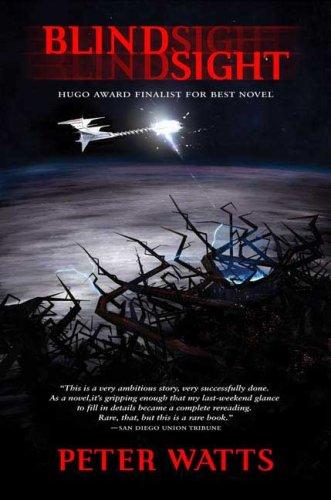
Blindsight by Peter Watts is a 2006 science fiction book about consciousness, first contact, identity and selfhood. Consciousness may not be necessary for intelligence — the aliens in Blindsight process and respond at extraordinary levels without apparent inner experience, and Watts grounds this in real neuroscience.
Summary
Blindsight follows a crew of post-human specialists sent to intercept an alien object at the edge of the solar system in 2082. The narrator, Siri Keeton, is a man who had half his brain removed as a child — a surgical solution to epilepsy that left him functionally intelligent but emotionally disconnected, a kind of human camera observing others without truly participating in experience. The ship is commanded by a resurrected vampire — a predatory subspecies of humanity, cold and brilliant — and crewed by specialists whose humanity has been similarly modified or fractured.
What the book is actually about is consciousness: whether it's necessary, whether it's even real, and whether it might be an evolutionary dead end. The aliens they encounter may be extraordinarily intelligent yet entirely without inner experience — processing, reacting, communicating without anyone home. Watts draws on real neuroscience (the bibliography at the back is serious) to argue that consciousness could be an epiphenomenon, a byproduct of cognition rather than its driver. This is not a comfortable idea. It lands hardest when you start applying it to the narrator himself, and then to yourself.
The prose is dense and technical in the best sense — Watts was a marine biologist before he was a novelist, and the book reads like hard SF should: demanding, rewarding, and uncondescending. The structure mirrors its themes. Siri narrates in retrospect, aboard a ship returning alone, which means the tension isn't about what happens but about whether meaning can be extracted from what happened. The footnotes and citations aren't decoration; they're load-bearing.
Blindsight is not for readers who want to like their characters or finish a book feeling resolved. It's for readers who want science fiction that operates at the level of philosophy of mind — who can sit with the possibility that the feeling of being someone might be an illusion the universe doesn't require. If that sounds like your kind of reading, very few novels go this deep.
Talk to Blindsight like its author wrote you back.
Get the ideas that fit your life — not generic summaries.
- Chat with the book
- Audiobook-style main ideas
- Adapts to your life and goals
- Helps you take action
Key takeaways
- 1.
Consciousness may not be necessary for intelligence — the aliens in Blindsight process and respond at extraordinary levels without apparent inner experience, and Watts grounds this in real neuroscience.
- 2.
The narrator's split-brain history makes him the novel's central instrument: he observes everything and experiences nothing, which is either a disability or the clearest possible vision.
- 3.
Vampires as a resurrected predatory subspecies are handled rigorously — not as fantasy, but as an evolutionary argument about what cognitive architecture gets optimized for.
- 4.
The book treats free will as a solved problem: your brain decides before you're conscious of deciding. The philosophical vertigo this creates is the point.
- 5.
First contact here is not about communication or wonder — it's about threat assessment and the terror of encountering something that has no framework for you at all.
- 6.
The retrospective narrative structure means Siri is telling you a story he may not be equipped to understand. What he leaves out is as important as what he includes.
- 7.
Watts uses hard science — split-brain experiments, blindsight phenomena, evolutionary psychology — not as backdrop but as argument. The novel is a philosophical position dressed as fiction.
- 8.
The ending doesn't resolve; it radiates. The question of what Siri has understood, or whether understanding is even possible for him, is left entirely open.
Discussion questions
Use these on your own, with a book club, or as chat starters in Superbook. Book club version, ready to copy or print →
- 1.
Watts's central argument is that consciousness might be an evolutionary liability rather than an advantage. Does the novel persuade you, or does it feel like motivated nihilism?
- 2.
Siri describes himself as a 'Chinese Room' — processing language and behavior without genuine understanding. Does the novel ultimately agree with him, or is it showing us that he's wrong about himself?
- 3.
The vampires are cold, brilliant, and predatory. Does Sarasti read as a character to you, or as a philosophical thought experiment wearing a character's shape?
- 4.
The crew members have all modified or fractured their humanity in different ways. Is the novel suggesting this is the next step, or a cautionary catalogue of what's lost?
- 5.
Rorschach — the alien structure — resists interpretation throughout. How did you read the aliens' behavior by the end? Hostile? Indifferent? Something else?
- 6.
Watts argues the aliens may have intelligence without consciousness. Does that distinction matter to you morally? Would it change how you'd treat them?
- 7.
The retrospective narration means we know Siri survives but don't know what he understood. Did you trust him as a narrator? At what point did his reliability start to feel uncertain?
- 8.
The novel is heavily footnoted with real science. Did that apparatus make the philosophical claims more or less unsettling — does grounding in reality help or does it just make it worse?
- 9.
Compared to a first-contact story like Contact by Carl Sagan, where does Blindsight land harder — and what does the difference say about how each author thinks about intelligence?
- 10.
By the end, do you think the crew's mission was a success, a failure, or simply the wrong question?
- 11.
If consciousness is indeed an epiphenomenon — if your sense of making decisions is an after-the-fact story your brain tells — does that change how you think about responsibility or choice?
- 12.
Watts has said the novel is a horror story about what we might find out about ourselves. Did it read as horror to you, or as something else?
Themes
Frequently asked questions
-
Is Blindsight hard to read?
Yes, deliberately so. The prose is dense, the neuroscience is real and requires engagement, and the narrator is by design an unreliable lens. It rewards slow reading and sitting with discomfort. Readers who want clarity or resolution will struggle. Readers who like their fiction to make serious philosophical demands will find it one of the most rewarding genre novels around.
-
What is Blindsight about, without spoilers?
A post-human crew travels to the edge of the solar system to make first contact with an alien object. The real subject is consciousness: whether it exists, whether it's necessary, and whether the humans aboard are as conscious as they think they are.
-
Why is Blindsight considered a classic of hard SF?
It takes the neuroscience of consciousness seriously as a scientific problem and builds its entire plot and theme around current (and contested) theories. The bibliography is real. Most SF uses science as backdrop; Blindsight uses it as argument.
-
Who shouldn't read Blindsight?
Readers who need likable characters, warm emotional arcs, or satisfying resolutions. The book is deliberately cold, its characters are deliberately broken, and it ends on questions rather than answers. It's a bleak and brilliant experience, not a comforting one.
-
Is there a sequel?
Yes — Echopraxia (2014), set in the same universe, continues some threads. It's considered nearly as strong, though more structurally conventional. Watts also wrote The Things, a short story retelling The Thing from a Watts-ian consciousness perspective, which is widely anthologized.