Literary fiction · Book club
Blood Meridian book club questions
Here are 12 book club questions for Blood Meridian by Cormac McCarthy, ordered to open easily and end somewhere worth arguing about. Copy them, print them, or bring them up one at a time.
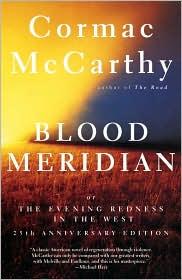
Blood Meridian, or The Evening Redness in the West is set along the Texas-Mexico border in the 1840s and loosely follows a teenage runaway known only as the kid, who falls in with the Glanton gang — a historical band of scalp hunters hired by the Mexican government to kill Apache raiders.
Cormac McCarthy · 1985 · 8h 0m
Full summary and key takeaways →The 12 questions
- 1.
Judge Holden argues that war is god, and that those who worship something else are merely waiting to find out. Does the novel endorse this view, or is it simply allowing him to speak?
- 2.
The kid has moments where he seems to resist. Are those moments meaningful, or does McCarthy show they change nothing? Does the novel think moral hesitation matters?
- 3.
The Glanton gang's victims include people the novel doesn't name or individualize. Is that a failure of moral imagination or a deliberate technique — and what does it achieve?
- 4.
McCarthy drew from historical sources. Knowing the Glanton gang was real changes the reading — does it make the novel more or less bearable? More or less important?
- 5.
The prose style is almost liturgical at times — biblical rhythm applied to mass murder. What does that tonal juxtaposition accomplish? Is it earned?
- 6.
Harold Bloom called Blood Meridian the greatest American novel of the second half of the twentieth century. What would you have to believe about fiction to agree with that?
- 7.
The novel never provides a clear moral framework. Is the absence of judgment the point, or does McCarthy lose something by refusing to take a position?
- 8.
The ending is notoriously opaque. What do you think happens, and does it matter?
- 9.
Blood Meridian is often read alongside the Western genre — John Ford, Louis L'Amour, the mythology of the frontier. What does it do to that mythology?
- 10.
The Judge seems to know he is being watched, observed, even written. Is he a character, or something else — an idea, a force, a metafictional figure?
- 11.
How does this novel compare to McCarthy's Border Trilogy (which starts with All the Pretty Horses) in terms of tone and moral vision?
- 12.
Can you name the last time you read violence depicted with this precision? What is the effect of McCarthy's refusal to look away?
How to run the discussion
- Pick six to eight, not all of them. An hour of real discussion covers fewer questions than anyone expects, and racing the list is what makes a book club feel like homework.
- Open with what people noticed, not what they concluded. Asking for a verdict first hardens opinions before anyone has heard each other.
- Let the disagreement run. The questions below that split a room are the ones worth the time; the ones everyone answers the same way can be skipped.
- Ask the quiet person a specific question. A direct, narrow question is far easier to answer than an open invitation to contribute.
Themes worth steering toward
If the conversation stalls, these are the threads that usually restart it.
Common questions
What are good book club questions for Blood Meridian?
Here are 12 book club questions for Blood Meridian by Cormac McCarthy, ordered to open easily and end somewhere worth arguing about. The strongest openers ask what each reader noticed rather than what they concluded, and the discussion usually turns on violence and human nature, manifest destiny, fate and free will.
How long should a book club discussion of Blood Meridian last?
Most groups run 60 to 90 minutes of actual discussion. That is roughly six to eight questions, not all of them, so pick the ones that suit your group rather than working down the list in order.
What are the main themes in Blood Meridian?
Violence and human nature, Manifest destiny, Fate and free will, Nihilism, History as slaughter. Those are the threads most likely to divide a room, which makes them the useful places to steer a discussion that has gone quiet.
Picking the next one? See books like Blood Meridian or questions for other book club picks.
