History · Book club
Bloodlands: Europe Between Hitler and Stalin book club questions
Here are 12 book club questions for Bloodlands: Europe Between Hitler and Stalin by Timothy Snyder, ordered to open easily and end somewhere worth arguing about. Copy them, print them, or bring them up one at a time.
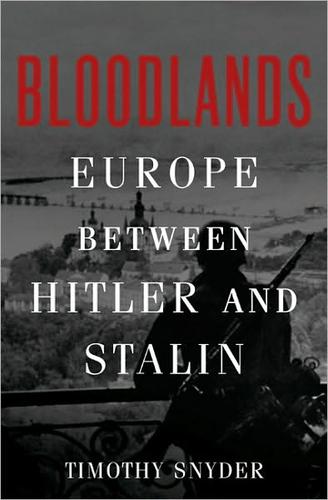
Bloodlands is Timothy Snyder's account of the territories between Nazi Germany and the Soviet Union — principally Poland, Ukraine, Belarus, and the Baltic states — where the two regimes' violence overlapped between 1933 and 1945.
Timothy Snyder · 2010 · 7h 30m
Full summary and key takeaways →The 12 questions
- 1.
Snyder argues that studying Nazi and Soviet violence separately distorts both histories. What do we gain and what do we risk by comparing them so directly?
- 2.
The Holodomor is sometimes called a genocide and sometimes described as a man-made famine. What does the distinction matter, practically and morally?
- 3.
Snyder shows that the perpetrators of mass murder were often ordinary people — local police, farmers, administrators. What does this suggest about the conditions that enable mass killing?
- 4.
Most Holocaust victims were shot rather than gassed. Why do you think the camp-centric image of the Holocaust became dominant in postwar memory, and what does that emphasis miss?
- 5.
How should nations that participated in or witnessed mass killing — Poland, Ukraine, Germany — construct public memory of events in which their own citizens were both victims and perpetrators?
- 6.
Snyder ends many chapters with individual names and stories. Why does this technique matter in a book that is otherwise about aggregate statistics?
- 7.
The two regimes cooperated under the Molotov-Ribbentrop Pact from 1939 to 1941. How does this cooperation complicate the standard narrative of World War II as a war between fascism and its opponents?
- 8.
Snyder describes a competition between two ideologies for control of the same people and land. In what ways did this competition intensify the violence, and in what ways did ideology provide cover for older patterns of ethnic conflict?
- 9.
The bloodlands are now independent states. How does the history Snyder describes shape politics and national identity in Ukraine, Poland, and the Baltic states today?
- 10.
What are the risks of writing history that emphasizes perpetrators and methods rather than survivors' experiences? What are the risks of the opposite approach?
- 11.
Snyder argues that numbers without names are dangerous. Do you agree? Is there a point at which the emphasis on individual stories obscures patterns that only statistics can reveal?
- 12.
The deliberate starvation of Soviet prisoners of war killed roughly 3.3 million men. This is less well known than other elements of the Second World War. Why do some mass deaths receive sustained historical attention while others are obscured?
How to run the discussion
- Pick six to eight, not all of them. An hour of real discussion covers fewer questions than anyone expects, and racing the list is what makes a book club feel like homework.
- Open with what people noticed, not what they concluded. Asking for a verdict first hardens opinions before anyone has heard each other.
- Let the disagreement run. The questions below that split a room are the ones worth the time; the ones everyone answers the same way can be skipped.
- Ask the quiet person a specific question. A direct, narrow question is far easier to answer than an open invitation to contribute.
Themes worth steering toward
If the conversation stalls, these are the threads that usually restart it.
Common questions
What are good book club questions for Bloodlands: Europe Between Hitler and Stalin?
Here are 12 book club questions for Bloodlands: Europe Between Hitler and Stalin by Timothy Snyder, ordered to open easily and end somewhere worth arguing about. The strongest openers ask what each reader noticed rather than what they concluded, and the discussion usually turns on mass killing, totalitarianism, state violence.
How long should a book club discussion of Bloodlands: Europe Between Hitler and Stalin last?
Most groups run 60 to 90 minutes of actual discussion. That is roughly six to eight questions, not all of them, so pick the ones that suit your group rather than working down the list in order.
What are the main themes in Bloodlands: Europe Between Hitler and Stalin?
Mass killing, Totalitarianism, State violence, World War II, Memory. Those are the threads most likely to divide a room, which makes them the useful places to steer a discussion that has gone quiet.
Picking the next one? See books like Bloodlands: Europe Between Hitler and Stalin or questions for other book club picks.
