Health · Book club
Born to Run book club questions
Here are 12 book club questions for Born to Run by Christopher McDougall, ordered to open easily and end somewhere worth arguing about. Copy them, print them, or bring them up one at a time.
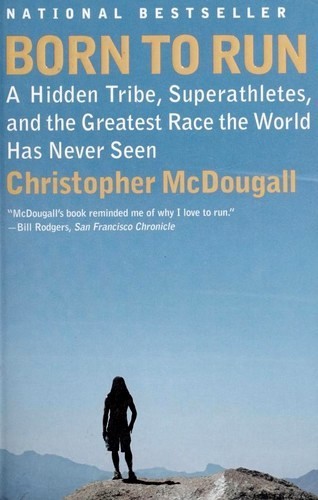
Born to Run begins as a personal injury investigation.
Christopher McDougall · 2009 · 5h 15m
Full summary and key takeaways →The 12 questions
- 1.
McDougall argues that most runners are injured not by bad luck but by bad form enabled by bad shoes. Does that framing change how you think about your own movement or exercise injuries?
- 2.
The Tarahumara run as a communal, joyful activity. How does that contrast with the way running or exercise is typically framed in the cultures most readers come from?
- 3.
Caballo Blanco gives up a conventional life to live in a canyon and run. At what point does obsession with a physical practice become wisdom rather than dysfunction?
- 4.
Lieberman's persistence-hunting hypothesis suggests our bodies are built for something most modern humans almost never do. What else in your daily life might be misaligned with what your body or mind evolved for?
- 5.
The running-shoe industry has spent decades telling runners they need more cushioning and support. How do you evaluate expert claims when the experts have a commercial interest in one answer?
- 6.
McDougall is a journalist who becomes a true believer. Where in the book do you think his reporting ends and his advocacy begins? Does it matter?
- 7.
Scott Jurek credits much of his performance to a plant-based diet and mental approach. How much weight do you give to mindset in physical performance compared to physiology and training?
- 8.
The book was criticized for romanticizing the Tarahumara and presenting them as a simpler, purer culture. Is that a fair critique? How should Western writers approach indigenous subjects?
- 9.
The barefoot running wave that followed this book caused its own wave of stress fractures. What does that tell you about how people read prescriptive nonfiction, and how do you guard against it?
- 10.
Ann Trason and the elite ultrarunners in the book are barely known outside their subculture despite feats that would be celebrated in any mainstream sport. Why do you think that is?
- 11.
McDougall describes the runner's high as something more profound than a neurochemical blip — a state that can sustain communities and mark rites of passage. Have you ever experienced movement as something beyond exercise?
- 12.
If running is genuinely a human birthright that modern life has suppressed, what else might belong in that category? What activities or capacities do most adults abandon without noticing?
How to run the discussion
- Pick six to eight, not all of them. An hour of real discussion covers fewer questions than anyone expects, and racing the list is what makes a book club feel like homework.
- Open with what people noticed, not what they concluded. Asking for a verdict first hardens opinions before anyone has heard each other.
- Let the disagreement run. The questions below that split a room are the ones worth the time; the ones everyone answers the same way can be skipped.
- Ask the quiet person a specific question. A direct, narrow question is far easier to answer than an open invitation to contribute.
Themes worth steering toward
If the conversation stalls, these are the threads that usually restart it.
Common questions
What are good book club questions for Born to Run?
Here are 12 book club questions for Born to Run by Christopher McDougall, ordered to open easily and end somewhere worth arguing about. The strongest openers ask what each reader noticed rather than what they concluded, and the discussion usually turns on running, human endurance, barefoot movement.
How long should a book club discussion of Born to Run last?
Most groups run 60 to 90 minutes of actual discussion. That is roughly six to eight questions, not all of them, so pick the ones that suit your group rather than working down the list in order.
What are the main themes in Born to Run?
Running, Human endurance, Barefoot movement, Ultramarathon, Evolution. Those are the threads most likely to divide a room, which makes them the useful places to steer a discussion that has gone quiet.
Picking the next one? See books like Born to Run or questions for other book club picks.
