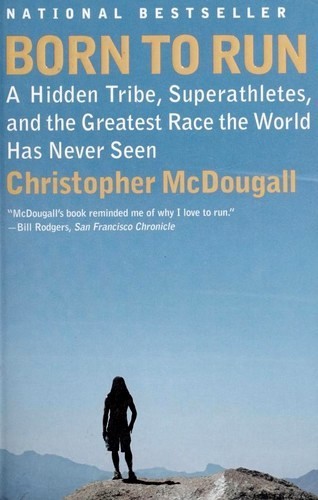
Born to Run by Christopher McDougall is a 2009 health book about running, human endurance, barefoot movement. Humans evolved as persistence hunters: our anatomy — upright posture, Achilles tendons, gluteus maximus, sweat glands — is specifically adapted for long-distance running, not sprinting.
Summary
Born to Run begins as a personal injury investigation. Christopher McDougall, a journalist and recreational runner, keeps getting hurt despite following conventional training advice, so he sets out to find the Tarahumara, a reclusive tribe in Mexico's Copper Canyon who routinely run hundred-mile distances in sandals made from tire rubber and appear to do it without injury. What starts as a magazine assignment becomes a two-year obsession that leads him through barefoot running science, evolutionary biology, and the subculture of American ultramarathons.
The book's central argument, drawn partly from Harvard biologist Daniel Lieberman's research, is that humans evolved as persistence hunters — we are uniquely built for long-distance running in ways most modern runners undermine with cushioned shoes. McDougall contends that thick-soled running shoes encourage heel striking, which sends impact forces up the leg on every stride, while barefoot or minimally shod runners tend to land on the midfoot and forefoot, absorbing impact through muscle and tendon rather than bone and cartilage. The implication is uncomfortable for the $3 billion running-shoe industry: the technology sold as injury prevention may be part of the injury problem.
The narrative unfolds around a climactic race McDougall helps organize in the Copper Canyon, pitting a group of elite American ultrarunners — including the eccentric Caballo Blanco, who had been living among the Tarahumara for years — against the tribe's best runners. The cast of Americans includes Ann Trason, Scott Jurek, and a handful of other figures from the cult world of 100-mile races. McDougall writes them with energy and specificity, and the canyon race itself, when it finally arrives, is genuinely suspenseful. The Tarahumara sections give the book an anthropological texture that separates it from typical sports narrative.
The science is real but selectively presented. Lieberman's persistence-hunting research is solid; the blanket case against running shoes has been more contested since the book's publication, with subsequent studies producing mixed results on barefoot running injury rates. McDougall is a journalist, not a researcher, and he argues with the enthusiasm of a convert. Readers looking for a comprehensive review of the biomechanics literature will be disappointed. But as a piece of adventure journalism that happens to reframe how millions of people think about running, it is hard to argue with the results. The book inspired a wave of minimalist running and sold a more important idea alongside it: that running is not punishment, and that joy and speed are not opposites.
Talk to Born to Run like its author wrote you back.
Get the ideas that fit your life — not generic summaries.
- Chat with the book
- Audiobook-style main ideas
- Adapts to your life and goals
- Helps you take action
Key takeaways
- 1.
Humans evolved as persistence hunters: our anatomy — upright posture, Achilles tendons, gluteus maximus, sweat glands — is specifically adapted for long-distance running, not sprinting.
- 2.
Heel striking, encouraged by thick-soled running shoes, generates impact forces that travel straight up the skeleton. Midfoot and forefoot landing, typical of unshod runners, routes that force through muscle and tendon.
- 3.
The Tarahumara of Mexico's Copper Canyon run hundred-mile distances through old age on minimal footwear and a diet centered on corn and chia, with low rates of the chronic injuries that plague Western recreational runners.
- 4.
Cushioned running shoes may not prevent injuries. Harvard biologist Daniel Lieberman's research suggests the modern running shoe, invented in the 1970s, coincided with the rise of most common running injuries rather than their decline.
- 5.
Joy matters. The Tarahumara run in groups, with singing, dancing, and tesguino beer. McDougall argues that play and social connection are part of what makes ultra-distance running sustainable across a lifetime.
- 6.
Caballo Blanco — an American dropout living in the Copper Canyon — represents the book's thesis embodied: a man who shed modern gear and competitive ego and found he could run farther and feel better than he ever had in his structured training years.
- 7.
Scott Jurek's dominance in ultramarathons, achieved on a plant-based diet and a philosophy of running as a spiritual practice, challenges assumptions about what elite athletic performance requires.
- 8.
The minimal-shoe movement McDougall helped ignite later produced its own injury wave as runners transitioned too fast. The book's deeper lesson — run with better form rather than more cushion — was more durable than the barefoot trend it sparked.
Discussion questions
Use these on your own, with a book club, or as chat starters in Superbook. Book club version, ready to copy or print →
- 1.
McDougall argues that most runners are injured not by bad luck but by bad form enabled by bad shoes. Does that framing change how you think about your own movement or exercise injuries?
- 2.
The Tarahumara run as a communal, joyful activity. How does that contrast with the way running or exercise is typically framed in the cultures most readers come from?
- 3.
Caballo Blanco gives up a conventional life to live in a canyon and run. At what point does obsession with a physical practice become wisdom rather than dysfunction?
- 4.
Lieberman's persistence-hunting hypothesis suggests our bodies are built for something most modern humans almost never do. What else in your daily life might be misaligned with what your body or mind evolved for?
- 5.
The running-shoe industry has spent decades telling runners they need more cushioning and support. How do you evaluate expert claims when the experts have a commercial interest in one answer?
- 6.
McDougall is a journalist who becomes a true believer. Where in the book do you think his reporting ends and his advocacy begins? Does it matter?
- 7.
Scott Jurek credits much of his performance to a plant-based diet and mental approach. How much weight do you give to mindset in physical performance compared to physiology and training?
- 8.
The book was criticized for romanticizing the Tarahumara and presenting them as a simpler, purer culture. Is that a fair critique? How should Western writers approach indigenous subjects?
- 9.
The barefoot running wave that followed this book caused its own wave of stress fractures. What does that tell you about how people read prescriptive nonfiction, and how do you guard against it?
- 10.
Ann Trason and the elite ultrarunners in the book are barely known outside their subculture despite feats that would be celebrated in any mainstream sport. Why do you think that is?
- 11.
McDougall describes the runner's high as something more profound than a neurochemical blip — a state that can sustain communities and mark rites of passage. Have you ever experienced movement as something beyond exercise?
- 12.
If running is genuinely a human birthright that modern life has suppressed, what else might belong in that category? What activities or capacities do most adults abandon without noticing?
Themes
Frequently asked questions
-
Is Born to Run worth reading if I'm not a runner?
Yes. The running science is the spine of the book, but the actual experience of reading it is adventure journalism — eccentric characters, a remote canyon, and a race built from scratch. Non-runners routinely finish it and find themselves wanting to go for a jog, which says something about how the book is written.
-
How long does it take to read Born to Run?
Around five hours at average reading pace. The chapters are short and propulsive, alternating between reportage and race narrative. Most readers find it hard to put down once the canyon storyline picks up in the second half.
-
What is Born to Run's main argument about running shoes?
That thick-soled shoes with cushioned heels encourage a heel-strike gait that amplifies impact forces on the skeleton, and that the rise of the modern running shoe in the 1970s corresponded with a rise in common running injuries rather than a reduction. The book doesn't argue you should run barefoot; it argues you should run with better form.
-
Who are the Tarahumara and why does the book focus on them?
The Tarahumara, or Rarámuri, are an indigenous group in Mexico's Copper Canyon who have maintained a tradition of long-distance running for centuries. McDougall uses them as evidence that humans can run extraordinary distances without injury when they run in a way consistent with how human feet evolved, on minimal footwear and with forefoot landing.
-
Did the barefoot running trend from this book actually work?
Mixed results. Biomechanists largely confirmed that forefoot landing is gentler on joints than heel striking. But the wave of runners who ditched their shoes or switched to minimalist footwear abruptly saw high rates of stress fractures. The transition needs to be slow. The book's form argument held up better than the gear prescription.
-
Who should read Born to Run?
Runners dealing with chronic injuries who want a different frame for why. Anyone interested in evolutionary biology applied to everyday movement. Readers who like adventure journalism in remote places. And people who think they hate running — the book makes a credible case that the version of running most people do and hate is not the only version.
Similar books
Wild: From Lost to Found on the Pacific Crest Trail
Cheryl Strayed
Breath: The New Science of a Lost Art
James Nestor
Why We Sleep
Matthew Walker
Grit: The Power of Passion and Perseverance
Angela Duckworth
