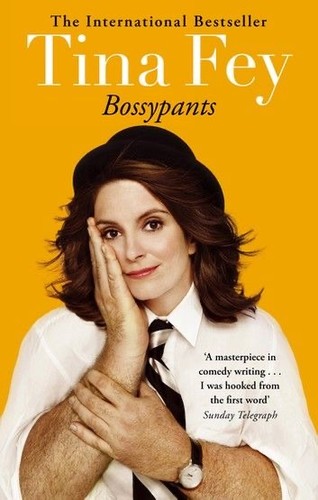
Bossypants by Tina Fey is a 2011 memoir book about comedy, women in entertainment, leadership. The rules of improv — agree and add, don't block, make your partner look good — are also rules for functional collaboration that most professional environments violate constantly.
Summary
Bossypants is Tina Fey's memoir and comic essay collection about her upbringing in suburban Pennsylvania, her years doing improv comedy in Chicago, her time as a writer and head writer at Saturday Night Live, her creation of 30 Rock, and the experience of being a woman in charge in show business. It's structured loosely as autobiography but functions as a series of observations, jokes, and arguments, many of them about what happens when women hold power in environments that weren't designed for them.
The career narrative is genuinely interesting. Fey writes about learning improv at Second City, getting hired at SNL as one of the few women in the writers' room, working her way to head writer, and eventually creating a show that ran for seven seasons. The behind-the-scenes detail about how SNL actually works — the week structure, the read-through process, the specific chaos of live television — is some of the best material in the book. The chapters on her Sarah Palin impression and the attention it brought are sharp and self-aware about the double-edged nature of that kind of viral fame.
The book's sharpest observations concern the specific tax placed on women in professional comedy. Fey writes about being told early and often that women aren't funny, about navigating rooms where she was expected to laugh at things she didn't find funny, and about the particular experience of being "the first woman to" anything, which sounds like recognition but usually means you're doing the work while others wait to see if you'll fail. She's funny about this, which makes it land harder than a straight critique would.
Bossypants is uneven — some chapters are funnier than others, and the memoir-writing impulse occasionally yields to filler. But the sections on improv culture, on the experience of being a female executive, and on the specific texture of Fey's childhood are genuinely good. The book holds up as a comedy memoir and as a document of what it cost to build the career she built.
Talk to Bossypants like its author wrote you back.
Get the ideas that fit your life — not generic summaries.
- Chat with the book
- Audiobook-style main ideas
- Adapts to your life and goals
- Helps you take action
Key takeaways
- 1.
The rules of improv — agree and add, don't block, make your partner look good — are also rules for functional collaboration that most professional environments violate constantly.
- 2.
Being 'the first woman to' do something in an institution is often less about honor than about proving a concept for others while the risk falls entirely on you.
- 3.
Fey's model of confidence is practical: you act confident, you deliver results, and the feeling eventually follows. Waiting to feel confident before acting is a luxury most careers don't allow.
- 4.
Comedy writers' rooms, like many creative environments, have clear status hierarchies. Navigating them requires being willing to be funny in ways that don't protect you.
- 5.
The question 'Is she difficult?' is almost never asked about men in the same role. Fey names this directly and examines what it costs women who are called difficult versus those who aren't.
- 6.
Beauty standards for women in entertainment are not incidental. They're enforced through casting, makeup calls, and the assumption that appearance is the first thing an audience evaluates.
- 7.
Having children while running a show is written about honestly: the guilt, the logistics, and the specific absurdity of being asked whether you can 'have it all' when the question is never asked of fathers.
- 8.
Apology is gendered. Women apologize reflexively for taking up space; men rarely do. Fey is self-aware about the habit and skeptical of its value.
Discussion questions
Use these on your own, with a book club, or as chat starters in Superbook. Book club version, ready to copy or print →
- 1.
Fey argues that improv rules are rules for good collaboration. Which of those rules — say yes, make your partner look good, don't block — would improve a team dynamic you're currently in?
- 2.
She writes about being told women aren't funny, an assertion she eventually stopped trying to disprove and started simply ignoring. What received wisdom have you stopped arguing with and started ignoring?
- 3.
The chapters on SNL's read-through process describe a brutal weekly evaluation. How do you handle that kind of recurring public judgment in your own work?
- 4.
Fey describes her confidence as performed before it was felt. Has that ever worked for you? What was the cost when it didn't?
- 5.
What does it mean to you that she was the first female head writer at SNL in 2000, not 1975? Does the timing change how you read the story?
- 6.
The book is funny about the specific absurdity of beauty demands on women in television. How visible are those demands in fields you know well?
- 7.
Fey is ambivalent about the Sarah Palin impression — it made her famous for something that wasn't quite her best work. Have you ever had a success that felt like the wrong kind?
- 8.
She's candid about the difficulty of parenting while running a show and skeptical of the 'having it all' framing. What would an honest version of that conversation look like, without the platitudes?
- 9.
The question 'Is she difficult?' rarely gets asked of men in authority. When and where have you seen that double standard operate?
- 10.
Fey says she learned more from bad bosses than good ones. What did your worst professional experience actually teach you?
- 11.
The book is about building a career that required being underestimated and then proving the estimators wrong. Is there a more efficient path? Would you have taken it?
- 12.
What's the difference between confidence that's earned through results and confidence that's performed until results follow? Is one more reliable than the other?
Themes
Frequently asked questions
-
Is Bossypants worth reading?
Yes, particularly if you're interested in comedy, the inner workings of Saturday Night Live, or what it takes to build a career in a field where your gender is treated as a liability. Fey is genuinely funny throughout, and the book has real things to say beyond its entertainment value.
-
How long does it take to read Bossypants?
Around five hours at average reading pace. The chapters are short and move quickly. It's the kind of book that's easy to read in a single long session or spread across a weekend.
-
What is Bossypants mainly about?
Fey's path from suburban Pennsylvania through Second City and SNL to creating 30 Rock, threaded with observations about women in professional comedy, the specific demands placed on female executives, and the texture of live television production.
-
How does Bossypants compare to Yes Please by Amy Poehler?
Both are comic memoir collections by women who came up through improv, and they share themes around ambition and the entertainment industry. Bossypants is slightly tighter and more focused on the professional narrative; Yes Please is more essayistic and personal. Reading one after the other is worthwhile.
-
Who should read Bossypants?
Fans of Fey's work, people interested in how Saturday Night Live actually operates, women navigating authority in professional environments, and anyone who wants a funny, honest account of building a creative career against institutional headwinds.