Biography · Book club
Boyd: The Fighter Pilot Who Changed the Art of War book club questions
Here are 12 book club questions for Boyd: The Fighter Pilot Who Changed the Art of War by Robert Coram, ordered to open easily and end somewhere worth arguing about. Copy them, print them, or bring them up one at a time.
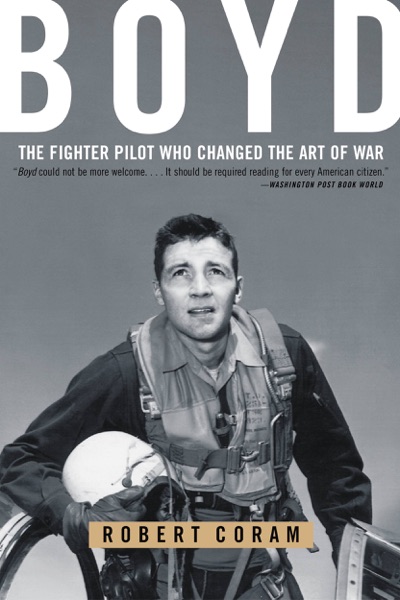
Boyd is Robert Coram's biography of Colonel John Boyd, the Air Force fighter pilot who became one of the most influential military strategists of the twentieth century without ever having commanded a major unit, written a best-selling book, or achieved the rank that would have made him famous while alive.
Robert Coram · 2002 · 8h 40m
Full summary and key takeaways →The 12 questions
- 1.
Boyd chose to give away his ideas rather than publish them, protecting his ability to think and revise rather than defend a fixed text. What are the trade-offs of that approach to intellectual work?
- 2.
The Air Force spent much of Boyd's career trying to manage him out. What does that institutional pattern tell us about how large organizations relate to unconventional thinkers?
- 3.
The OODA loop is often reduced to a simple cycle. What is lost when it is presented that way, and why do you think people keep oversimplifying it?
- 4.
Boyd's energy-maneuverability theory was developed against official resistance on government time he was not supposed to be using. How do you think about the ethics of that kind of unauthorized work?
- 5.
Boyd's concept of orientation — the mental models that shape how you process what you observe — is the loop's most important element. What does examining your own orientation reveal about your assumptions?
- 6.
Maneuver warfare focuses on disrupting the enemy's decision cycle rather than destroying their forces. How does that principle apply outside of military contexts — in business competition, in organizational design?
- 7.
Coram argues that Boyd traded advancement for impact. Is that trade-off real, or is it a romanticized version of what actually happened to a difficult person?
- 8.
Boyd's briefings ran for fifteen hours. What does that choice — refusing to compress or publish — say about how he thought his ideas should be transmitted?
- 9.
The Gulf War is cited as a validation of Boyd's maneuver warfare doctrine. Does a single historical event validate a strategic theory, or does that create a false sense of certainty?
- 10.
Boyd's personal life was genuinely difficult — he was absent, demanding, and financially irresponsible to his family. How do you hold that alongside the intellectual achievement?
- 11.
Which institutions in your own field most resemble the Air Force bureaucracy Boyd fought — resistant to unconventional thinking, organized to protect the status quo?
- 12.
Boyd never commanded a major unit and never led troops in sustained combat. Does that undermine his authority as a strategist, or is that framing itself part of the institutional thinking he was arguing against?
How to run the discussion
- Pick six to eight, not all of them. An hour of real discussion covers fewer questions than anyone expects, and racing the list is what makes a book club feel like homework.
- Open with what people noticed, not what they concluded. Asking for a verdict first hardens opinions before anyone has heard each other.
- Let the disagreement run. The questions below that split a room are the ones worth the time; the ones everyone answers the same way can be skipped.
- Ask the quiet person a specific question. A direct, narrow question is far easier to answer than an open invitation to contribute.
Themes worth steering toward
If the conversation stalls, these are the threads that usually restart it.
Common questions
What are good book club questions for Boyd: The Fighter Pilot Who Changed the Art of War?
Here are 12 book club questions for Boyd: The Fighter Pilot Who Changed the Art of War by Robert Coram, ordered to open easily and end somewhere worth arguing about. The strongest openers ask what each reader noticed rather than what they concluded, and the discussion usually turns on military strategy, innovation, decision-making.
How long should a book club discussion of Boyd: The Fighter Pilot Who Changed the Art of War last?
Most groups run 60 to 90 minutes of actual discussion. That is roughly six to eight questions, not all of them, so pick the ones that suit your group rather than working down the list in order.
What are the main themes in Boyd: The Fighter Pilot Who Changed the Art of War?
Military strategy, Innovation, Decision-making, Institutional resistance, Systems thinking. Those are the threads most likely to divide a room, which makes them the useful places to steer a discussion that has gone quiet.
Picking the next one? See books like Boyd: The Fighter Pilot Who Changed the Art of War or questions for other book club picks.
