Philosophy · Book club
Breaking the Spell: Religion as a Natural Phenomenon book club questions
Here are 12 book club questions for Breaking the Spell: Religion as a Natural Phenomenon by Daniel C. Dennett, ordered to open easily and end somewhere worth arguing about. Copy them, print them, or bring them up one at a time.
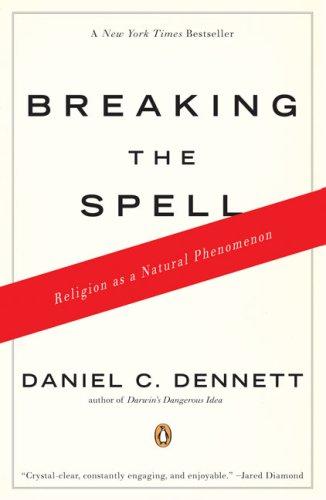
Breaking the Spell is Daniel Dennett's case that religion is a natural phenomenon — one that can and should be studied using the methods of evolutionary biology, cognitive science, and anthropology.
Daniel C. Dennett · 2006 · 8h 45m
Full summary and key takeaways →The 12 questions
- 1.
Dennett says that studying religion scientifically is not inherently disrespectful. Do you agree? Where does the line fall between analysis and desecration?
- 2.
He argues that the persistence of religion is better explained by evolution and cognitive bias than by truth. Does an explanation of why we believe something affect whether we think the belief is justified?
- 3.
What is a genuine benefit religion has provided in your community or family? Does identifying that benefit require accepting any theological claim?
- 4.
Dennett proposes that children should receive a neutral education about world religions before any religious initiation. Is that feasible, and is it actually neutral?
- 5.
He distinguishes folk religion from doctrinal religion. Which of those does he actually engage with, and which should he engage with more?
- 6.
The meme framework suggests religions spread because they are good at spreading, not because they are true. Does that frame feel illuminating or reductive to you?
- 7.
If the community and comfort functions of religion could be provided by secular institutions, would that weaken the case for religion? Why or why not?
- 8.
Dennett says religious moderates provide cover for extremists by making faith itself culturally untouchable. Do you find that argument persuasive?
- 9.
How does Dennett's treatment of religion compare to how he'd want evolution or climate science to be treated? Is the comparison apt?
- 10.
What would it mean for a religious institution to meet the transparency standards Dennett thinks are appropriate? Which institutions already come close?
- 11.
He worries about stealth religion in public policy. Can you identify a recent example where religious assumptions shaped a secular-seeming debate?
- 12.
Is there anything Breaking the Spell cannot explain about religion? What would a refutation of his framework need to show?
How to run the discussion
- Pick six to eight, not all of them. An hour of real discussion covers fewer questions than anyone expects, and racing the list is what makes a book club feel like homework.
- Open with what people noticed, not what they concluded. Asking for a verdict first hardens opinions before anyone has heard each other.
- Let the disagreement run. The questions below that split a room are the ones worth the time; the ones everyone answers the same way can be skipped.
- Ask the quiet person a specific question. A direct, narrow question is far easier to answer than an open invitation to contribute.
Themes worth steering toward
If the conversation stalls, these are the threads that usually restart it.
Common questions
What are good book club questions for Breaking the Spell: Religion as a Natural Phenomenon?
Here are 12 book club questions for Breaking the Spell: Religion as a Natural Phenomenon by Daniel C. Dennett, ordered to open easily and end somewhere worth arguing about. The strongest openers ask what each reader noticed rather than what they concluded, and the discussion usually turns on religion, evolution, naturalism.
How long should a book club discussion of Breaking the Spell: Religion as a Natural Phenomenon last?
Most groups run 60 to 90 minutes of actual discussion. That is roughly six to eight questions, not all of them, so pick the ones that suit your group rather than working down the list in order.
What are the main themes in Breaking the Spell: Religion as a Natural Phenomenon?
Religion, Evolution, Naturalism, Science of belief, Philosophy of mind. Those are the threads most likely to divide a room, which makes them the useful places to steer a discussion that has gone quiet.
Picking the next one? See books like Breaking the Spell: Religion as a Natural Phenomenon or questions for other book club picks.
