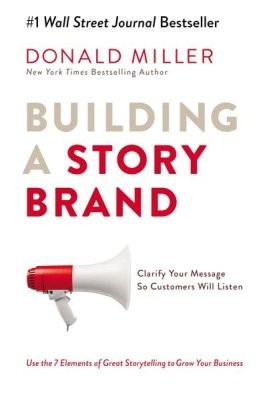
Building a StoryBrand by Donald Miller is a 2017 business book about marketing, branding, storytelling. Most companies position themselves as the hero of their marketing. The most effective brand messaging positions the customer as the hero and the company as the guide.
Summary
Building a StoryBrand is Donald Miller's argument that most companies fail at marketing because they communicate from the wrong perspective. They talk about themselves — their history, their values, their expertise — rather than positioning the customer as the hero of a story in which the company plays a supporting role. Miller's framework, called SB7, borrows from Joseph Campbell's hero's journey and applies it systematically to brand messaging.
The SB7 framework has seven elements: a Character (the customer, not the company), a Problem (what the customer is up against, broken into external, internal, and philosophical dimensions), a Guide (the company, positioned as a wise and empathetic advisor like Yoda, not the hero like Luke), a Plan (the steps the customer takes to solve the problem), a Call to Action (both a direct and transitional CTA), Avoiding Failure (what is at stake if the customer doesn't act), and Achieving Success (the transformation the customer experiences). The most important shift is from company-as-hero to company-as-guide, which Miller argues most brands resist because it requires humility.
Miller is explicit that most company websites fail the "grunt test": a caveman who stumbles onto the site should be able to understand in five seconds what the company offers, how it improves their life, and what to do to buy it. Most websites are so filled with internal language, abstract values, and navigation complexity that they fail this test badly. The StoryBrand framework is partly a diagnostic — revealing why messaging doesn't work — and partly a prescription for fixing it.
The book is accessible and moves quickly, with a workshop-style structure that walks readers through completing their own one-line BrandScript as they go. Some of the narrative framework is oversimplified, and more sophisticated marketing situations — B2B enterprise, regulated industries, international markets — require adaptation. But the core insight, that clarity beats cleverness in brand communication, is genuinely useful and frequently ignored.
Talk to Building a StoryBrand like its author wrote you back.
Get the ideas that fit your life — not generic summaries.
- Chat with the book
- Audiobook-style main ideas
- Adapts to your life and goals
- Helps you take action
Key takeaways
- 1.
Most companies position themselves as the hero of their marketing. The most effective brand messaging positions the customer as the hero and the company as the guide.
- 2.
The SB7 framework: Character, Problem, Guide, Plan, Call to Action, Failure, and Success. The seven elements structure a brand narrative that customers can immediately understand and engage with.
- 3.
Customer problems have three levels: external (the surface problem), internal (the feeling it creates), and philosophical (the injustice of the situation). Addressing all three resonates more deeply than addressing only the external.
- 4.
The grunt test: a caveman should understand what you offer, how it improves their life, and what to do next within five seconds of landing on your website. Most websites fail this test.
- 5.
Guides are empathetic and authoritative. They demonstrate that they understand the hero's problem and have the credentials to help solve it. Companies that skip empathy feel arrogant; companies that skip authority feel unsure.
- 6.
A clear Call to Action is not optional. If you don't tell customers exactly what to do next, most won't figure it out themselves. Both direct (buy now) and transitional (download a guide) CTAs have value.
- 7.
What's at stake if the customer doesn't solve the problem? Customers make decisions based on avoiding failure, not only on achieving success. Both stakes must be named clearly.
- 8.
Clarity always beats cleverness. Clever taglines that require interpretation lose customers who are scanning rather than reading. Simple, specific language wins.
Discussion questions
Use these on your own, with a book club, or as chat starters in Superbook. Book club version, ready to copy or print →
- 1.
Miller says most companies make themselves the hero of their marketing. Look at a company you work with or follow closely — is it making the customer the hero or itself the hero?
- 2.
The external-internal-philosophical problem framework is one of the most useful parts of the book. What are the three levels of the problem your product or service solves?
- 3.
What would it take to pass the grunt test with your current brand materials? What would you cut, clarify, or rewrite?
- 4.
Miller argues that positioning as a guide requires both empathy and authority. What signals communicate empathy in marketing, and which ones communicate authority? Can both coexist in a single message?
- 5.
What is your transitional call to action — the step between 'found you' and 'ready to buy'? How does it nurture customers who aren't ready to commit immediately?
- 6.
The SB7 framework assumes a single hero with a single problem. How do you adapt it for products with multiple buyer personas or complex B2B selling with multiple stakeholders?
- 7.
Miller's failure stakes: he says customers make decisions to avoid failure, not just to achieve success. Is that true in your market? What are the specific failure stakes your customers care most about?
- 8.
StoryBrand is designed for website and marketing copy. How well does the framework apply to sales conversations, pitch decks, or internal communications?
- 9.
What does success look like for your customer after they use your product or service? Miller argues that the transformation — not the product — is what you should be selling.
- 10.
Miller says clarity beats cleverness. Where have you seen clever marketing that obscured rather than communicated? What was the cost?
- 11.
Some brands are built on mystery, exclusivity, or complexity rather than clarity. Does the StoryBrand framework apply in those cases, or are there markets where clarity is not the right strategy?
Themes
Frequently asked questions
-
Is Building a StoryBrand worth reading?
Yes, especially if your marketing materials are cluttered with internal language and your website fails the grunt test. The framework is simple enough to apply immediately and concrete enough to produce a usable BrandScript in a few hours.
-
What is the StoryBrand BrandScript?
A one-page summary of your brand narrative in the SB7 framework: your customer (character), their problem, your guide positioning, your plan for them, your call to action, the failure they're avoiding, and the success they're achieving. It serves as the source document for all marketing copy.
-
Does Building a StoryBrand work for B2B companies?
Yes, with adaptation. B2B buyers still respond to clear problem framing and a guide positioning. The challenge is that B2B often has multiple stakeholders who care about different problems. Miller's later work addresses this, but the base framework requires adjustment for complex enterprise sales.
-
What is the grunt test?
A diagnostic Miller recommends for websites: could a caveman stumble on your site and understand in five seconds what you offer, how it improves their life, and what to do to buy it? Most websites are too cluttered with internal language to pass this test.
-
How long does Building a StoryBrand take to read?
Around four hours. Miller writes in a conversational style and includes workshop exercises throughout. Many readers work through the BrandScript exercise as they read, which adds time but produces an immediately useful output.
Similar books
This Is Marketing: You Can't Be Seen Until You Learn to See
Seth Godin
Obviously Awesome
April Dunford

Contagious: Why Things Catch On
Jonah Berger
Purple Cow: Transform Your Business by Being Remarkable
Seth Godin
