Purple Cow: Transform Your Business by Being Remarkable by Seth Godin is a 2003 business book about marketing, innovation, differentiation. The old marketing model — average product plus mass advertising — is broken because people have learned to ignore advertising they didn't ask for.
Summary
Purple Cow is Seth Godin's argument that the era of traditional marketing — mass advertising, interruption, and promotion — is effectively over, and that the only reliable route to growth is making something so remarkable that people talk about it without being paid to. The title comes from a thought experiment: driving through the countryside, you'd be amazed by a purple cow. But even an extraordinary cow becomes invisible once you've seen enough of them. Remarkable products earn attention once; ordinary products never earn it at all.
Godin's diagnosis is that the old model — make an average product, buy advertising, reach enough people, profit — is broken because people have learned to ignore advertising they didn't ask for, and because every mass channel has become saturated. The solution is not better advertising. The solution is making the product, service, or experience itself worth talking about. Remarkable is not a marketing strategy layered on top of a mediocre product — it is the product.
The book is structured as a collection of short chapters and case studies rather than a single sustained argument. Godin profiles companies that found their purple cow — JetBlue, Apple, Starbucks — and dissects what made them remarkable. He is deliberately vague about how to find your own purple cow, arguing that the search is contextual and that specific advice would itself become ordinary. The framework is: find the spectrum of possible products in your market, go to the edge of it, design something so specific and so extreme that it compels conversation.
Purple Cow is short, accessible, and genuinely motivating. Its limitation is that it is more diagnostic than prescriptive — Godin is clear about the problem and convincing about why ordinary products fail, but the path to remarkable is left largely to the reader. For execution frameworks, readers will need to look elsewhere. As a mindset shift, particularly for businesses that have been trying to out-advertise their way to growth, it remains one of the clearest statements of why that doesn't work.
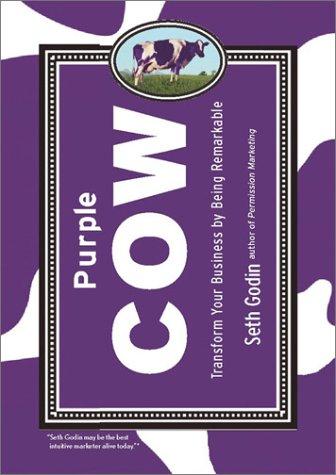
Talk to Purple Cow: Transform Your Business by Being Remarkable like its author wrote you back.
Get the ideas that fit your life — not generic summaries.
- Chat with the book
- Audiobook-style main ideas
- Adapts to your life and goals
- Helps you take action
Key takeaways
- 1.
The old marketing model — average product plus mass advertising — is broken because people have learned to ignore advertising they didn't ask for.
- 2.
Remarkable is the only reliable strategy. Products that are worth talking about earn word of mouth; products designed to be safe earn silence.
- 3.
The purple cow metaphor: ordinary is invisible, even if extraordinary was once astonishing. The only way to cut through noise is to design something genuinely unexpected.
- 4.
Marketing is no longer something you add after the product is designed — it must be baked into the product itself. If the product is not remarkable, no marketing budget will compensate.
- 5.
Target the early adopters, the sneezers — the people who care intensely and tell others. They carry your message to the mainstream; advertising cannot do what they do.
- 6.
Safe is risky. Designing a product to offend no one means it interests no one. The brands that try to appeal to everyone end up remarkable to no one.
- 7.
Finding the purple cow requires going to the edges of your market — the most expensive version, the most convenient version, the most opinionated version — not the average of what already exists.
- 8.
Otaku — the Japanese word for consumers who are obsessively passionate about something — are the engine of remarkable spread. Design for people who care too much, not for people who are mildly interested.
Discussion questions
Use these on your own, with a book club, or as chat starters in Superbook. Book club version, ready to copy or print →
- 1.
Godin says safe is risky. Where in your own work or business are you defaulting to ordinary because the remarkable option feels too risky?
- 2.
Think of a product or service in your field that is genuinely remarkable — not just good, but conversation-worthy. What specifically makes it so?
- 3.
Godin argues that remarkable should be baked into the product, not bolted on as a marketing strategy. Can you name a company that bolted on remarkable after the fact successfully?
- 4.
Who are the sneezers in a market you're familiar with? How do you reach them, and what makes them willing to spread something?
- 5.
The purple cow that earns attention today becomes ordinary tomorrow. How do you keep making the cow purple as your market adapts?
- 6.
What does 'remarkable' mean for a B2B product or service with a small, specialized audience? Does it look different from consumer remarkable?
- 7.
Godin says you should target the edges, not the middle. In a market you know, what would the extreme version of the product look like, and who would it be for?
- 8.
What organizational pressures push companies toward ordinary products? How do you fight them?
- 9.
Godin wrote Purple Cow in 2003. Has social media changed the dynamics he describes, or reinforced them?
- 10.
What's the difference between being remarkable and being gimmicky? Where have you seen companies cross that line?
- 11.
Is there a market where ordinary is the best strategy — where being unremarkable is actually a competitive advantage? What would that market look like?
Themes
Frequently asked questions
-
Is Purple Cow worth reading?
Yes, especially if you're marketing a product by trying to out-advertise competitors or if you're building something safe to avoid offending anyone. The mindset shift is the value — it's short enough that the time investment is low.
-
How long does Purple Cow take to read?
About two to three hours. The chapters are very short, often a page or two. It reads more like a collection of connected essays than a single sustained argument.
-
What is the main point of Purple Cow?
That ordinary products are invisible in a world saturated with advertising, and that the only reliable path to growth is making something so specific and unexpected that the right people talk about it without being paid to.
-
Does Purple Cow tell you how to be remarkable?
Mostly no, by design. Godin argues that specific prescriptions become ordinary quickly and that the remarkable solution is context-dependent. The book is better at diagnosing the problem than prescribing the solution.
-
How does Purple Cow relate to Godin's other books?
Permission Marketing addressed advertising before Purple Cow. This Is Marketing is his most comprehensive treatment of the same themes, published fifteen years later with more nuance. Purple Cow remains the sharpest single statement of the core argument.
Similar books
This Is Marketing: You Can't Be Seen Until You Learn to See
Seth Godin

Contagious: Why Things Catch On
Jonah Berger
Blue Ocean Strategy
W. Chan Kim and Renée Mauborgne
Crossing the Chasm
Geoffrey A. Moore
