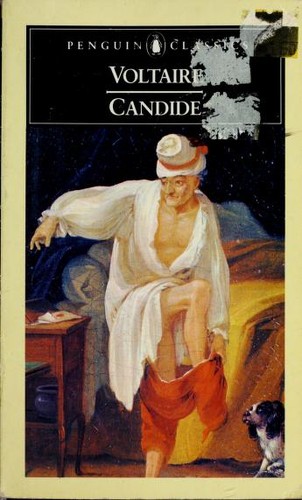
Talk to Candide like its author wrote you back.
Get the ideas that fit your life — not generic summaries.
- Chat with the book
- Audiobook-style main ideas
- Adapts to your life and goals
- Helps you take action
What it argues
Candide is a young man raised in a Westphalian castle on the philosophy of his tutor Pangloss: that everything is for the best in the best of all possible worlds. Over the course of about 150 pages, Voltaire subjects this proposition to a relentless empirical test. Candide is expelled from the castle, pressed into an army, survives a massacre, finds Pangloss in hideous condition from syphilis, witnesses the Lisbon earthquake (an actual 1755 catastrophe that killed tens of thousands), is flogged by the Inquisition, flees to the Americas, discovers and loses Eldorado, survives the Atlantic slave trade as an observer, is robbed, attacked, and otherwise catastrophized at a pace of roughly one disaster per page. At each turn, Pangloss insists the situation is optimal.
Voltaire is attacking Leibniz's philosophical optimism — the doctrine that this is the best of all possible worlds because God created it — but the satire reaches well beyond a single philosopher. The Inquisition, Jesuit missionaries, colonial exploitation, the Wars of the Austrian Succession, human slavery, and aristocratic privilege all receive treatment. The pace is farcical; the content is horrific; the gap between those registers is the satirical engine. Characters are killed and revived; the same people appear by improbable coincidences; logic is applied to monstrous conclusions with serene composure. This is Swift's mode, applied with French rationalist efficiency.
What it gets right
- 1.
Pangloss's optimism — 'all is for the best in the best of all possible worlds' — is the novel's punching bag, but Voltaire's target is not Leibniz specifically so much as any philosophical system that explains away present suffering by reference to a larger benevolent design.
- 2.
The pace is the argument. By refusing to dwell on any single atrocity, Voltaire implies that suffering is not episodic but systemic — the world's baseline condition, not an exception.
- 3.
The Lisbon earthquake, which killed approximately forty thousand people in 1755, was a genuine philosophical crisis for optimism in eighteenth-century Europe. Candide is the literary response to that event.
What it covers
Who wrote it
Voltaire (François-Marie Arouet, 1694–1778) was a French Enlightenment writer, philosopher, and polemicist who was imprisoned in the Bastille twice, exiled from France repeatedly, and remained one of the most influential intellectuals of his era throughout. He wrote in almost every form: tragedy, epic poetry, history, philosophy, correspondence, and fiction. Candide (1759) was published anonymously and immediately banned as blasphemous. His other major works include Zadig, Micromégas, his Philosophical Dictionary, and his histories of Charles XII and the age of Louis XIV. He died in Paris at eighty-three, shortly after returning from a final triumphant visit.
