Economics · Book club
Capitalism and Freedom book club questions
Here are 12 book club questions for Capitalism and Freedom by Milton Friedman, ordered to open easily and end somewhere worth arguing about. Copy them, print them, or bring them up one at a time.
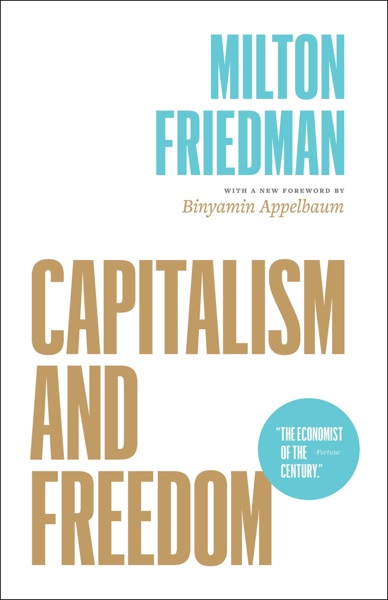
Capitalism and Freedom was published in 1962, and the ideas it contains had been circulating even longer — the book grew from lectures Friedman gave at a 1956 conference.
Milton Friedman · 1962 · 5h 45m
Full summary and key takeaways →The 12 questions
- 1.
Friedman argues competitive markets separate economic from political power. Is that separation stable, or does economic concentration eventually translate into political influence?
- 2.
The book largely sets aside the question of starting conditions. How much does economic freedom matter if people begin with very unequal endowments of capital, education, and social connections?
- 3.
Which of Friedman's 1962 policy proposals have been implemented? Which look prescient, and which have proved more complicated than he suggested?
- 4.
Friedman is sceptical of occupational licensing. Are there cases where you think licensing genuinely protects the public, or does the evidence support his critique uniformly?
- 5.
How does the negative income tax proposal compare to universal basic income proposals now circulating? What is similar and what is different?
- 6.
The school voucher argument rests on competitive pressure improving quality. Where has competition in education produced better outcomes, and where hasn't it?
- 7.
Friedman distrusted discretionary monetary policy. How do you evaluate that position after the 2008 crisis, when discretionary central bank action arguably prevented a depression?
- 8.
The book was written at the height of Cold War anxiety about state power. How does reading it in 2025 change which anxieties feel most relevant?
- 9.
Friedman acknowledges market failure but argues government failure is typically worse. Is that a principled position or a rhetorical move?
- 10.
Many of Friedman's ideas entered mainstream policy. Has that vindicated him, or have the limits of those policies become more visible in practice?
- 11.
The book argues military conscription is an infringement of freedom. How do you weigh freedom from conscription against the equity arguments for shared military obligation?
- 12.
Friedman's framework largely ignores environmental externalities. How would a strict Friedmanite address climate change, and is that answer adequate?
How to run the discussion
- Pick six to eight, not all of them. An hour of real discussion covers fewer questions than anyone expects, and racing the list is what makes a book club feel like homework.
- Open with what people noticed, not what they concluded. Asking for a verdict first hardens opinions before anyone has heard each other.
- Let the disagreement run. The questions below that split a room are the ones worth the time; the ones everyone answers the same way can be skipped.
- Ask the quiet person a specific question. A direct, narrow question is far easier to answer than an open invitation to contribute.
Themes worth steering toward
If the conversation stalls, these are the threads that usually restart it.
Common questions
What are good book club questions for Capitalism and Freedom?
Here are 12 book club questions for Capitalism and Freedom by Milton Friedman, ordered to open easily and end somewhere worth arguing about. The strongest openers ask what each reader noticed rather than what they concluded, and the discussion usually turns on economic freedom, limited government, monetary policy.
How long should a book club discussion of Capitalism and Freedom last?
Most groups run 60 to 90 minutes of actual discussion. That is roughly six to eight questions, not all of them, so pick the ones that suit your group rather than working down the list in order.
What are the main themes in Capitalism and Freedom?
Economic freedom, Limited government, Monetary policy, Individual liberty, Market competition. Those are the threads most likely to divide a room, which makes them the useful places to steer a discussion that has gone quiet.
Picking the next one? See books like Capitalism and Freedom or questions for other book club picks.
