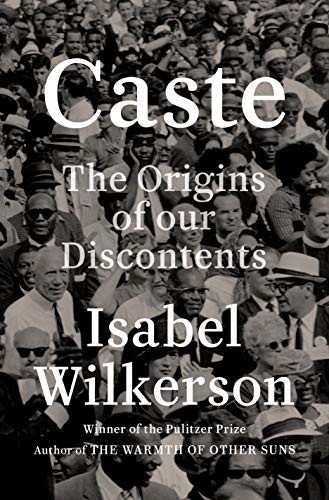
Caste: The Origins of Our Discontents by Isabel Wilkerson is a 2020 memoir book about race, power, social hierarchy. Caste is a hierarchy of human worth maintained by a set of interlocking mechanisms — hereditary status, stigma, violence, spatial separation — that operate below the level of individual prejudice.
Summary
Isabel Wilkerson's second book proposes a reframing of American racial hierarchy: rather than thinking of racism primarily as prejudice, she argues that the United States has operated as a caste society, with Black Americans at the bottom of a rigidly maintained hierarchy similar in its structure — though different in its specific mechanisms — to the caste systems of India and Nazi Germany. The comparison is not casual; Wilkerson spent years researching it, and the Indian and German parallels illuminate aspects of American racial order that more familiar frameworks sometimes obscure.
The book is structured as both argument and personal essay. Wilkerson opens with an incident she experienced personally — a film crew's disbelief that she was the journalist they had arranged to meet, not the clerical help — and uses that experience to introduce what she calls the presumption of incompetence that caste assigns to those at the bottom. Throughout the book she weaves personal anecdotes with historical analysis, moving from her own experiences of caste's operation to the structural history that produced them.
The India comparison is the book's most intellectually productive. The Dalit (formerly untouchable) caste of India and African Americans in the United States share a set of structural features — hereditary status, endogamy, stigma, spatial separation, and violence as enforcement — that, Wilkerson argues, reflect a common human tendency to create and maintain hierarchies of worth. The Nazi comparison is more specific: she documents the fact that Nazi jurists studied and drew on American Jim Crow law when drafting the Nuremberg Laws, finding American race law useful as a template.
The eight pillars of caste — hereditary status, enforcement by stigma and terror, endogamy, occupational hierarchy, dehumanization, purity and pollution, inherent superiority and inferiority, and cruelty as enforcement — are examined in separate chapters, each supported by historical and contemporary evidence. The book does not argue that caste explains everything about American racial inequality; it argues that the caste framework illuminates dimensions of that inequality that the more common frameworks of prejudice, discrimination, and institutional racism do not fully capture.
Talk to Caste: The Origins of Our Discontents like its author wrote you back.
Get the ideas that fit your life — not generic summaries.
- Chat with the book
- Audiobook-style main ideas
- Adapts to your life and goals
- Helps you take action
Key takeaways
- 1.
Caste is a hierarchy of human worth maintained by a set of interlocking mechanisms — hereditary status, stigma, violence, spatial separation — that operate below the level of individual prejudice.
- 2.
Racist behavior does not require racist attitudes. The caste framework explains how people can discriminate without believing they are prejudiced and how structural disadvantage persists beyond the intentions of individuals.
- 3.
Nazi jurists used American Jim Crow law as a model when drafting the Nuremberg Laws. The comparison is documented, not rhetorical.
- 4.
The Dalit caste experience in India and the African American experience in the United States share structural features that the caste framework makes visible.
- 5.
The dominant caste's investment in maintaining the hierarchy is partly material — caste systems provide cheap labor and social protection for those above the bottom — and partly psychological.
- 6.
Changing individual attitudes without changing the structural mechanisms of caste does not dismantle caste. The distinction between racism (attitude) and casteism (structure) has policy implications.
- 7.
The physical infrastructure of American cities — the patterns of neighborhood segregation, the placement of highways, the geography of schools — reflects caste's spatial enforcement.
- 8.
Personal testimony and historical analysis are not competing forms of evidence; they are complementary. Wilkerson's book interweaves both with discipline.
Discussion questions
Use these on your own, with a book club, or as chat starters in Superbook. Book club version, ready to copy or print →
- 1.
Does the caste framework add something to your understanding of American racial inequality that the more familiar language of racism and discrimination does not?
- 2.
The India and Germany comparisons are controversial among some scholars. Do you find them illuminating, strained, or both?
- 3.
Wilkerson documents that Nazi jurists studied American Jim Crow law. Does that fact change how you think about the American racial system?
- 4.
The book uses personal anecdotes to introduce structural arguments. Does that move work, or does the personal sometimes feel like a distraction from the systemic?
- 5.
Wilkerson distinguishes between racism (individual attitude) and casteism (structural hierarchy). Is that distinction important, or is it a semantic difference without practical consequence?
- 6.
The eight pillars of caste are examined in separate chapters. Which of the pillars did you find most surprising or most convincing?
- 7.
The book implies that dismantling caste requires structural change, not just attitude change. What would structural change look like in practice?
- 8.
Caste was published in 2020, during a year of intense national attention to racial inequality. How has that context shaped the book's reception?
- 9.
Does the caste framework change how you understand your own position in the social hierarchy?
- 10.
The comparison between American racial hierarchy and the Indian caste system can feel uncomfortable to some readers — either because it seems to equate different systems or because it seems to downplay American exceptionalism. How do you respond?
- 11.
What does Wilkerson want readers to do after reading the book? Is the call to action implicit or explicit?
Themes
Frequently asked questions
-
Is Caste a memoir or a work of history?
It is both — a hybrid that blends Wilkerson's personal experiences of caste's operation with historical and sociological analysis. This dual mode is deliberate and is itself part of the argument: that caste is experienced personally as well as documented statistically.
-
Is the Nazi comparison appropriate?
Wilkerson documents the connection specifically: Nazi jurists explicitly studied American race law when drafting the Nuremberg Laws. The comparison is historical, not rhetorical. Some scholars dispute its emphasis; others find it essential.
-
How does Caste relate to The Warmth of Other Suns?
They are companion books. The first tells the story of the Great Migration through three individual lives. Caste develops the analytical framework — the caste system — that explains why those individuals had to migrate. The first is narrative; the second is argumentative.
-
Does Caste argue for specific policy solutions?
The argument is primarily diagnostic rather than prescriptive. Wilkerson suggests that understanding the caste framework is a prerequisite for effective remediation but does not advocate for specific policies. Some readers find this frustrating; others see it as appropriate for the book's scope.
-
Is the book appropriate for readers who are new to thinking about race in America?
Yes. The personal anecdotes make the structural arguments accessible, and Wilkerson contextualizes all historical references. It has been widely used as an entry point for readers who have not previously engaged deeply with this material.
Similar books
The Warmth of Other Suns
Isabel Wilkerson
Just Mercy: A Story of Justice and Redemption
Bryan Stevenson
The New Jim Crow: Mass Incarceration in the Age of Colorblindness
Michelle Alexander
