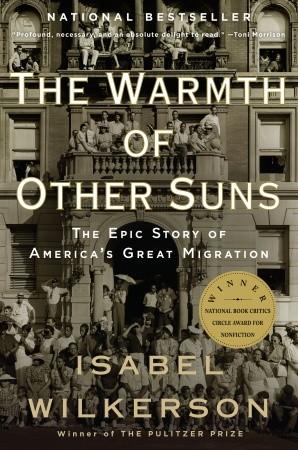
The Warmth of Other Suns by Isabel Wilkerson is a 2010 memoir book about migration, race, identity. Six million people made individual decisions that together constituted one of the largest demographic transformations in American history. Understanding the Great Migration requires holding both the individual and the statistical simultaneously.
Summary
Isabel Wilkerson's account of the Great Migration — the movement of six million Black Americans from the South to the North and West between 1915 and 1970 — is one of the most important works of narrative nonfiction published in the twenty-first century. It tells the story of this vast demographic shift through three individuals: Ida Mae Gladney, a sharecropper's wife who left Mississippi for Chicago in 1937; George Swanson Starling, a citrus picker who left Florida for New York in 1945; and Robert Joseph Pershing Foster, a doctor who left Louisiana for Los Angeles in 1953. It took Wilkerson fifteen years to report and write.
The three narratives are interwoven rather than told consecutively, and the interweaving builds a cumulative argument that what these three individuals experienced was simultaneously unique and representative. Each carried a specific set of skills, family circumstances, and ambitions; each faced a specific iteration of the racial terror and economic exploitation that drove the migration; and each arrived at a specific northern or western city at a specific moment of receiving community's history. The individual stories make the statistical abstraction of six million people comprehensible.
Wilkerson is meticulous about the conditions that produced the migration. The caste system of the Jim Crow South — the formal laws and the informal codes that governed every interaction between Black and white, the violence that maintained the system, the specific economic arrangements that kept Black sharecroppers in permanent debt — is rendered in physical and documentary detail. She interviewed over a thousand people during her research, and the testimony she collected gives the statistics of lynching, of wage theft, of poll taxes, of separate and inferior everything, the weight of lived experience.
The arrivals in Chicago, New York, and Los Angeles are rendered with equal specificity. The Great Migration transformed the cities that received it — in music, in politics, in economics, in the structure of residential segregation that northern cities developed to contain the new arrivals. Wilkerson traces these transformations without sentimentalizing the North: the conditions in northern cities were better than the conditions in the Jim Crow South, and also significantly worse than the conditions of white northern residents, and the book holds both facts simultaneously.
Talk to The Warmth of Other Suns like its author wrote you back.
Get the ideas that fit your life — not generic summaries.
- Chat with the book
- Audiobook-style main ideas
- Adapts to your life and goals
- Helps you take action
Key takeaways
- 1.
Six million people made individual decisions that together constituted one of the largest demographic transformations in American history. Understanding the Great Migration requires holding both the individual and the statistical simultaneously.
- 2.
The Jim Crow system was a caste system enforced by violence and embedded in economic arrangements that kept Black Southerners in permanent dependency. It was not simply 'discrimination' but a totalizing structure.
- 3.
The North was better, not good. Black migrants who arrived in Chicago or New York found legal equality, better wages, and an absence of formal terror, and also residential segregation, employment discrimination, and a different set of humiliations.
- 4.
Migration is an act of courage and ambition, not desperation. Wilkerson resists the framing of migrants as merely fleeing; she shows them as choosing, calculating, and anticipating.
- 5.
Individual lives contain the history of their era. The three central figures are not case studies; they are full people whose stories carry historical meaning without being reduced to it.
- 6.
The Great Migration produced the urban Black culture of the twentieth century: jazz, blues, gospel, the Harlem Renaissance, Chicago's South Side literary tradition, Motown. The migration and the culture are inseparable.
- 7.
Residential segregation in northern cities was not natural but constructed — through real estate covenants, redlining, and white mob violence. The geography of American cities reflects specific policies.
- 8.
Fifteen years of research produces a different kind of intimacy with a subject than a few years can. Wilkerson's relationships with her subjects — she maintained contact with all three over many years — show in the texture of the portraits.
Discussion questions
Use these on your own, with a book club, or as chat starters in Superbook. Book club version, ready to copy or print →
- 1.
Wilkerson uses three individual stories to represent six million. How well does this narrative strategy work? What might it miss?
- 2.
The Jim Crow system is rendered through physical and documentary specificity. Does Wilkerson's approach — showing rather than analyzing — make the system more or less understandable than a more analytical account would?
- 3.
Each of the three migrants chose a different city. How do their different destinations shape their different outcomes?
- 4.
Wilkerson is careful not to romanticize the North. Do you think she succeeds? Does the book ever suggest that the North was a kind of promised land?
- 5.
The book argues that the Great Migration transformed American culture. What specific cultural changes does it attribute to the migration?
- 6.
Robert Pershing Foster drove across the South to California and was refused lodging at every white motel en route. What does that episode say about the migration's conditions?
- 7.
The book took fifteen years. Does that investment show in the text? What do you attribute to the length of the research?
- 8.
Ida Mae Gladney, George Starling, and Robert Foster were alive when Wilkerson interviewed them and contributed their memories to the book. How does living-subject memoir differ from biographical reconstruction from archives?
- 9.
The title comes from Richard Wright. What does the image of the 'warmth of other suns' capture about the migration's motivations?
- 10.
The Great Migration happened within the living memory of older Americans. How does proximity to living witnesses change what narrative nonfiction can do?
- 11.
What does the book suggest about the relationship between individual choices and historical forces?
Themes
Frequently asked questions
-
Is The Warmth of Other Suns a work of journalism or of history?
Both. Wilkerson's background is journalism and her methods are journalistic — extensive interviews, primary source research, first-person reporting. But the scope, the archival depth, and the historical analysis place it firmly in the tradition of narrative history. It is one of the rare books that is taken equally seriously in both disciplines.
-
How long does the book take to read?
About fourteen to sixteen hours. At over 600 pages it is substantial, but the three intertwined narratives create a compelling rhythm that carries most readers through.
-
Is the book appropriate for younger readers?
The violence of the Jim Crow section is graphic in places — lynching, racial terror — and is not sanitized. It is appropriate for older teens and adults. The human stories are accessible to anyone.
-
What are Ida Mae, George, and Robert's fates by the end of the book?
Ida Mae lived into her nineties in Chicago. George Starling settled in New York and worked as a Pullman porter. Robert Foster became a doctor in Los Angeles and eventually was Elvis Presley's personal physician. All three were alive when Wilkerson first interviewed them.
-
How does this book relate to Caste?
The Warmth of Other Suns examines how the Jim Crow caste system drove the migration. Caste is a more theoretical book that develops the caste framework explicitly and applies it broadly to American, Indian, and Nazi German history. The two books are complementary; the first is more narrative, the second more analytical.