Memoir · Book club
Caste: The Origins of Our Discontents book club questions
Here are 11 book club questions for Caste: The Origins of Our Discontents by Isabel Wilkerson, ordered to open easily and end somewhere worth arguing about. Copy them, print them, or bring them up one at a time.
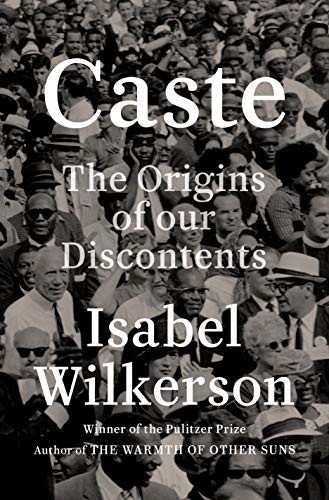
Isabel Wilkerson's second book proposes a reframing of American racial hierarchy: rather than thinking of racism primarily as prejudice, she argues that the United States has operated as a caste society, with Black Americans at the bottom of a rigidly maintained hierarchy similar in its structure — though different in its specific mechanisms — to the caste systems of India and Nazi Germany.
Isabel Wilkerson · 2020 · 8h 40m
Full summary and key takeaways →The 11 questions
- 1.
Does the caste framework add something to your understanding of American racial inequality that the more familiar language of racism and discrimination does not?
- 2.
The India and Germany comparisons are controversial among some scholars. Do you find them illuminating, strained, or both?
- 3.
Wilkerson documents that Nazi jurists studied American Jim Crow law. Does that fact change how you think about the American racial system?
- 4.
The book uses personal anecdotes to introduce structural arguments. Does that move work, or does the personal sometimes feel like a distraction from the systemic?
- 5.
Wilkerson distinguishes between racism (individual attitude) and casteism (structural hierarchy). Is that distinction important, or is it a semantic difference without practical consequence?
- 6.
The eight pillars of caste are examined in separate chapters. Which of the pillars did you find most surprising or most convincing?
- 7.
The book implies that dismantling caste requires structural change, not just attitude change. What would structural change look like in practice?
- 8.
Caste was published in 2020, during a year of intense national attention to racial inequality. How has that context shaped the book's reception?
- 9.
Does the caste framework change how you understand your own position in the social hierarchy?
- 10.
The comparison between American racial hierarchy and the Indian caste system can feel uncomfortable to some readers — either because it seems to equate different systems or because it seems to downplay American exceptionalism. How do you respond?
- 11.
What does Wilkerson want readers to do after reading the book? Is the call to action implicit or explicit?
How to run the discussion
- Pick six to eight, not all of them. An hour of real discussion covers fewer questions than anyone expects, and racing the list is what makes a book club feel like homework.
- Open with what people noticed, not what they concluded. Asking for a verdict first hardens opinions before anyone has heard each other.
- Let the disagreement run. The questions below that split a room are the ones worth the time; the ones everyone answers the same way can be skipped.
- Ask the quiet person a specific question. A direct, narrow question is far easier to answer than an open invitation to contribute.
Themes worth steering toward
If the conversation stalls, these are the threads that usually restart it.
Common questions
What are good book club questions for Caste: The Origins of Our Discontents?
Here are 11 book club questions for Caste: The Origins of Our Discontents by Isabel Wilkerson, ordered to open easily and end somewhere worth arguing about. The strongest openers ask what each reader noticed rather than what they concluded, and the discussion usually turns on race, power, social hierarchy.
How long should a book club discussion of Caste: The Origins of Our Discontents last?
Most groups run 60 to 90 minutes of actual discussion. That is roughly six to eight questions, not all of them, so pick the ones that suit your group rather than working down the list in order.
What are the main themes in Caste: The Origins of Our Discontents?
Race, Power, Social hierarchy, History, Identity. Those are the threads most likely to divide a room, which makes them the useful places to steer a discussion that has gone quiet.
Picking the next one? See books like Caste: The Origins of Our Discontents or questions for other book club picks.
