Literary fiction · Book club
Catch-22 book club questions
Here are 12 book club questions for Catch-22 by Joseph Heller, ordered to open easily and end somewhere worth arguing about. Copy them, print them, or bring them up one at a time.
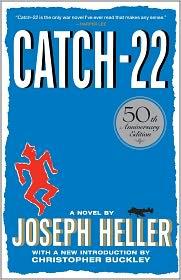
Yossarian is a bombardier stationed on the Mediterranean island of Pianosa during World War II who has concluded that the people trying to kill him are not the enemy — they're everyone, including his own commanders.
Joseph Heller · 1961 · 11h 45m
Full summary and key takeaways →The 12 questions
- 1.
Yossarian's position is simple: he just wants to survive. The institution treats this as insubordination. Is his individualism heroic, selfish, or just sane?
- 2.
Milo Minderbinder bombs his own squadron and is forgiven because it pencils out financially. Is this satire of capitalism, or is Heller saying something darker about how economies relate to war?
- 3.
The novel's humor gets progressively harder to laugh at as the body count rises. Did you notice where you stopped laughing? What changed?
- 4.
The Catch-22 trap — you can't escape a system by using the system's logic — applies outside the military. Where have you encountered it?
- 5.
Doc Daneeka continues to live while officially dead. Major Major Major Major can only be seen when he's not in his office. What is Heller doing with identity and institutional record?
- 6.
The officers — Cathcart, Dreedle, Peckem — are entirely motivated by careerism and compete with each other in ways that have nothing to do with the war. Is this exaggeration, or does it ring true?
- 7.
Snowden's death is revealed slowly across the novel. How does Heller's withholding of the full scene affect your experience of reading the book up to that point?
- 8.
Nately's whore pursues Yossarian throughout the second half of the novel for reasons that are never explained. What does she represent, and why does she keep trying to kill him?
- 9.
Is Yossarian a hero? He does almost nothing brave, and his final act is desertion. Does the novel endorse him, or just understand him?
- 10.
Heller was a World War II veteran writing in 1961 about the Korean War as much as the Second World War. Does the novel feel specific to a historical moment, or does its logic apply to all wars?
- 11.
Orr's escape at the end retroactively reframes his apparent incompetence. Did you read any of the earlier Orr scenes as hints? What does Heller want you to think about how we read competence?
- 12.
The novel was rejected by many publishers. Today it's often ranked among the greatest American novels. What about it still makes publishers nervous — or readers resistant?
How to run the discussion
- Pick six to eight, not all of them. An hour of real discussion covers fewer questions than anyone expects, and racing the list is what makes a book club feel like homework.
- Open with what people noticed, not what they concluded. Asking for a verdict first hardens opinions before anyone has heard each other.
- Let the disagreement run. The questions below that split a room are the ones worth the time; the ones everyone answers the same way can be skipped.
- Ask the quiet person a specific question. A direct, narrow question is far easier to answer than an open invitation to contribute.
Themes worth steering toward
If the conversation stalls, these are the threads that usually restart it.
Common questions
What are good book club questions for Catch-22?
Here are 12 book club questions for Catch-22 by Joseph Heller, ordered to open easily and end somewhere worth arguing about. The strongest openers ask what each reader noticed rather than what they concluded, and the discussion usually turns on war and absurdity, institutional logic versus survival, sanity and madness.
How long should a book club discussion of Catch-22 last?
Most groups run 60 to 90 minutes of actual discussion. That is roughly six to eight questions, not all of them, so pick the ones that suit your group rather than working down the list in order.
What are the main themes in Catch-22?
War and absurdity, Institutional logic versus survival, Sanity and madness, Capitalism and exploitation, Mortality and meaning. Those are the threads most likely to divide a room, which makes them the useful places to steer a discussion that has gone quiet.
Picking the next one? See books like Catch-22 or questions for other book club picks.
