History · Book club
Citizens: A Chronicle of the French Revolution book club questions
Here are 12 book club questions for Citizens: A Chronicle of the French Revolution by Simon Schama, ordered to open easily and end somewhere worth arguing about. Copy them, print them, or bring them up one at a time.
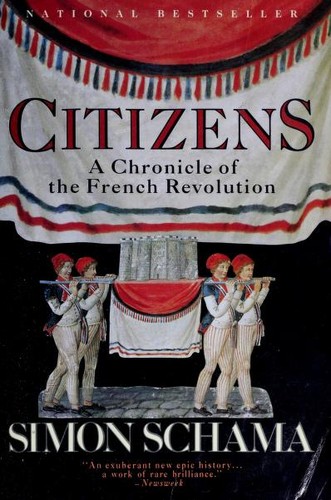
Simon Schama's Citizens was published to mark the bicentennial of the French Revolution in 1989 and immediately became one of the most controversial histories of the event in decades.
Simon Schama · 1989 · 19h 0m
Full summary and key takeaways →The 12 questions
- 1.
Schama argues the Terror was present in seed from 1789. Does that feel like a compelling reading of the evidence, or does it flatten the genuine contingency of revolutionary events?
- 2.
He spends nearly a third of the book on the pre-revolutionary decades. What does that choice of starting point commit him to in the argument that follows?
- 3.
Is there a meaningful difference between arguing that the Terror was 'implicit' in the Revolution's founding logic and arguing that it was inevitable?
- 4.
The book was published in 1989, the bicentennial year and the year of the Soviet collapse. How does that context shape what Schama seems to be arguing about revolution in general?
- 5.
Schama is critical of the Marxist historiography that dominated French Revolutionary studies. Is his own narrative framework — tragic, humanist, suspicious of ideological enthusiasm — any less ideologically shaped?
- 6.
The Revolution's language of citizenship, rights, and national belonging is still the dominant political language of the West. Does understanding its violent origins change how you relate to that vocabulary?
- 7.
He focuses heavily on political elites and the articulate classes. What do you think citizens further down the social scale — servants, peasants, artisans — would have said about the Revolution he describes?
- 8.
Schama writes novelistically, with attention to individuals and scenes. Does that narrative technique illuminate the Revolution or risk making it feel more coherent than it was?
- 9.
Is there a revolution in history that you think turned out significantly differently from how its architects imagined? What does that suggest about the relationship between intention and outcome in radical politics?
- 10.
The book argues that France in the 1780s was modernizing and reform was possible. If that's right, what does it say about the political failure that produced the Revolution?
- 11.
Citizens was controversial among professional historians when it appeared. How should a general reader evaluate historical revisionism when they can't assess the underlying evidence themselves?
- 12.
The Revolution created the template for modern radical politics — the idea that total transformation is possible and that resistance to it is treasonous. Is that template still operative today?
How to run the discussion
- Pick six to eight, not all of them. An hour of real discussion covers fewer questions than anyone expects, and racing the list is what makes a book club feel like homework.
- Open with what people noticed, not what they concluded. Asking for a verdict first hardens opinions before anyone has heard each other.
- Let the disagreement run. The questions below that split a room are the ones worth the time; the ones everyone answers the same way can be skipped.
- Ask the quiet person a specific question. A direct, narrow question is far easier to answer than an open invitation to contribute.
Themes worth steering toward
If the conversation stalls, these are the threads that usually restart it.
Common questions
What are good book club questions for Citizens: A Chronicle of the French Revolution?
Here are 12 book club questions for Citizens: A Chronicle of the French Revolution by Simon Schama, ordered to open easily and end somewhere worth arguing about. The strongest openers ask what each reader noticed rather than what they concluded, and the discussion usually turns on revolution, france, violence.
How long should a book club discussion of Citizens: A Chronicle of the French Revolution last?
Most groups run 60 to 90 minutes of actual discussion. That is roughly six to eight questions, not all of them, so pick the ones that suit your group rather than working down the list in order.
What are the main themes in Citizens: A Chronicle of the French Revolution?
Revolution, France, Violence, Political radicalism, Modernity. Those are the threads most likely to divide a room, which makes them the useful places to steer a discussion that has gone quiet.
Picking the next one? See books like Citizens: A Chronicle of the French Revolution or questions for other book club picks.
