Science · Book club
Civilized to Death book club questions
Here are 12 book club questions for Civilized to Death by Christopher Ryan, ordered to open easily and end somewhere worth arguing about. Copy them, print them, or bring them up one at a time.
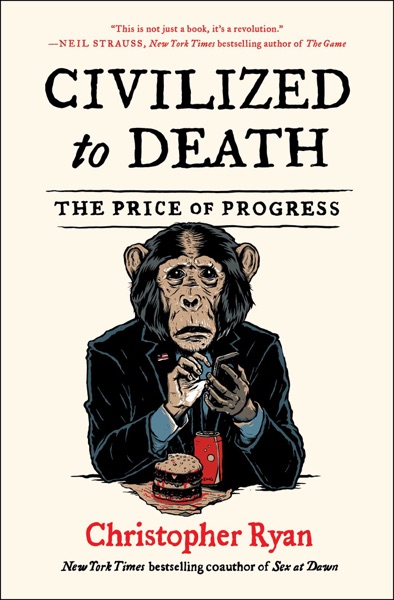
Christopher Ryan is the co-author of Sex at Dawn, a 2010 book that argued human beings are not naturally monogamous.
Christopher Ryan · 2019 · 5h 45m
Full summary and key takeaways →The 12 questions
- 1.
Ryan argues that civilization's gains — longer average lifespans, lower violence, greater material wealth — come with real costs that the progress narrative obscures. Which costs do you find most compelling, and which do you find exaggerated?
- 2.
The book claims that forager work lives were shorter and more satisfying than agricultural ones. What does your own relationship with work tell you about this claim?
- 3.
He argues that depression and anxiety are not natural features of human psychology but adaptations to a misfit between our evolved needs and modern conditions. Does that explanation fit your own experience?
- 4.
Ryan distinguishes between lifespans distorted by child mortality and the actual longevity of adults who survived childhood. How does that distinction change your understanding of what 'life expectancy' means?
- 5.
The absence of chronic diseases in forager populations is well-documented. What would it actually require to change modern diets and environments enough to see comparable results?
- 6.
He suggests that the close community of small bands provided something modern social structures cannot. What do you currently have that comes closest to that kind of social density?
- 7.
Ryan admits a return to foraging is impossible but wants to salvage lessons from forager life. Which lessons seem most transferable to your actual circumstances?
- 8.
The book is explicitly a provocation rather than a policy proposal. What is the most useful provocation it raises for how you think about your own life choices?
- 9.
He is critical of progress narratives that treat the direction of change as inherently good. What narrative about progress do you find yourself most uncritically accepting?
- 10.
Sex at Dawn argued that monogamy is not natural for humans. Civilized to Death makes a parallel argument about many civilization's other structures. Where do you find the argument compelling and where does it seem to overreach?
- 11.
The communities of meaning Ryan describes — shared work, known neighbors, mutual obligation — are absent from most modern urban lives. What is your actual community of mutual obligation?
- 12.
If you could change one feature of modern life that Ryan identifies as costly, what would it be, and what would you be willing to give up to get it?
How to run the discussion
- Pick six to eight, not all of them. An hour of real discussion covers fewer questions than anyone expects, and racing the list is what makes a book club feel like homework.
- Open with what people noticed, not what they concluded. Asking for a verdict first hardens opinions before anyone has heard each other.
- Let the disagreement run. The questions below that split a room are the ones worth the time; the ones everyone answers the same way can be skipped.
- Ask the quiet person a specific question. A direct, narrow question is far easier to answer than an open invitation to contribute.
Themes worth steering toward
If the conversation stalls, these are the threads that usually restart it.
Common questions
What are good book club questions for Civilized to Death?
Here are 12 book club questions for Civilized to Death by Christopher Ryan, ordered to open easily and end somewhere worth arguing about. The strongest openers ask what each reader noticed rather than what they concluded, and the discussion usually turns on civilization, human nature, hunter-gatherers.
How long should a book club discussion of Civilized to Death last?
Most groups run 60 to 90 minutes of actual discussion. That is roughly six to eight questions, not all of them, so pick the ones that suit your group rather than working down the list in order.
What are the main themes in Civilized to Death?
Civilization, Human nature, Hunter-gatherers, Progress, Well-being. Those are the threads most likely to divide a room, which makes them the useful places to steer a discussion that has gone quiet.
Picking the next one? See books like Civilized to Death or questions for other book club picks.
