Business · Book club
Co-Intelligence book club questions
Here are 12 book club questions for Co-Intelligence by Ethan Mollick, ordered to open easily and end somewhere worth arguing about. Copy them, print them, or bring them up one at a time.
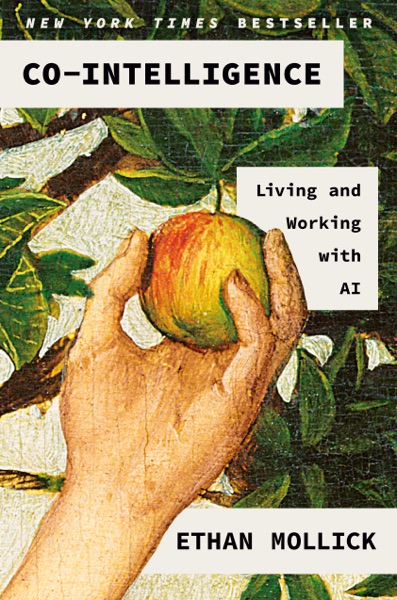
Co-Intelligence is Ethan Mollick's argument that large language models represent something genuinely new — not a search engine, not a simple automation tool — and that the right response is not fear or hype but active, informed experimentation.
Ethan Mollick · 2024 · 4h 0m
Full summary and key takeaways →The 12 questions
- 1.
Mollick's 'jagged frontier' says AI is uneven in ways that aren't obvious. Which tasks in your own work do you think AI handles better or worse than you'd expect?
- 2.
Have you tried treating an AI as a collaborator — giving it context, pushing back, iterating — rather than just asking it questions? How did the results differ?
- 3.
Mollick says early adopters gain a meaningful advantage. Do you agree, or does that framing create anxiety that oversimplifies the actual shift?
- 4.
Where in your work have you noticed AI shaping your thinking even when you're the one making decisions? Did that feel helpful or limiting?
- 5.
What would it mean to develop 'critical AI literacy' in your field? What errors would you need to be able to spot?
- 6.
The book describes AI as a 'brilliant friend' giving expert-level advice without social friction. What are the limits of that framing?
- 7.
Mollick is candid that AI can be confidently wrong. Has that happened to you? How did you catch it?
- 8.
If AI can produce competent first drafts quickly, what becomes the most valuable thing a skilled human adds to a project?
- 9.
The book avoids both utopian and dystopian predictions. Do you find that balanced, or does it understate the risks?
- 10.
What is a task in your field that you believe AI will never do well? What makes you confident in that judgment?
- 11.
Mollick argues that waiting for the technology to stabilize is itself a costly choice. Is there a point at which that argument becomes a sales pitch for disruption?
- 12.
What would it look like to integrate AI into your work in a way that amplified your judgment rather than replacing it?
How to run the discussion
- Pick six to eight, not all of them. An hour of real discussion covers fewer questions than anyone expects, and racing the list is what makes a book club feel like homework.
- Open with what people noticed, not what they concluded. Asking for a verdict first hardens opinions before anyone has heard each other.
- Let the disagreement run. The questions below that split a room are the ones worth the time; the ones everyone answers the same way can be skipped.
- Ask the quiet person a specific question. A direct, narrow question is far easier to answer than an open invitation to contribute.
Themes worth steering toward
If the conversation stalls, these are the threads that usually restart it.
Common questions
What are good book club questions for Co-Intelligence?
Here are 12 book club questions for Co-Intelligence by Ethan Mollick, ordered to open easily and end somewhere worth arguing about. The strongest openers ask what each reader noticed rather than what they concluded, and the discussion usually turns on artificial intelligence, human-ai collaboration, knowledge work.
How long should a book club discussion of Co-Intelligence last?
Most groups run 60 to 90 minutes of actual discussion. That is roughly six to eight questions, not all of them, so pick the ones that suit your group rather than working down the list in order.
What are the main themes in Co-Intelligence?
Artificial intelligence, Human-AI collaboration, Knowledge work, Productivity, Future of work. Those are the threads most likely to divide a room, which makes them the useful places to steer a discussion that has gone quiet.
Picking the next one? See books like Co-Intelligence or questions for other book club picks.
