Economics · Book club
Common Stocks and Uncommon Profits book club questions
Here are 12 book club questions for Common Stocks and Uncommon Profits by Philip A. Fisher, ordered to open easily and end somewhere worth arguing about. Copy them, print them, or bring them up one at a time.
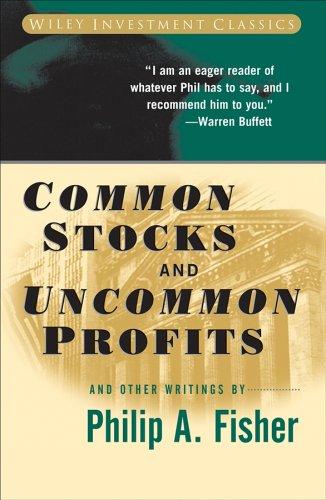
Common Stocks and Uncommon Profits is Philip Fisher's argument that the best investment returns come from identifying great companies — those with strong management, excellent products, and durable competitive positions — and holding them for very long periods.
Philip A. Fisher · 1958 · 3h 45m
Full summary and key takeaways →The 12 questions
- 1.
Fisher argues that the real return comes from identifying great companies and holding them for decades. What companies do you know well enough that you could make that kind of commitment?
- 2.
The scuttlebutt method requires significant effort — talking to competitors, suppliers, customers. Have you ever done anything like this before investing in a company? What did you learn?
- 3.
Fisher places management quality at the center of his framework. How do you actually evaluate management quality as an outside investor? What signals are reliable and which are misleading?
- 4.
The fifteen points framework was developed in the 1950s for manufacturing and technology companies of that era. Which criteria translate well to today's software and platform businesses, and which need to be adapted?
- 5.
Fisher says sell almost never. Buffett has said something similar. Why do you think most investors — including institutional professionals — turn over their portfolios so frequently if long-term holding clearly works?
- 6.
Fisher and Graham approached investing differently: Graham focused on price relative to current value, Fisher on growth potential and management quality. Which framework resonates more with how you naturally think about investing?
- 7.
How do you distinguish between a company you understand well because you've done genuine research and a company you think you understand because you use its products?
- 8.
Fisher recommends concentration in your best ideas. Does your current portfolio reflect genuine conviction in a small number of companies, or is it spread thin?
- 9.
The companies Fisher would have recommended holding for decades — companies like Motorola, Texas Instruments, and Dow Chemical — have had very different fates over the following sixty years. What does that tell you about the limits of his framework?
- 10.
Fisher argues that investor patience through volatility is itself a source of competitive return — most investors can't maintain it. Do you have the psychological constitution for the approach Fisher describes?
- 11.
Fisher wrote this book before the rise of institutional investors, algorithmic trading, and instant information. Has the information environment changed enough to make the scuttlebutt method obsolete, or is it more relevant than ever?
- 12.
If you were to apply the fifteen points to one company you follow closely, which points would it pass and which would it fail?
How to run the discussion
- Pick six to eight, not all of them. An hour of real discussion covers fewer questions than anyone expects, and racing the list is what makes a book club feel like homework.
- Open with what people noticed, not what they concluded. Asking for a verdict first hardens opinions before anyone has heard each other.
- Let the disagreement run. The questions below that split a room are the ones worth the time; the ones everyone answers the same way can be skipped.
- Ask the quiet person a specific question. A direct, narrow question is far easier to answer than an open invitation to contribute.
Themes worth steering toward
If the conversation stalls, these are the threads that usually restart it.
Common questions
What are good book club questions for Common Stocks and Uncommon Profits?
Here are 12 book club questions for Common Stocks and Uncommon Profits by Philip A. Fisher, ordered to open easily and end somewhere worth arguing about. The strongest openers ask what each reader noticed rather than what they concluded, and the discussion usually turns on growth investing, scuttlebutt research, management quality.
How long should a book club discussion of Common Stocks and Uncommon Profits last?
Most groups run 60 to 90 minutes of actual discussion. That is roughly six to eight questions, not all of them, so pick the ones that suit your group rather than working down the list in order.
What are the main themes in Common Stocks and Uncommon Profits?
Growth investing, Scuttlebutt research, Management quality, Long-term holding, Business analysis. Those are the threads most likely to divide a room, which makes them the useful places to steer a discussion that has gone quiet.
Picking the next one? See books like Common Stocks and Uncommon Profits or questions for other book club picks.
