Business · Book club
Competing in the Age of AI book club questions
Here are 11 book club questions for Competing in the Age of AI by Marco Iansiti & Karim Lakhani, ordered to open easily and end somewhere worth arguing about. Copy them, print them, or bring them up one at a time.
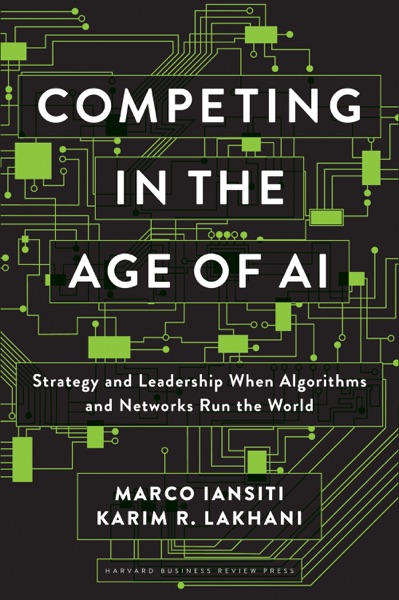
Competing in the Age of AI is Marco Iansiti and Karim Lakhani's argument that artificial intelligence is not just another technology to be adopted, but a fundamental redesign of how firms operate — and that companies built from the start with AI at their core will eventually displace firms that try to bolt AI onto traditional operating models.
Marco Iansiti & Karim Lakhani · 2020 · 5h 15m
Full summary and key takeaways →The 11 questions
- 1.
Iansiti and Lakhani argue that AI is not just another technology but a fundamental redesign of how firms operate. Does the distinction hold up, or is every major technology shift described in similarly sweeping terms?
- 2.
Which traditional businesses in your industry or experience are most exposed to displacement by AI-native competitors, and why?
- 3.
The AI factory model assumes you have the data and the algorithms to replace human decisions. What kinds of business decisions are hardest to algorithmize, and why?
- 4.
The book argues that traditional organizational structures are poorly suited to AI-native operating models. What specifically would need to change in an organization you know well?
- 5.
Data network effects favor incumbents with large existing user bases. What does that imply for new entrants trying to compete in markets where established players have data advantages?
- 6.
The authors acknowledge that incumbents face a genuine transformation challenge. Is incremental adoption of AI sufficient, or does transformation require rebuilding from scratch?
- 7.
The book was published in 2020 and describes AI capabilities as of that period. What has changed since, and how does it affect the book's argument?
- 8.
What human skills become more valuable in a world where AI handles routine cognitive tasks? What becomes less valuable?
- 9.
Iansiti and Lakhani treat ethics as central to AI strategy. Do you think most firms actually integrate those considerations strategically, or treat them primarily as compliance?
- 10.
The case studies in the book are heavily weighted toward US and Chinese technology giants. How well do the frameworks apply to smaller firms, different geographies, or different industries?
- 11.
If you were building a new business from scratch today, what would 'AI-native from the start' look like in a domain you know well?
How to run the discussion
- Pick six to eight, not all of them. An hour of real discussion covers fewer questions than anyone expects, and racing the list is what makes a book club feel like homework.
- Open with what people noticed, not what they concluded. Asking for a verdict first hardens opinions before anyone has heard each other.
- Let the disagreement run. The questions below that split a room are the ones worth the time; the ones everyone answers the same way can be skipped.
- Ask the quiet person a specific question. A direct, narrow question is far easier to answer than an open invitation to contribute.
Themes worth steering toward
If the conversation stalls, these are the threads that usually restart it.
Common questions
What are good book club questions for Competing in the Age of AI?
Here are 11 book club questions for Competing in the Age of AI by Marco Iansiti & Karim Lakhani, ordered to open easily and end somewhere worth arguing about. The strongest openers ask what each reader noticed rather than what they concluded, and the discussion usually turns on artificial intelligence, business strategy, digital transformation.
How long should a book club discussion of Competing in the Age of AI last?
Most groups run 60 to 90 minutes of actual discussion. That is roughly six to eight questions, not all of them, so pick the ones that suit your group rather than working down the list in order.
What are the main themes in Competing in the Age of AI?
Artificial intelligence, Business strategy, Digital transformation, Operating models, Data. Those are the threads most likely to divide a room, which makes them the useful places to steer a discussion that has gone quiet.
Picking the next one? See books like Competing in the Age of AI or questions for other book club picks.
